IA · 22 October 2026 · 4 min read
Shielded Credentials for AI Agents: 1Password Introduces Zero-Knowledge Sign-Ins
In brief: With the launch of 1Password for Agents, the password management provider has introduced a security layer allowing autonomous AI agents to log into online accounts without ever viewing or storing cleartext credentials. Sign-in approval remains strictly with the user via authorized device notifications, addressing one of the most critical security bottlenecks in enterprise AI agent adoption.
by Team Mocchi's
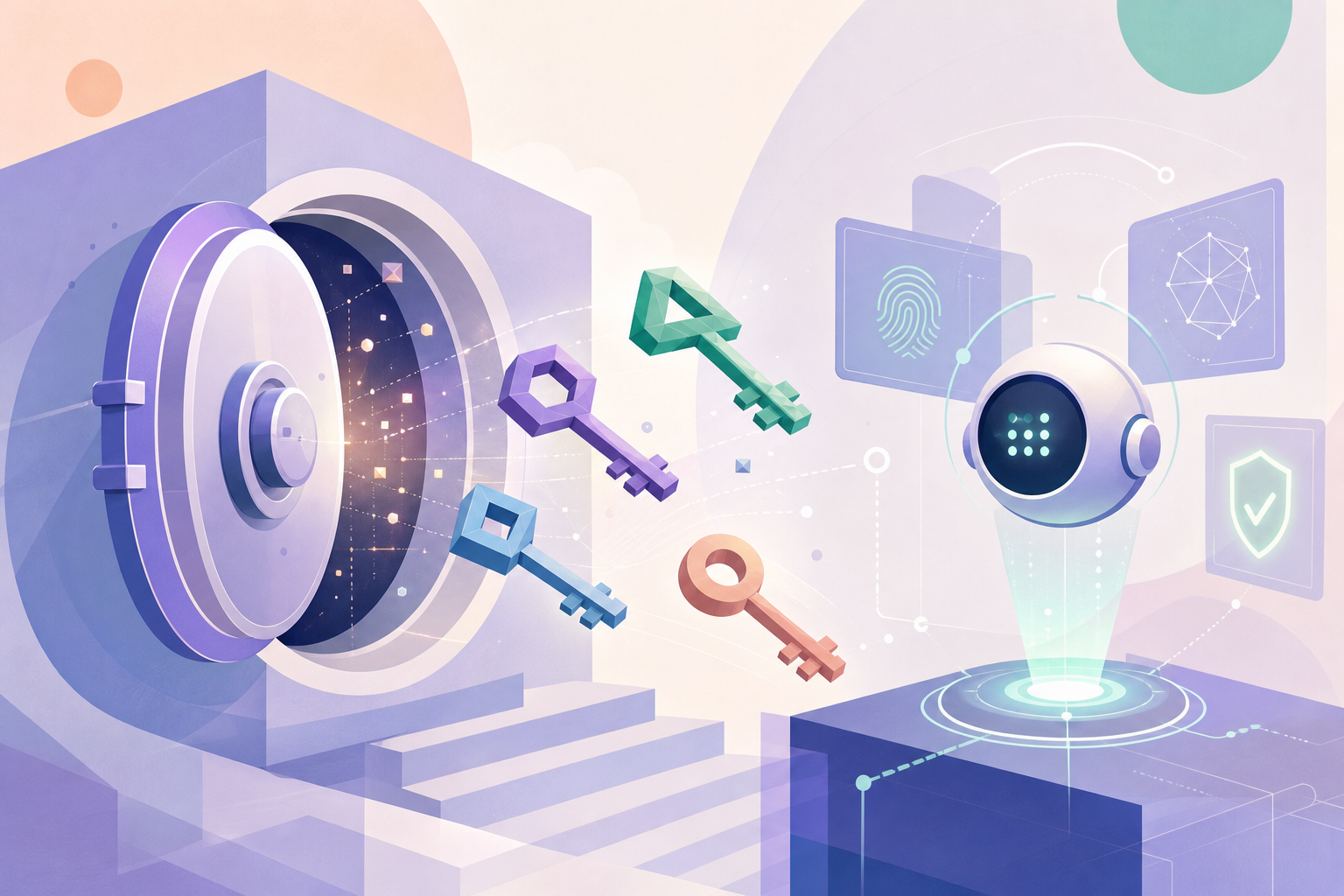
The rise of autonomous software agents has long faced a persistent security paradox: to delegate real-world workflows on the web—such as booking business travel, pulling confidential reports, or orchestrating integrations—users have been forced to hand over cleartext credentials or high-privilege API keys. Addressing this architectural flaw, as reported by The Verge, 1Password has unveiled "1Password for Agents," a system engineered to let autonomous AI agents authenticate into services without ever viewing, reading, or storing underlying passwords.
The company’s objective is to build a reliable trust layer between autonomous systems and user accounts. By isolating an agent's operational capability from direct access to sensitive credentials, the framework mitigates the risk that runtime vulnerabilities or prompt injection attacks could turn a legitimate bot into an exfiltration vector.
How blind authentication works
The architecture introduced by 1Password draws upon the principle of least privilege and two-factor authentication patterns. When an autonomous agent encounters a login interface while completing an assigned task, it does not prompt the user for credentials or scan local environments. Instead, the agent presents a unique cryptographic verification key to 1Password, declaring which service it needs to reach and for what operational purpose.
1Password then pushes a real-time prompt to the user’s authorized device, detailing the exact account and context requested by the bot. Upon explicit user approval, the 1Password client automatically fills the login fields within an isolated container. The agent enters the active session without ever receiving the plaintext password or long-term static tokens, effectively preventing credential harvesting from system logs or model caches.
As 1Password Chief Product Officer Aashish Tripathi stated, handing over permanent credentials in the hope that software behaves responsibly is no longer viable. Autonomous agents need to execute specific tasks without obtaining indefinite ownership over everything residing within that account.
The agent surge and identity governance
This push toward robust credential mediation arrives during a major shift toward enterprise agent deployment. In parallel developments, as highlighted by TechCrunch, Anthropic has introduced "Claude Duet," a dedicated agent application powered by Claude Opus 5.5 designed to automate multi-step background tasks within virtual environments across thousands of business connectors.
1Password for Agents rolls out with day-one support for platforms including Claude Duet, ChatGPT Work, Meta Muse, and Town, while partnering with programmatic browser providers such as Browserbase and Browser Use. The move signals that the frontier of enterprise AI is expanding beyond raw model intelligence into enterprise-grade infrastructure: identity and access management (IAM), granular permissions, and end-to-end auditability.
Mocchi's take
For companies planning to deploy autonomous agents across business operations, 1Password's approach draws a clear boundary between reckless prototyping and production-grade implementation. Allowing AI agents to act without directly holding root credentials is non-negotiable for safeguarding internal systems, maintaining regulatory compliance, and satisfying strict data privacy frameworks. Machine identity governance is rapidly becoming one of the most vital layers of software architecture: any organization integrating agentic workflows must build on the premise that models should never directly possess the master keys to the systems they operate.