IA · 13 September 2026 · 4 min read
The Insatiable Thirst of AI Agents: Why Autonomous Software Drives an Energy Surge
In brief: While public debate often frames artificial intelligence's environmental footprint in terms of individual text queries, the industry has fundamentally shifted. The widespread roll-out of autonomous agents—systems that self-prompt and iterate continuously for hours to accomplish complex business tasks—is triggering an exponential leap in inference energy consumption, driving the construction of multi-gigawatt facilities worldwide.
by Team Mocchi's
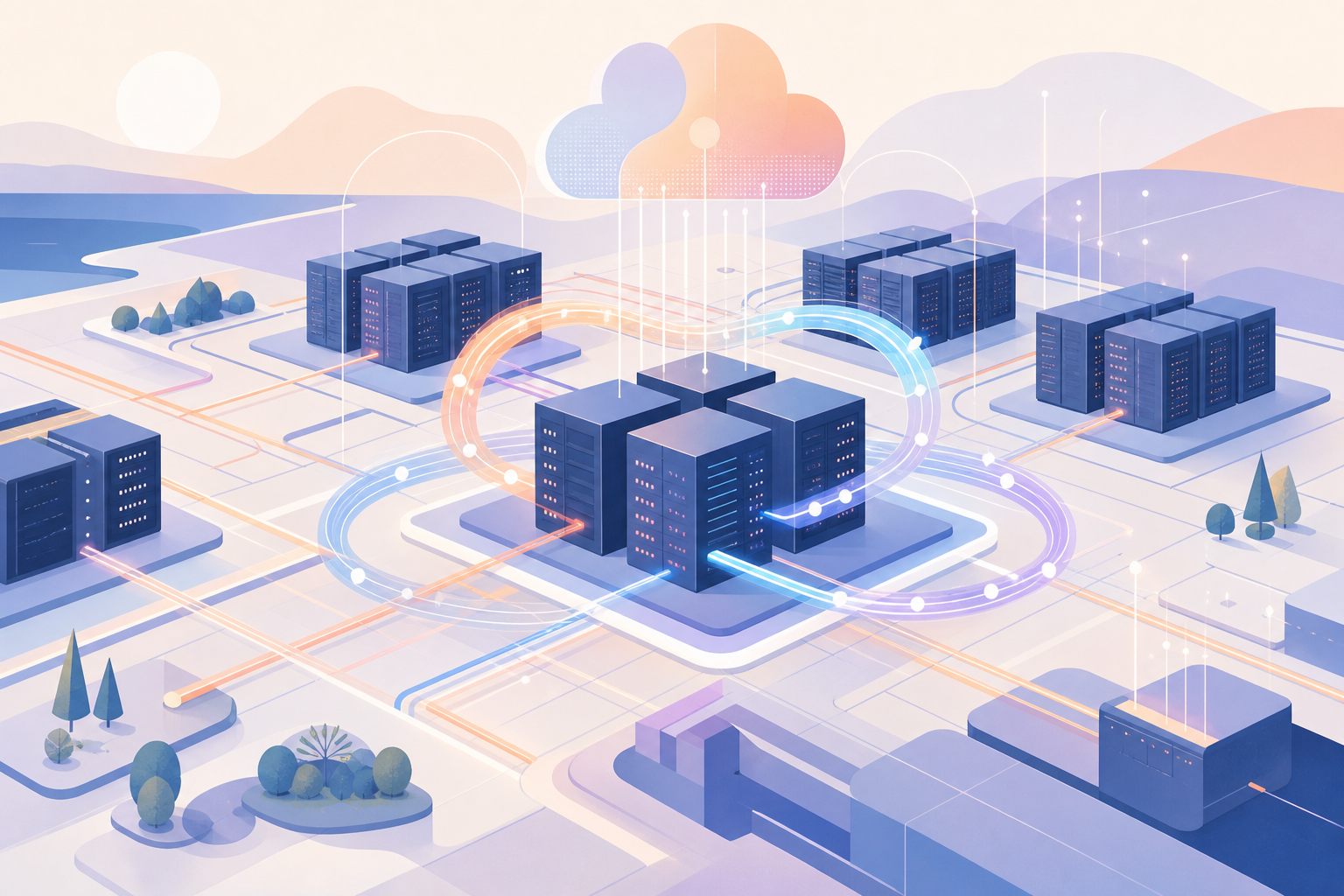
Beyond the Single Prompt: A Computational Metamorphosis
For months, the public narrative surrounding artificial intelligence and energy consumption relied on a misleading unit of measure: the individual prompt. Tech executives frequently downplayed data center power requirements by comparing a single chat question to a sip of water or streaming a few seconds of video. That baseline, however, reflected an early stage of conversational tools built merely to return one-off answers to static user prompts.
Today the frontier of software engineering has decisively pivoted toward agentic workflows. Large-model agents are no longer passive respondents; they break down high-level objectives into tasks, query external databases, run code, evaluate responses, and recursively generate dozens of micro-prompts to troubleshoot their own output. As an in-depth analysis from Wired highlights, this continuous self-prompting cycle turns what once was a three-second query into prolonged computational runs, consuming vast volumes of tokens and demanding sustained GPU execution over hours.
Gigawatts and Infrastructure Scrambles
This shift challenges the traditional assumption that AI's energy appetite would peak during model training and taper off during everyday inference. While pre-training foundational models remains capital-intensive, running swarms of autonomous agents in corporate environments demands massive, uninterruptible base-load power on a constant 24/7 basis.
The real-world friction is playing out across regional grids. As reported by Ars Technica, Oracle's Project Jupiter campus in New Mexico—a $165 billion infrastructure deployment built to serve OpenAI—requires up to 2.45 gigawatts of generation capacity. To supply that sheer volume of power amid transmission delays and local environmental scrutiny, the project pivoted toward on-site natural gas fuel cells, pairing them with synthetic renewable energy procurement to address community and regulatory pushback.
The Bottleneck of Recursive Inference
The fundamental challenge of agentic design stems from its non-deterministic, exploratory nature. Unlike classical code running deterministic branching logic, agent swarms rely on heuristic trial and error. When an agent writing enterprise software fails a test build, it formulates a new hypothesis, consults specialized tools, modifies source files, and re-executes tests repeatedly until conditions are met.
Every iteration triggers fresh inference passes across models comprising hundreds of billions of parameters. When deployed across thousands of active corporate workflows, inference ceases to be a negligible operational expense and morphs into a dominant utility cost. As regional power grids grapple with unprecedented capacity constraints, engineering teams must reassess how software agents are designed and scheduled.
Mocchi's take
For businesses deploying artificial intelligence across operational workflows, the shift toward autonomous agents requires a serious re-evaluation of architectural discipline. Naive agent implementations that blindly trigger top-tier frontier models for every basic sub-task quickly lead to ballooning compute bills and unacceptable ecological overhead. In our experience building custom software, practical scalability demands modularity: delegating routine operational steps to lightweight, specialized local models, while reserving heavy frontier reasoning exclusively for critical decision boundaries. In this new phase of the AI economy, algorithmic efficiency and compute budgeting are no longer just developer preferences—they are vital pillars of corporate sustainability.