IA · 3 August 2026 · 4 min read
AI Moves Beyond Screens to Power Fast-Food Drive-Thrus: Retail's Physical Shift
In brief: Conversational AI integration in the US fast-food industry has officially transitioned from experimental pilots to mass deployment. Major chains including Taco Bell, White Castle, and Dairy Queen are rolling out AI voice ordering agents across hundreds of drive-thru lanes. Overcoming early viral glitches, modern LLM-powered voice systems demonstrate how conversational AI is maturing for real-world physical operations.
by Team Mocchi's
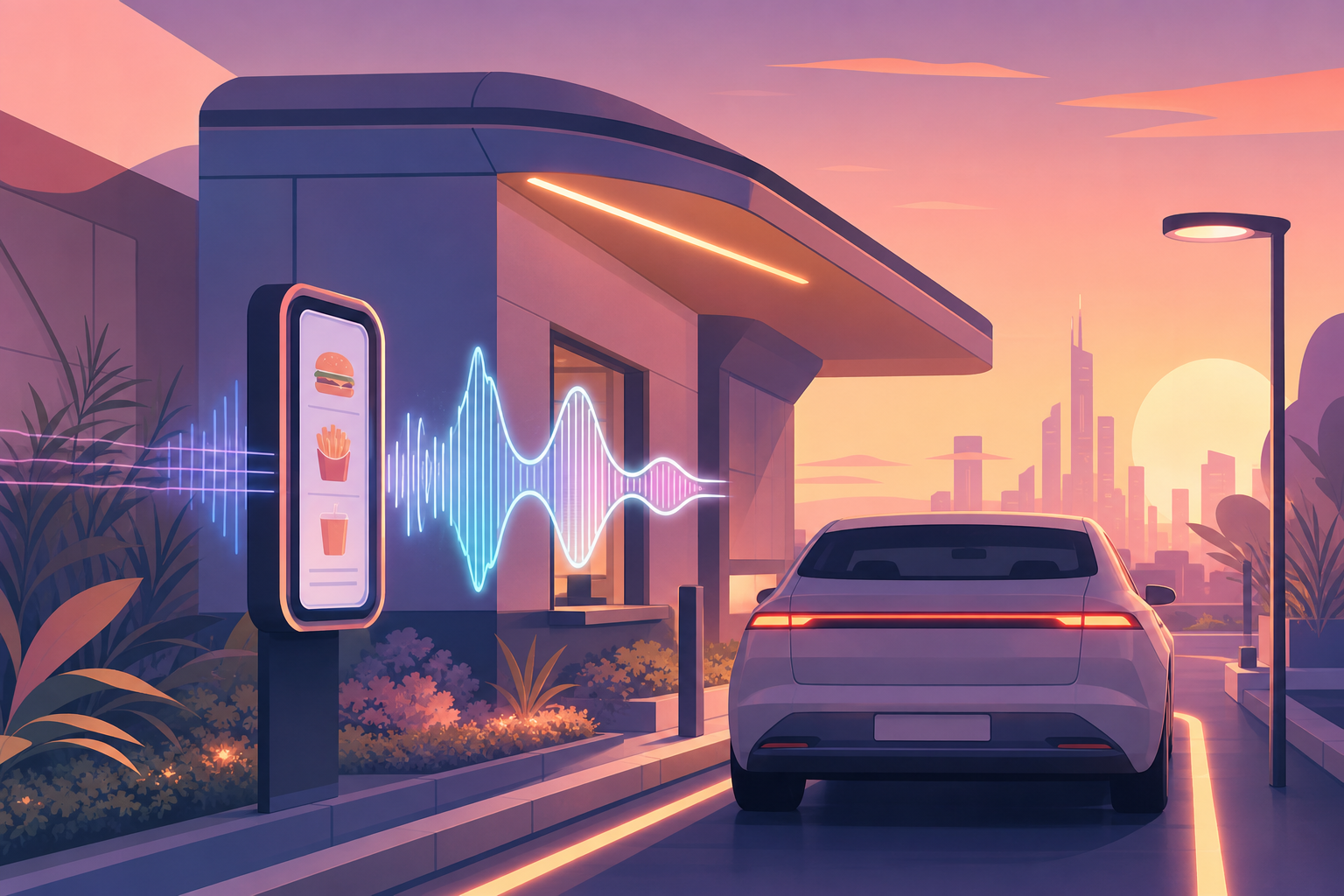
Artificial intelligence is taking a decisive leap from software development environments and document processing into physical retail operations. As highlighted in an analysis by WIRED, voice-driven AI automation across US fast-food drive-thrus is experiencing rapid acceleration, evolving from an experimental novelty into a standard operational framework for hundreds of locations.
According to data published by Intouch Insight in its annual industry survey, the proportion of US drive-thru lanes managed by AI voice assistants has steadily increased to 6%. While this percentage may appear modest at first glance, it marks a structural inflection point driven by strategic rollouts across top quick-service restaurant chains.
The Scale of Physical Automation
Major fast-food brands are executing broad conversions across their ordering channels. Taco Bell announced the deployment of AI voice ordering agents in 890 drive-thru lanes—accounting for over 10% of its US footprint—leveraging technology developed alongside Nvidia and Omilia. Meanwhile, White Castle currently utilizes its AI voice assistant "Julia," powered by SoundHound, across 12% of its locations, while mandating AI agents as standard equipment for every newly opened restaurant.
Similarly, Dairy Queen and Del Taco are expanding voice AI technology across 25 states using specialized platforms such as Presto. The strategic goals extend well beyond faster order processing: AI agents deliver consistent upselling prompts, lower order error rates, and relieve operational pressure on store staff in an industry historically impacted by high employee turnover.
Overcoming Early Operational Glitches
This widespread expansion comes after years of challenging real-world testing. Between 2021 and 2024, early field pilots—most notably McDonald's early trials—drew public skepticism when viral social media posts exposed awkward order mistakes, such as unintentionally adding hundreds of chicken nuggets or placing bacon on ice cream orders.
Recent advancements in natural language processing and significant reductions in response latency have eliminated most of these friction points. Today's models can effectively isolate customer speech from loud background engine noise, interpret diverse regional accents, and seamlessly adapt to last-minute order modifications. Operationally, voice AI does not simply eliminate human workers; it shifts their role away from listening through headsets to focus on food assembly and direct customer service at the pickup window.
Mocchi's take
The expansion of voice AI in drive-thru lanes demonstrates that generative AI is moving well beyond web chatbots to power operational workflows in the physical world. For European companies and retail operators, this shift provides a clear takeaway: the true ROI of enterprise AI lies not in standalone model capabilities, but in seamless, ultra-low-latency integration with core backend infrastructure (POS and ERP systems). Building reliable physical AI solutions requires robust software architecture capable of edge computing, handling edge cases gracefully, and maintaining high availability in noisy, fast-paced commercial environments.