Tech · 6 November 2026 · 4 min read
A Screen and a Joystick on Your Finger: The Smart Ring Built to Direct AI Agents
In brief: Hardware startup Aina has unveiled its first smart ring, engineered specifically as a physical controller to oversee autonomous AI agents. Equipped with a micro-display, an analog joystick, and two-way audio, the wearable aims to solve the burden of continuous human supervision without forcing users to reach for their smartphones for every micro-decision.
by Team Mocchi's
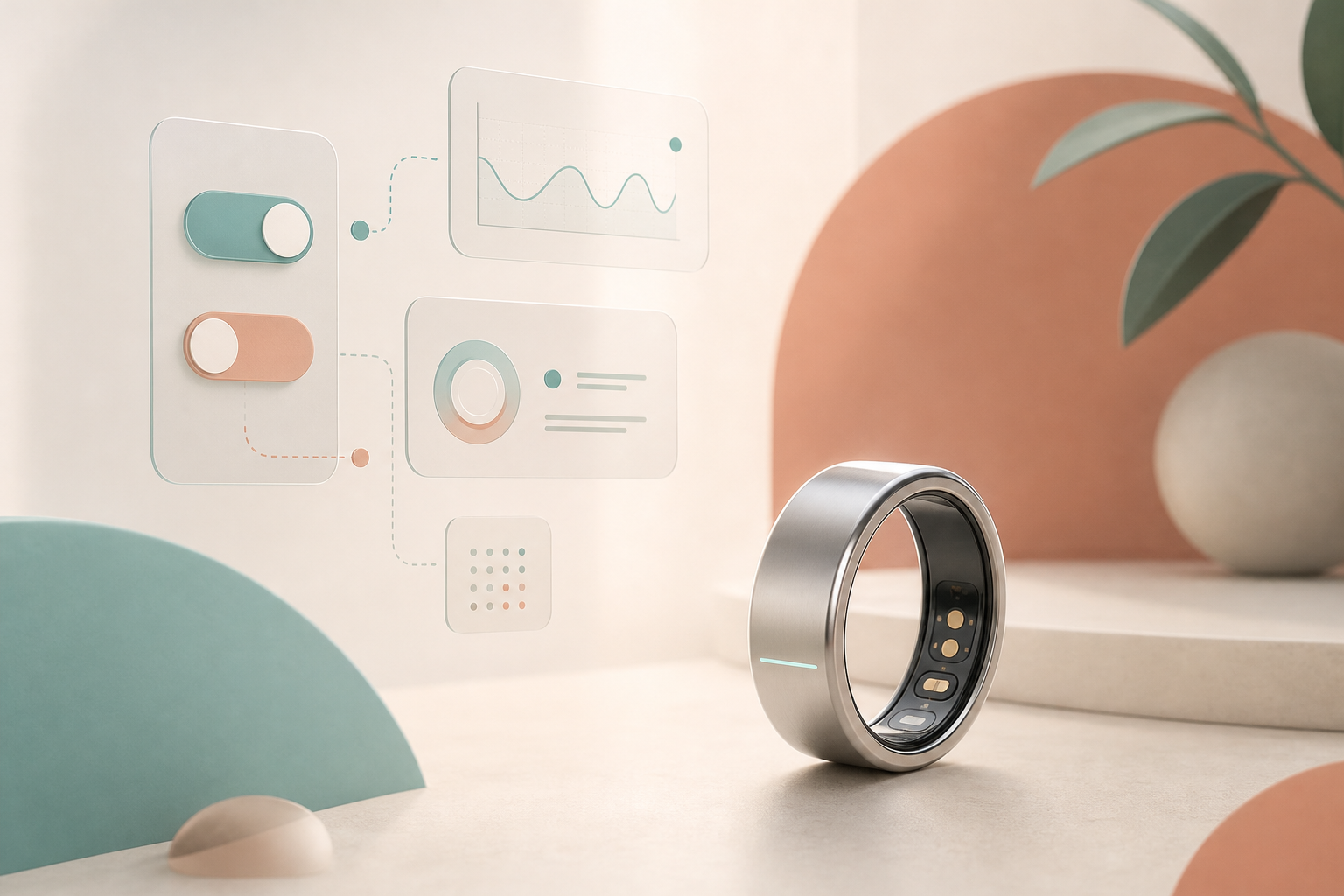
The rise of autonomous software agents has created an operational paradox: the more tasks we delegate to artificial intelligence, the more micro-decisions we are forced to validate. When an intelligent system reschedules a calendar meeting, drafts an email response, or lines up a transportation booking, keeping a human in the loop remains essential to avoid costly mistakes. Yet pulling a smartphone out of your pocket dozens of times a day to tap approval banners quickly turns delegation into a cognitive bottleneck.
Hardware startup Aina is tackling this exact friction with the unveiling of the Aina Ring, a wearable that leaves behind the crowded health-tracking sector to position itself as a physical remote control for autonomous digital assistants.
The 'remote control' thesis: interaction reduced to approvals
As reported in an exclusive by WIRED, Aina founder Apoorv Shankar — former hardware chief at health-ring maker Ultrahuman — operates on a clear premise: the dominant interface of the near future will neither be typing commands nor long voice chats, but a steady cadence of approvals and rejections. When agents operate proactively in the background, human workers will primarily spend their attention confirming or denying proposed actions.
To keep that oversight from becoming overwhelming, Aina built a titanium wearable housing a miniature display, a physical mini-joystick, a microphone, and an onboard speaker. At the software level, the ring runs the Context Aware Operating System (CAOS), which connects to personal schedules, locations, and application feeds to generate contextual prompts called "Aina Cues." If an employee leaves the office at the end of the day, the ring anticipates the commute and suggests ordering a ride. A quick flick of the joystick to the right approves the booking instantly, while a push in the opposite direction dismisses it.
Hands-on testing and hardware heritage
Early hands-on impressions published by TechCrunch describe the device as a heavily miniaturized smartwatch interface packed into a ring. Beyond binary task approvals, the built-in microphone allows users to dictate voice notes directly to desktop applications or prompt conversational agents via integrations like Wispr Flow or Aina's proprietary speech engine. The speaker also enables brief audio confirmations and short phone calls.
The ring builds on earlier experimental hardware. At CES 2026, the company showcased Dune under the Project Mirage brand — a programmable three-key desk accessory that adapted its shortcuts depending on active desktop software. Adapting that philosophy to a finger-worn ring took fifteen months of stealth development and a 5.5 million dollar seed round. Pre-orders are priced at 399 dollars ahead of a 499 dollar retail price tag, with customer shipments expected in January 2027.
Overcoming skepticism in the post-AI gadget era
Aina enters the market against a backdrop of deep skepticism toward purpose-built AI consumer hardware. Missteps by devices such as the Humane Ai Pin and Rabbit r1 showed that trying to circumvent smartphones with clunky or half-baked gadgets leads to swift consumer fatigue. Aina takes a more realistic route by not attempting to replace phones, instead serving as a low-friction companion focused on triage and lightweight confirmation.
Even so, the product faces steep technical hurdles. Cramming mechanical inputs, audio drivers, continuous wireless connections, and displays into a wearable profile creates tight constraints on battery life and durability. Furthermore, the practical value of the ring hinges entirely on third-party application ecosystems: if agents deliver irrelevant recommendations or miss critical context, physical micro-prompts will merely shift digital clutter from the pocket to the finger.
Mocchi's take
Aina's hardware highlights a critical truth about the agentic era: the primary hurdle is no longer whether models can plan complex tasks, but how smoothly humans can supervise them. For companies developing enterprise automation and agentic software, the takeaway is clear: trust in autonomous systems does not come from flooding users with alerts, but from stripping cognitive friction out of oversight. Before looking at novel wearable hardware, software teams must rethink their application UX around asynchronous, contextual, and non-intrusive approval patterns.