IA · 28 August 2026 · 5 min read
Anthropic Introduces Model Hardware Standard: AI Agents Step Beyond the Screen into the Physical Realm
In brief: Anthropic has introduced the Model Hardware Standard (MHS), an open framework designed to enable AI agents to interface directly with physical devices, scientific instruments, and production lines. Integrated with the Model Context Protocol, MHS replaces months of bespoke driver engineering, allowing frontier models to orchestrate complex physical systems in real time. The standard paves the way for autonomous closed-loop scientific research and advanced industrial automation.
by Team Mocchi's
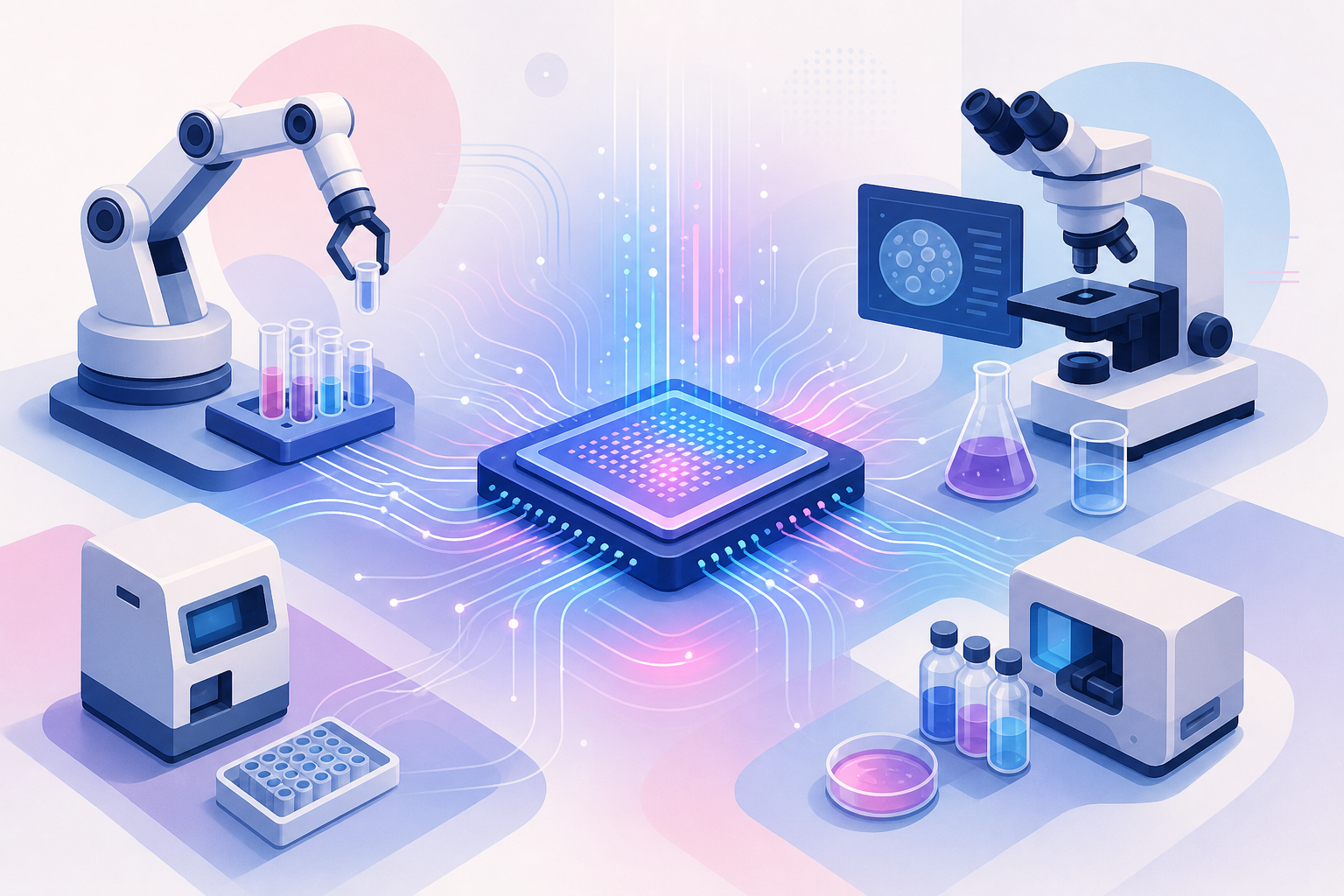
Until recently, the operational domain of autonomous artificial intelligence agents has been confined within digital environments: manipulating text, writing software, querying databases, and calling software APIs. With the release of the Model Hardware Standard (MHS), Anthropic is breaking through this barrier, creating a standardized layer of drivers and communication interfaces designed to let foundation models directly control physical devices, robotic arms, microscopes, and factory machinery.
Released as a research preview, MHS provides a unified interface so AI models can orchestrate arbitrary hardware without requiring custom software integration for every individual tool.
From Digital Logic to Actuators: How MHS Operates
Hardware interoperability has long been a bottleneck across scientific laboratories and manufacturing plants, where specialized instruments rely on proprietary protocols, incompatible data standards, and closed software stacks. As reported by Ars Technica, MHS establishes a common abstraction layer through which physical devices expose capabilities to standard command-line interfaces, APIs, and AI agents alike.
By leveraging the Model Context Protocol (MCP), models such as Claude can ingest real-time sensor telemetries, dispatch physical commands, verify results using connected cameras, and adjust operational parameters dynamically. Anthropic notes that this architecture can condense weeks or months of manual hardware integration down to mere hours or minutes.
Accelerating Closed-Loop Science and Manufacturing
The genesis of MHS emerged from observing neuroscience workflows at the Howard Hughes Medical Institute's Janelia Research Campus, where coordinating rotating lasers, microscopes, and sensors required intensive manual code bridging. The standard seeks to scale this concept across diverse experimental and industrial domains.
According to WIRED, several research teams and startups are already testing the framework for closed-loop automated discovery. In such systems, the AI agent not only formulates research hypotheses from literature, but also sets up physical apparatuses, triggers experimental runs, analyzes observational outputs, diagnoses hardware anomalies, and refines experiments recursively without human intervention.
In industrial settings, MHS holds similar promise: autonomous agents equipped with computer vision can orchestrate multi-vendor robotic arms along a manufacturing line, diagnosing mechanical bottlenecks and recalibrating operations in real time.
Physical Risks and Operational Guardrails
Empowering AI agents with physical actuation entails risks fundamentally different from text-generation errors. Hallucinations or misjudged agent steps in the physical world can result in hardware collisions, equipment damage, or chemical misallocations.
Anthropic emphasized that MHS is currently restricted to vetted research and industrial partners to thoroughly assess safety boundaries. While the firm relies on system-level model guardrails to prevent misuse, cybersecurity and robotics experts continue to stress the need for deterministic validation layers whenever software agents govern physical machinery.
Mocchi's take
For technology and manufacturing enterprises, standardizing how AI models interface with physical hardware marks a pivotal architectural shift. Removing the friction of custom driver integration significantly lowers the adoption cost for intelligent automation across manufacturing facilities and specialized labs. We advise organizations, however, to pair autonomous agent workflows with strict physical hardware interlocks and isolated network perimeters before delegating mission-critical operations to probabilistic systems.