IA · 9 November 2026 · 4 min read
Anthropic buys $3.4B in gas turbines as energy becomes AI's ultimate bottleneck
In brief: Facing multi-year delays to connect new data centers to public power grids, Anthropic has committed $3.4 billion to acquire Caterpillar natural gas turbines capable of producing up to 1.7 gigawatts of electricity. The deal represents a major pivot away from the company's historical preference for renting third-party computing capacity, signaling that direct access to primary energy has become the critical factor determining survival in the frontier AI race.
by Team Mocchi's
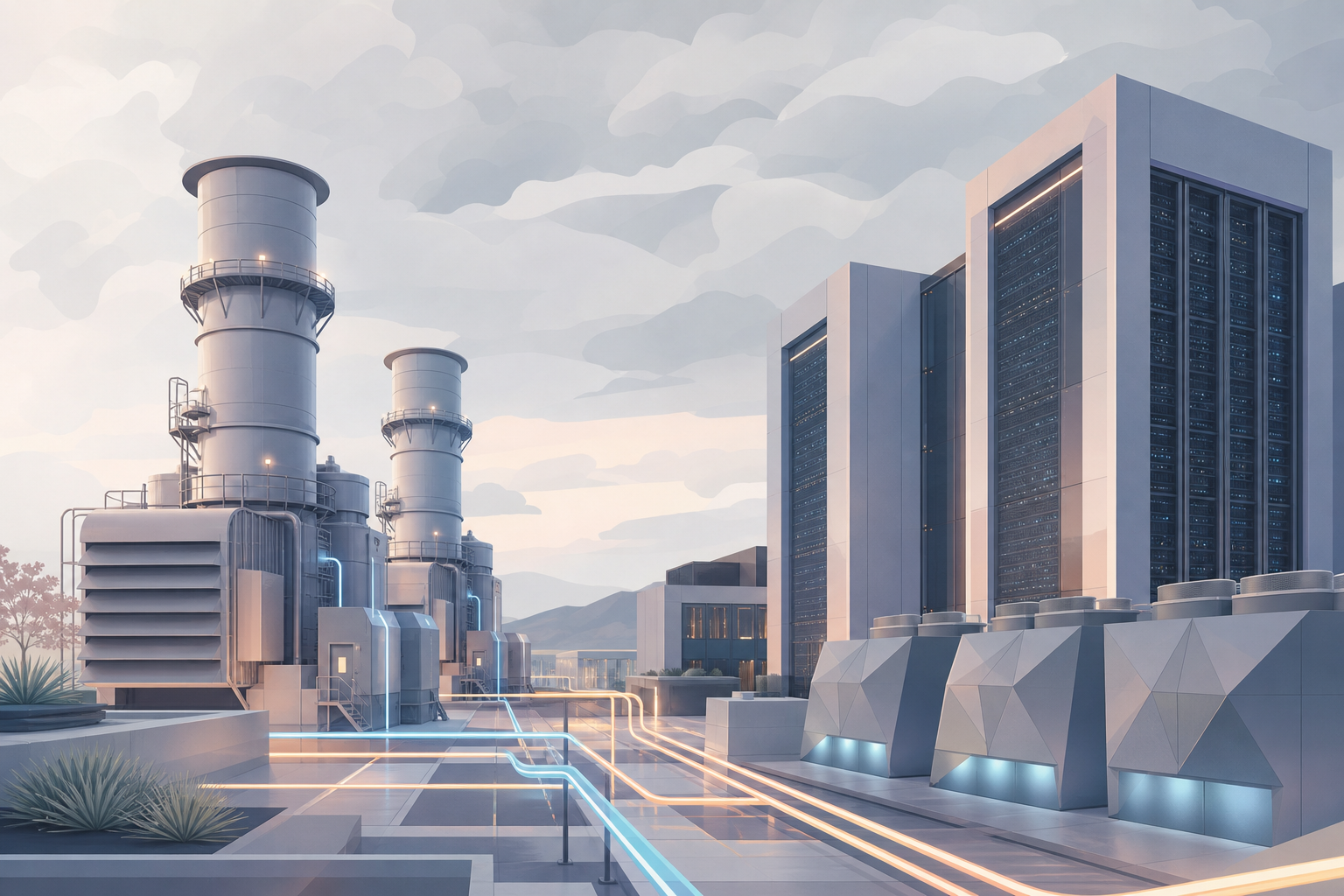
The expansion of state-of-the-art artificial intelligence models is no longer constrained solely by semiconductor supply chains or data availability: raw electricity has emerged as the definitive physical barrier. In an unprecedented move for an organization founded with a purely software and research orientation, Anthropic has committed $3.4 billion to purchase natural gas turbines manufactured by Caterpillar, securing an aggregate generating capacity of up to 1.7 gigawatts.
The hardware was originally ordered by energy equipment supplier OnePWR. When the intermediary encountered financing difficulties, Anthropic moved swiftly to acquire the contracts directly from Caterpillar, preventing the scarce generating assets from falling into the hands of competing hyperscalers such as OpenAI, Google, or Meta.
Abandoning the asset-light playbook
Until now, Anthropic’s operating philosophy centered on remaining asset-light: avoiding the direct ownership of heavy industrial physical plants while renting compute capacity from infrastructure partners. As reported by TechCrunch, the company’s recent IPO registration paperwork (Form S-1) revealed ongoing commitments of $1.25 billion per month to xAI for compute access, alongside expectations to enter further multi-billion-dollar capacity leases.
However, extreme grid congestion has broken that operational model. In North America, the backlog to connect major industrial power loads to regional transmission grids frequently stretches past seven years, while delivery queues for heavy-duty gas turbines now reach into the early 2030s. Securing turbines directly for behind-the-meter generation allows Anthropic to build dedicated, islanded generation facilities that power compute clusters without waiting for utility approvals.
The reality gap in AI's climate claims
Anthropic's massive fossil fuel acquisition sharpens the contrast between corporate sustainability rhetoric and infrastructure reality. For years, major tech firms claimed that advanced AI systems would accelerate global decarbonization through algorithmic optimization. Yet, as detailed in an analysis by MIT Technology Review, tangible evidence of AI driving net emissions reductions across critical economic sectors remains sparse, while the industry's own energy footprint accelerates.
To ensure uninterrupted baseload power for model training and real-time inference workloads, AI companies are increasingly turning to dedicated natural gas installations as their only realistic bridge solution. Generating 1.7 gigawatts is comparable to the electricity consumption of over one million residential households, and Anthropic's multi-billion-dollar commitment proves that power availability now supersedes corporate carbon pledges.
Mocchi's take
Anthropic’s multi-billion-dollar turbine deal makes it unmistakably clear that frontier AI development is no longer purely an algorithmic challenge, but an aggressive land-grab for physical power and thermal generation. For European and Italian businesses, this dynamic reinforces a crucial lesson: attempting to replicate brute-force, gigawatt-scale monolithic models is neither economically viable nor compliant with continental ESG frameworks. The sustainable competitive advantage for our market lies in architectural efficiency—deploying domain-specific, quantized small language models and lean runtime pipelines that maximize practical utility while requiring only a fraction of the compute footprint.