Tech · 18 August 2026 · 4 min read
Eyes in Your Ears: Leaked macOS Firmware Reveals Apple's Camera-Equipped AirPods
In brief: Video demonstrations and code references discovered in the macOS release candidate have revealed Apple's upcoming AirPods with built-in cameras. The hardware feeds visual context into Siri and Visual Intelligence, challenging AI smart glasses while sparking renewed debate around wearable privacy.
by Team Mocchi's
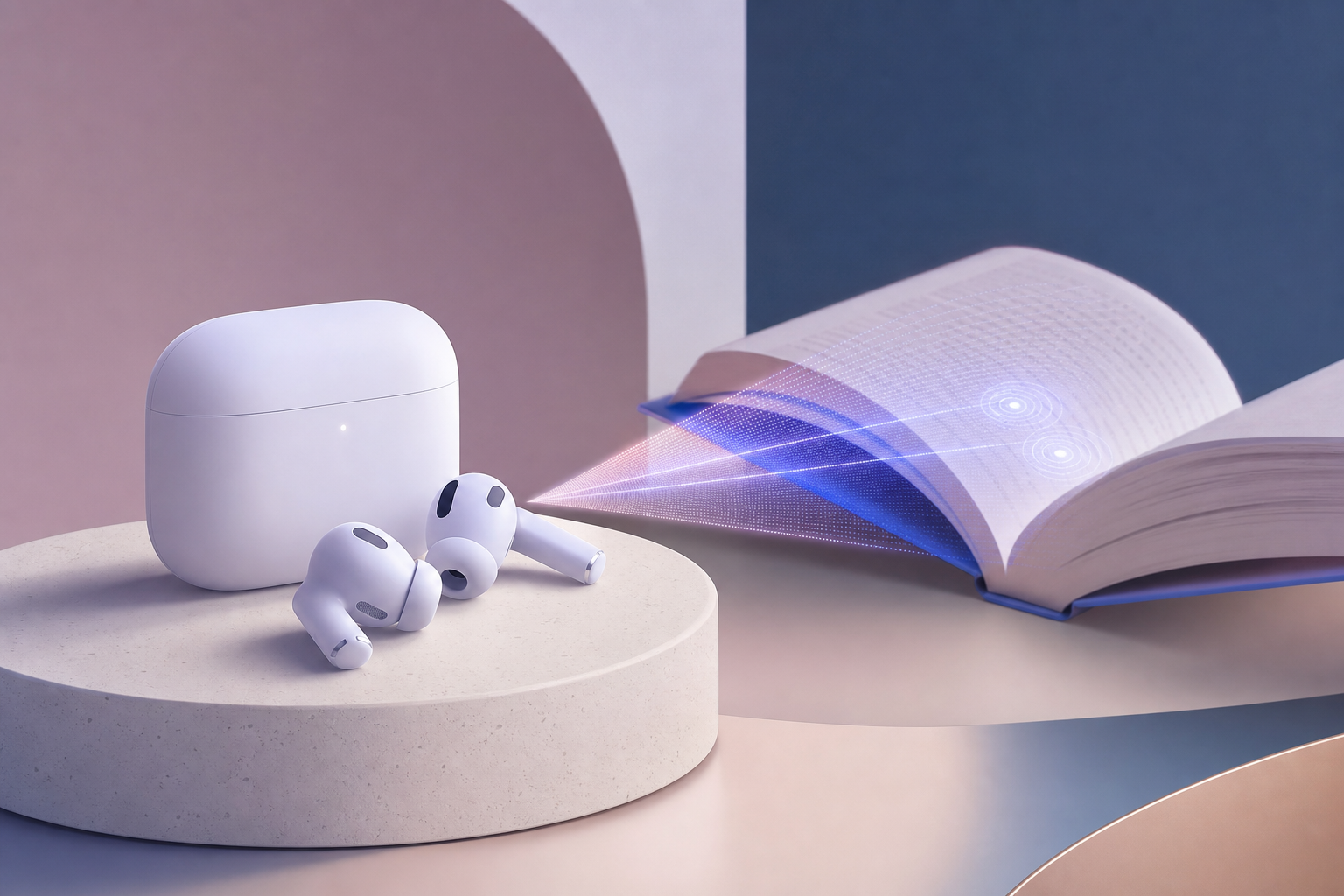
The firmware leak: demo footage inside macOS Tahoe
The confirmation did not arrive via an official keynote stage, but deep inside the system assets of the macOS Tahoe 26.7 Release Candidate: the long-rumored AirPods featuring integrated cameras have surfaced with concrete visual proof. As reported by The Verge, a short demo video embedded in the firmware shows a user wearing the redesigned earbuds while holding up a book, allowing the onboard optical sensors to inspect the cover and parse its title.
During the clip, a Siri voiceover introduces the workflow: “With Visual Intelligence, your world becomes savable. See something you like? Just ask me to save it for later.” The footage underscores that these sensors are not designed for social media snapshots or video capture, but rather to serve as continuous sensory inputs for Apple’s multimodal AI stack.
From stems to surroundings: how Visual Intelligence operates
Technical details extracted from the operating system build highlight a familiar yet revised form factor. The earbuds feature a slightly chunkier housing than the current AirPods Pro 3, complete with longer stems designed to accommodate low-resolution camera modules and auxiliary processing hardware. Analysts also uncovered a dedicated system prompt titled “Hair Detected”, engineered to alert wearers when long hair obstructs the lens and degrades spatial understanding.
The hardware is built to feed Apple Intelligence with environmental context. By capturing low-power visual data, the system enables Siri to deliver turn-by-turn walking guidance grounded in physical landmarks, translate street signs, and store actionable reminders based on physical objects encountered throughout the day.
Discreet form factor vs. privacy concerns: the Meta comparison
Embedding cameras into pervasive audio gear shifts the battleground for ambient computing, putting Apple in direct competition with smart glasses such as Meta’s Ray-Ban series. However, as noted in an analysis by TechCrunch, the subtler earbud form factor carries significant sensitivity regarding passive recording and privacy in shared public environments.
To address user friction, the hardware is expected to incorporate external status LEDs that illuminate whenever optical data is being captured or transmitted, backed by local on-device processing and Apple's encrypted Private Cloud Compute architecture. The presence of polished demo media within current system builds points to a formal debut at the upcoming autumn hardware event alongside the broader rollout of next-generation Siri capabilities.
Mocchi's take
The introduction of visual sensors on consumer audio devices signals a definitive shift beyond smartphone screens toward truly ambient AI. For software engineers and digital product teams, this form factor paves the way for sophisticated zero-UI experiences where multimodal context and voice entirely replace manual inputs. Moving forward, the real competitive edge will belong to teams that can architect privacy-first systems, processing sensitive environmental feeds locally while delivering seamless contextual utility.