Tech · 29 October 2026 · 4 min read
Jobs' Last Taboo Falls: Apple Introduces the MacBook Pro with Touchscreen and OLED Display
In brief: Apple has unveiled its first major MacBook Pro redesign in more than five years in Los Angeles, bringing a touchscreen and an OLED panel to macOS for the first time. Available in 14-inch and 16-inch sizes powered by M5 Pro and M5 Max chips, the notebook swaps the webcam notch for a Dynamic Island and revives the glowing lid logo. The update represents a landmark shift in Apple's desktop ergonomics, paired with a steep jump in entry-level pricing.
by Team Mocchi's
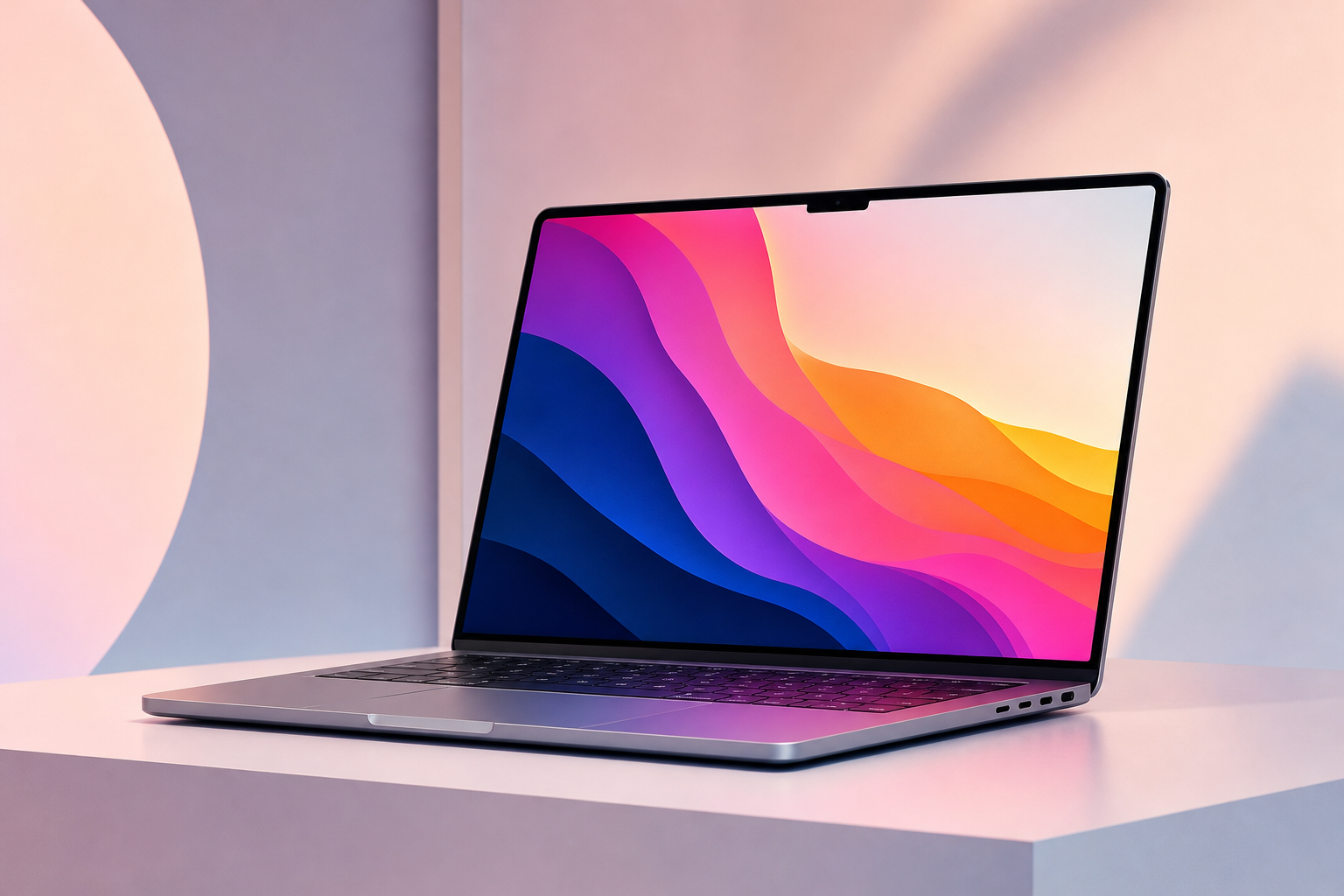
For sixteen years, Apple's official stance on touch-enabled laptops remained defined by Steve Jobs: touch surfaces shouldn't be vertical, because arm fatigue inevitably sets in after a few minutes. That long-held design dogma was officially retired in Los Angeles, where the company revealed its first major MacBook Pro redesign since 2021, bringing native touch interaction and OLED display technology to macOS for the first time.
As reported by Ars Technica during the product unveiling, the refreshed machine does not adopt a 2-in-1 convertible hinge. Instead, it preserves the traditional clamshell form factor, engineered for standard desk and lap use while integrating direct finger input alongside the keyboard and Force Touch trackpad.
Touch arrives on macOS with gestures and Dynamic Island
Bringing touch to the Mac operating system does not overhaul the fundamental desktop layout, but it introduces a direct second layer of navigation. In initial hands-on testing published by Ars Technica, the panel handles complex multitouch inputs smoothly: three-finger swipes to toggle between virtual desktops, pinch-to-zoom in maps and photo viewers, window resizing by dragging edges, and quick flick gestures to tile apps to either side of the screen.
On the hardware front, the display drops the rectangular camera notch introduced in 2021 in favor of the Dynamic Island. First popularized on iPhones, the cutout occupies a far smaller portion of a 14- or 16-inch workspace. Tapping the island directly with a finger allows users to expand background tasks, media controls, and timers without redirecting the mouse cursor.
«PROLED XDR» panel and reduced chassis weight
The second major upgrade centers on the display substrate. Apple has transitioned from Mini-LED backlighting to an OLED panel marketed as the PROLED XDR. The display delivers up to 2,000 nits of peak brightness and a specified 10,000,000:1 contrast ratio, while preserving ProMotion variable refresh rates up to 120 Hz and introducing dedicated burn-in mitigation measures.
Despite the addition of a touch-sensing layer, the aluminum enclosure is noticeably lighter. The 14-inch model weighs in at approximately 3 pounds (around 1.36 kg), shedding roughly half a pound compared to its direct predecessor. On the exterior lid, Apple also reintroduced a beloved classic feature: the iconic rear Apple logo illuminates once again when the display is opened, reversing a 2015 design retreat.
M5 Silicon and steep enterprise pricing
Internally, the lineup relies on M5 Pro and M5 Max chips rather than debuting the M6 series, reserving larger AI architectural shifts for future cycles. Unified memory tops out at 128 GB, while internal solid-state storage can be expanded up to a massive 16 TB configuration.
Those capabilities come with a sharp upward price adjustment. In the United States, the baseline 14-inch model with M5 Pro starts at $2,899, while the 16-inch version begins at $3,399. Stepping up to M5 Max pushes starting prices to $4,499 for the 14-inch and $4,799 for the 16-inch tier, prior to memory and storage upgrades. Preorders are open immediately, with customer deliveries scheduled to begin on November 6.
Mocchi's take
Bringing touch input to macOS erases decades of rigid separation between laptops and tablets, presenting a practical challenge for software engineering teams. For custom software agencies and European enterprises developing desktop platforms, CAD tools, or business applications on Mac, this shift requires rethinking tap targets, spatial menus, and interaction flows that were previously calculated strictly for cursor accuracy. Given the steep enterprise price tag, initial company rollouts will remain concentrated among specialized creative and technical staff, but user expectations for touch responsiveness on Mac will quickly become a baseline for modern business software.