IA · 10 September 2026 · 5 min read
Apple Normalizes Ambient Listening: With Audio Intelligence, AI Enters Every Conversation
In brief: At its fall hardware event, Apple unveiled Audio Intelligence for Apple Watch Series 12 and Ultra 4, bringing continuous ambient listening features like Live Rewind and Siri Recap to hundreds of millions of wrists. To mitigate privacy concerns, Cupertino is locking down raw audio processing within the hardware-isolated Secure Exclave of the new S11 processor, ensuring no raw audio recordings are stored while marking a decisive cultural shift toward passive ambient computing.
by Team Mocchi's
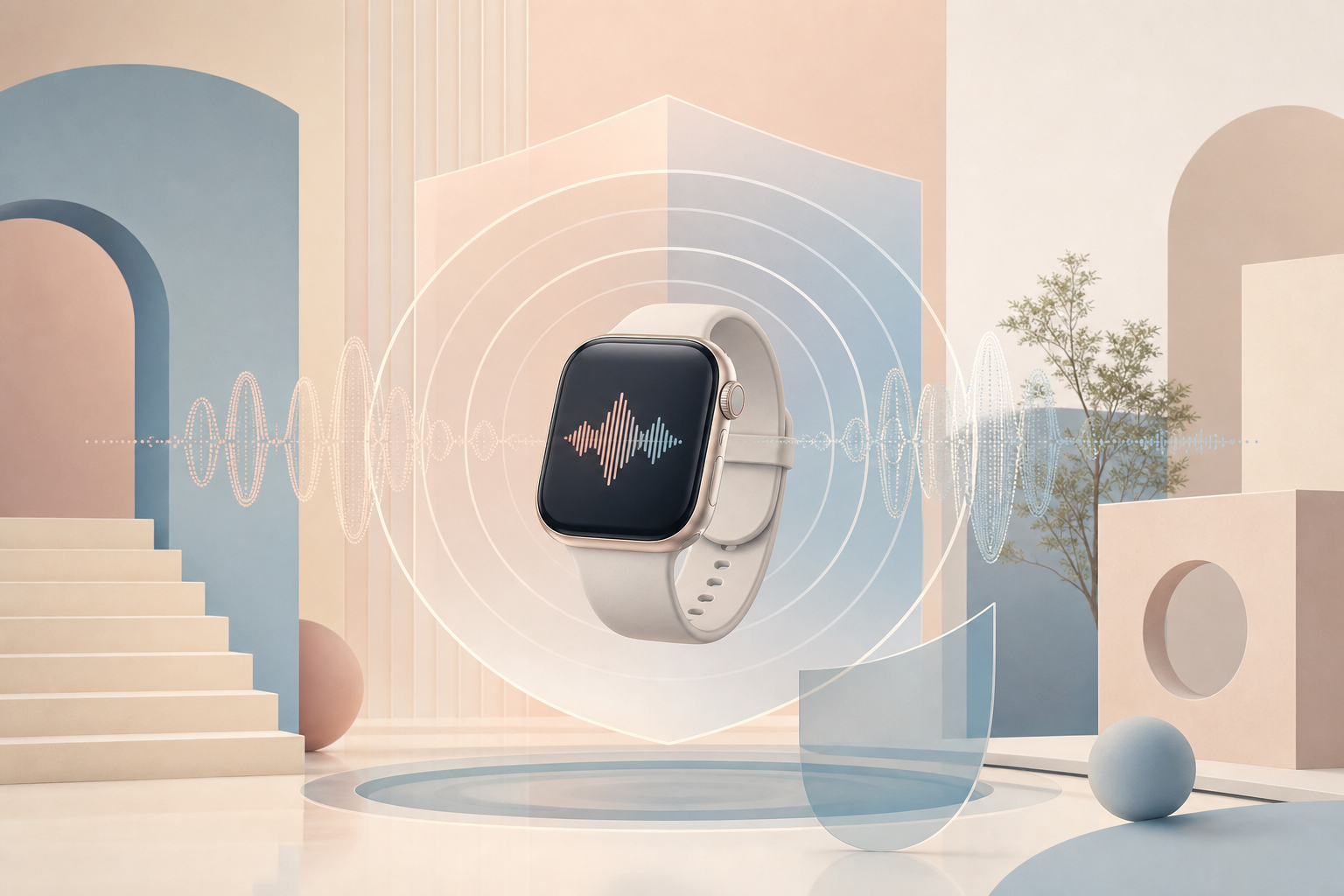
For years, the prospect of a consumer electronic device constantly listening to our everyday conversations was treated as a red line, fiercely opposed by privacy advocates and handled with extreme caution by tech giants. At its September hardware keynote, Apple decided to cross that threshold. Alongside the new Apple Watch Series 12 and Ultra 4, the company introduced Audio Intelligence, an AI-powered suite that processes ambient acoustic signals in real time to provide on-demand transcriptions and summaries.
As reported by TechCrunch, Cupertino’s move directly normalizes the concept of technology that is always listening, turning what was once a niche pursuit attempted by dedicated wearable gadgets into a mainstream reality for hundreds of millions of users.
Live Rewind and Siri Recap: Vocal context on your wrist
The user-facing experience of Audio Intelligence centers on two primary tools: Live Rewind and Siri Recap. Live Rewind tackles a universal human problem: everyday lapses in attention. By double-tapping the Digital Crown, a wearer can immediately bring up a text transcript of what was just spoken moments earlier, rescuing missed remarks without having to ask the speaker to repeat themselves.
Siri Recap expands this capability across broader contexts, synthesizing semantic overviews of discussions, ad-hoc voice notes, and interactions throughout the day. Complementing these productivity features is passive sound recognition designed for accessibility, capable of alerting users via haptic feedback to critical auditory signals—such as emergency sirens, doorbells, crying infants, or smoke detectors—even in noisy environments.
As analyzed by Wired, these acoustic capabilities connect to the broader Siri AI ecosystem rolling out across the ecosystem, enabling the assistant to weave acoustic cues from the wrist into personal data already residing on-device, including calendars, messages, and notes.
The Secure Exclave: Hardware-level privacy guarantees
Anticipating the inevitable alarm over an always-on microphone, Apple accompanied the launch with an in-depth security white paper detailing its data protection model. According to The Verge, the company chose not to rely on software policies, but on physical silicon isolation.
The new S11 processor introduces a Secure Exclave, a hardware-isolated compartment completely severed from the main operating system. Raw audio captured by the watch microphones feeds exclusively into this protected buffer, where on-device neural models analyze speech and sounds without ever writing an audio file to disk. The stream operates as a rolling buffer that is continuously overwritten; no audio data persists in flash memory, and the raw feed is inaccessible to watchOS, third-party apps, or Apple itself.
Text summaries or transcriptions are only retained when explicitly triggered or confirmed by the user. Furthermore, whenever textual insights are synced to an iPhone, the transfer is protected by end-to-end encryption negotiated directly between the devices' secure hardware enclaves.
The Social Etiquette of Ubiquitous Ambient AI
Apple's initiative lands amidst an ongoing wave of wearable AI experimentation. Over the past several months, dedicated AI pendants and clips attempted to passively log user environments, but struggled with form-factor limitations and social friction. By embedding ambient listening directly into the world's most ubiquitous smartwatch, Apple overcomes hardware adoption friction, yet pushes the debate squarely into the arena of social etiquette.
Even with cryptographic guarantees that audio is processed locally and discarded, interacting with someone wearing a watch capable of rewinding and transcribing conversation introduces subtle psychological tension in personal and professional meetings. The boundary between a personal cognitive assistant and perceived ambient surveillance remains razor-thin.
Mocchi's take
For enterprise leaders and digital product developers, Apple’s foray into ambient audio marks the practical dawn of pervasive contextual computing. The most significant engineering achievement here is not merely the local speech model, but the architectural discipline of silicon compartmentalization—such as the Secure Exclave—enabling continuous environmental sensing with minimal power drain and verifiable isolation. For businesses exploring on-device AI workflows, this demonstrates that future adoption will not hinge solely on algorithmic power, but on architectural integrity: ensuring that user utility never comes at the expense of absolute cryptographic trust.