IA · 4 November 2026 · 5 min read
Fifteen Seconds of Wrist Memory: Apple Begins Testing Audio Intelligence
In brief: Apple has released the first developer betas featuring Audio Intelligence, a dedicated suite of ambient AI capabilities designed for the Apple Watch. The platform introduces Live Rewind, which transcribes the last fifteen seconds of conversation on demand, and Siri Recap, an ambient tool that summarizes recently concluded discussions. To ease privacy concerns surrounding continuous listening, Apple has isolated raw audio processing within a dedicated hardware enclave with end-to-end encryption for saved text.
by Team Mocchi's
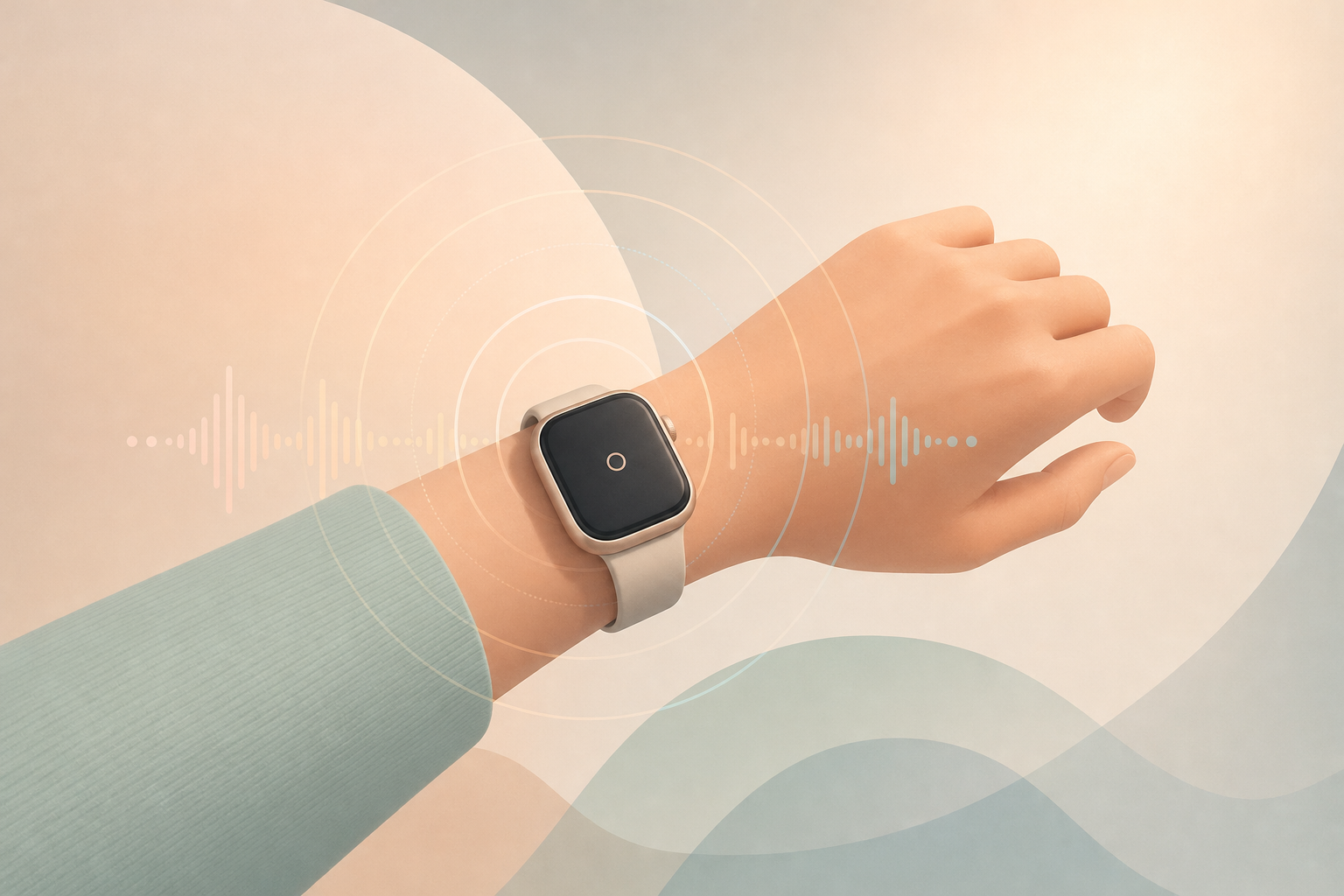
Wearable artificial intelligence is moving beyond startup experiments to establish a direct presence on mainstream consumer platforms. With the release of the developer betas for watchOS 27.3 and iOS 27.3, Apple has initiated real-world testing of Audio Intelligence, a technology suite previewed at its autumn hardware event that aims to turn smartwatches into passive contextual recorders.
At the core of the rollout are two distinct speech-processing tools: Live Rewind and Siri Recap. Both rely on ambient microphone access to interpret acoustic surroundings, applying different architectural approaches to handle short-term recall and broader conversational summaries.
Rewind and recap: rethinking the wrist interface
The first tool, Live Rewind, addresses a common communication bottleneck: missing an essential detail during a fast-paced verbal exchange, such as an address or a list of instructions. By double-pressing the Digital Crown, users trigger a temporary buffer inspection that converts the last fifteen seconds of detected dialogue into an on-screen text snippet. This transcript can either be viewed momentarily or saved and queried through Siri for later review.
Siri Recap focuses on larger narrative arcs. As reported by The Verge, the feature employs ambient listening algorithms to register when a dialogue has finished, subsequently generating a high-level summary inside the Siri app with a contextual title and bulleted action items. The beta also incorporates sound recognition routines designed for hearing-impaired users—alerting to sirens or doorbells—alongside automated Shazam background song identification.
Hardware enclaves against surveillance backlash
Always-listening microphones on personal devices have long provoked public skepticism, particularly after multiple standalone recording wearables faced severe pushback over bystander consent and cloud transmission risks. In response, Apple accompanied the release with a technical whitepaper outlining its architectural constraints.
As highlighted by TechCrunch, all Audio Intelligence features are strictly opt-in. At the silicon level, raw acoustic input is processed inside a volatile memory ring on a dedicated coprocessor: raw audio files are never written to disk, remaining inaccessible to third-party applications, the watch operating system, and Apple's own infrastructure. Only when an owner manually commits a recap or transcript does the system synchronize the text across personal devices via end-to-end encrypted iCloud channels protected by two-factor authentication.
The trajectory of ambient computing
Apple's initiative clarifies an ongoing industry realignment: while single-purpose AI pins and smart pendants have struggled to secure widespread traction, dominant ecosystem players are folding ambient memory capabilities into hardware form factors that users already wear and trust.
The strategic bet lies in normalizing passive computational memory without requiring intrusive facial cameras or conspicuous accessories. As the system transitions from developer channels to worldwide consumer availability, its success will depend on whether local summarization remains reliable amidst everyday noise and whether its strict privacy boundaries withstand independent security audits.
Mocchi's take
The arrival of structured ambient listening on the Apple Watch establishes a new baseline for interface design, shifting human working memory support directly onto edge hardware. For companies evaluating enterprise software and field operations, this rollout demonstrates that the highest-impact AI workflows are shifting away from centralized cloud chatbots toward low-latency, event-driven edge processing. The defining architectural lesson here is trust: integrating ambient intelligence into professional workflows will succeed only when strict hardware-level data isolation ensures sensitive conversations never leave the physical device.