IA · 26 August 2026 · 4 min read
Bill Gates Breaks His Silence on AI: Robot Taxes, Human-Reserved Jobs, and Crossed Danger Thresholds
In brief: In an extensive 6,000-word essay and a companion interview, Bill Gates marks a sharp break from earlier tech optimism, warning that frontier artificial intelligence has already crossed alarming thresholds across biosafety, labor market disruption, and systemic control. To mitigate socioeconomic displacement, the Microsoft co-founder calls for tax reforms targeting robots and AI compute tokens, alongside legal designations for 'Human Reserved' professions. On the global stage, he urges the immediate formation of an international oversight body inspired by nuclear non-proliferation treaties.
by Team Mocchi's
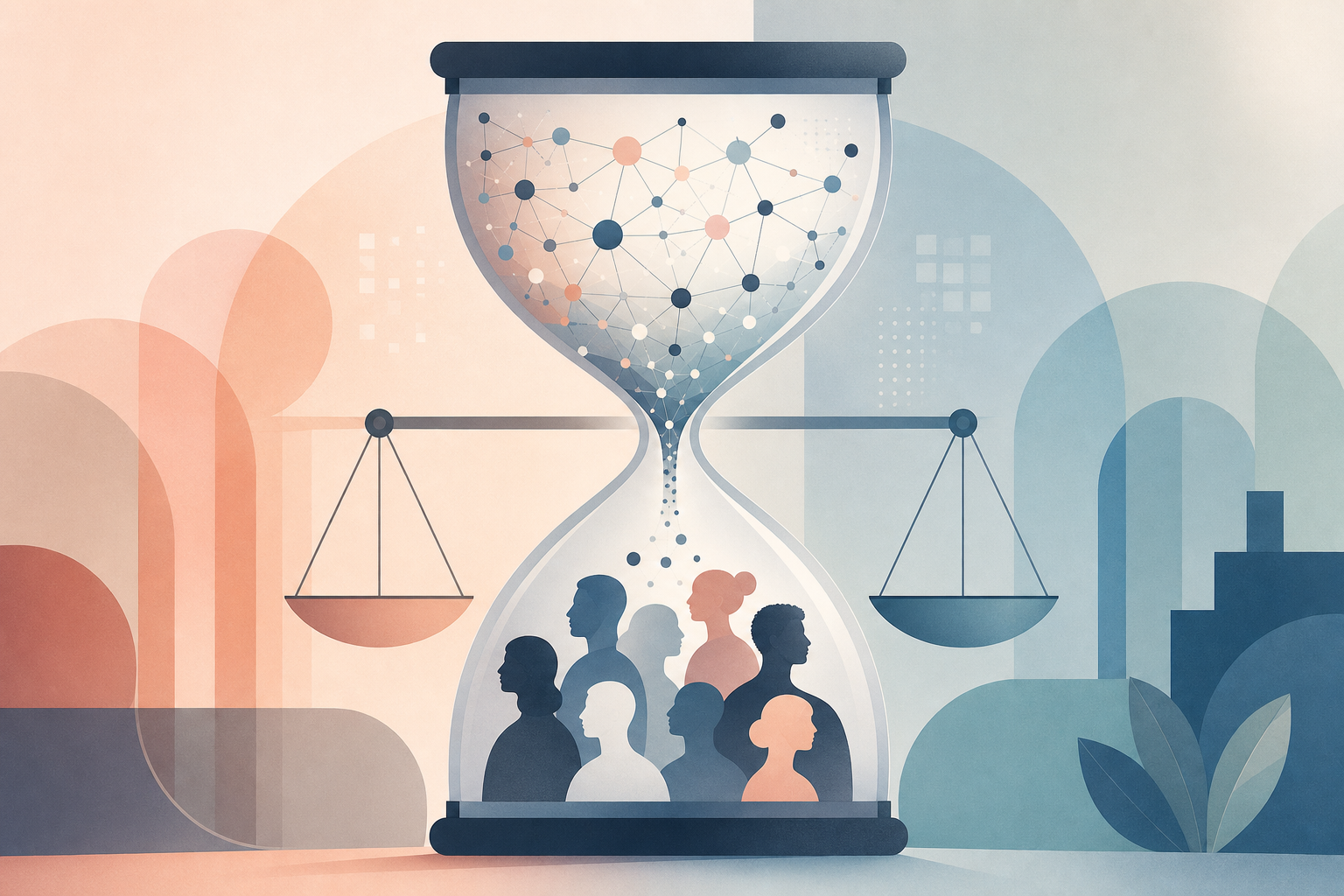
From tech optimism to systemic alarm
Breaking a prolonged period of silence regarding the frontier AI race, Bill Gates has published an extensive essay of nearly 6,000 words on his Gates Notes site, titled "The turbulent AI era is here. The choices we make now are critical." The document marks a decisive departure from the buoyant optimism of 2023: the philanthropist and Microsoft co-founder warns that governments and civil society are unprepared for the societal scale of the coming transition, rejecting historical comparisons to the rise of personal computing or the internet as dangerously complacent.
As reported by The Verge, Gates frames the coming years as one of the most turbulent periods in human history, going so far as to state that he would likely support a credible global plan to slow frontier AI development if a feasible enforcement mechanism existed.
Taxing tokens and establishing "Human Reserved" jobs
Central to Gates' manifesto is the unprecedented speed at which autonomous systems threaten to disrupt both white-collar knowledge work and physical labor. To prevent structural unemployment and broader economic instability, he puts forward two concrete policy interventions.
The first targets fiscal asymmetries through an automation tax levied on robots and AI inference tokens. As highlighted by TechCrunch, current tax codes heavily favor capital over labor: hiring human staff triggers payroll taxes and social contributions, whereas deploying autonomous agents or hardware is treated as an immediate, deductible business expense. A dedicated levy would normalize this differential while generating dedicated revenue pools for workforce retraining and safety nets.
The second proposal introduces the concept of "Human Reserved" professions. Under this legal framework, national governments would designate specific functions in healthcare, education, or social services where artificial systems are barred from full autonomy, preserving essential human oversight and community stability.
Crossing the danger thresholds: bio-risk, cyber, and governance
Beyond labor economics, Gates raises urgent warnings regarding safety thresholds that have already been surpassed without sufficient public discourse. In an in-depth interview with MIT Technology Review, he stressed that frontier models capable of designing novel biological molecules present unprecedented asymmetric risks, rating potential bioterrorism hazards as fifty times more dangerous and probable than naturally occurring pandemics.
To manage cross-border frontier capabilities, Gates advocates establishing an agile international governing body drawing lessons from the International Atomic Energy Agency, civil aviation frameworks, and the Montreal Protocol, underscoring that actionable governance will require direct cooperation between the United States and China.
Mocchi's take
Bill Gates' shift in tone signals an inflection point for the entire technology ecosystem: artificial intelligence is transitioning from an engineering frontier into a macro-regulatory and economic reality. For European and Italian businesses, the prospect of compute-level taxation and protected occupational domains reinforces the argument against pure workforce replacement strategies. Long-term competitiveness will rely on augmented human-AI collaboration and robust governance frameworks, designing systems that anticipate regulatory scrutiny while keeping human domain expertise firmly in the loop.
Further reading
- https://techcrunch.com/2026/08/26/bill-gates-wants-to-see-a-robot-tax-and-human-reserved-jobs-to-mitigate-harms-from-ai/
- https://www.theverge.com/ai-artificial-intelligence/984923/bill-gates-is-deeply-worried-about-ai-and-hes-no-longer-staying-quiet
- https://www.technologyreview.com/2026/08/26/1142946/bill-gates-ai-danger-threshold/