Tech · 11 June 2026 · 3 min read
China Launches World’s First Wind-Powered Underwater Data Center
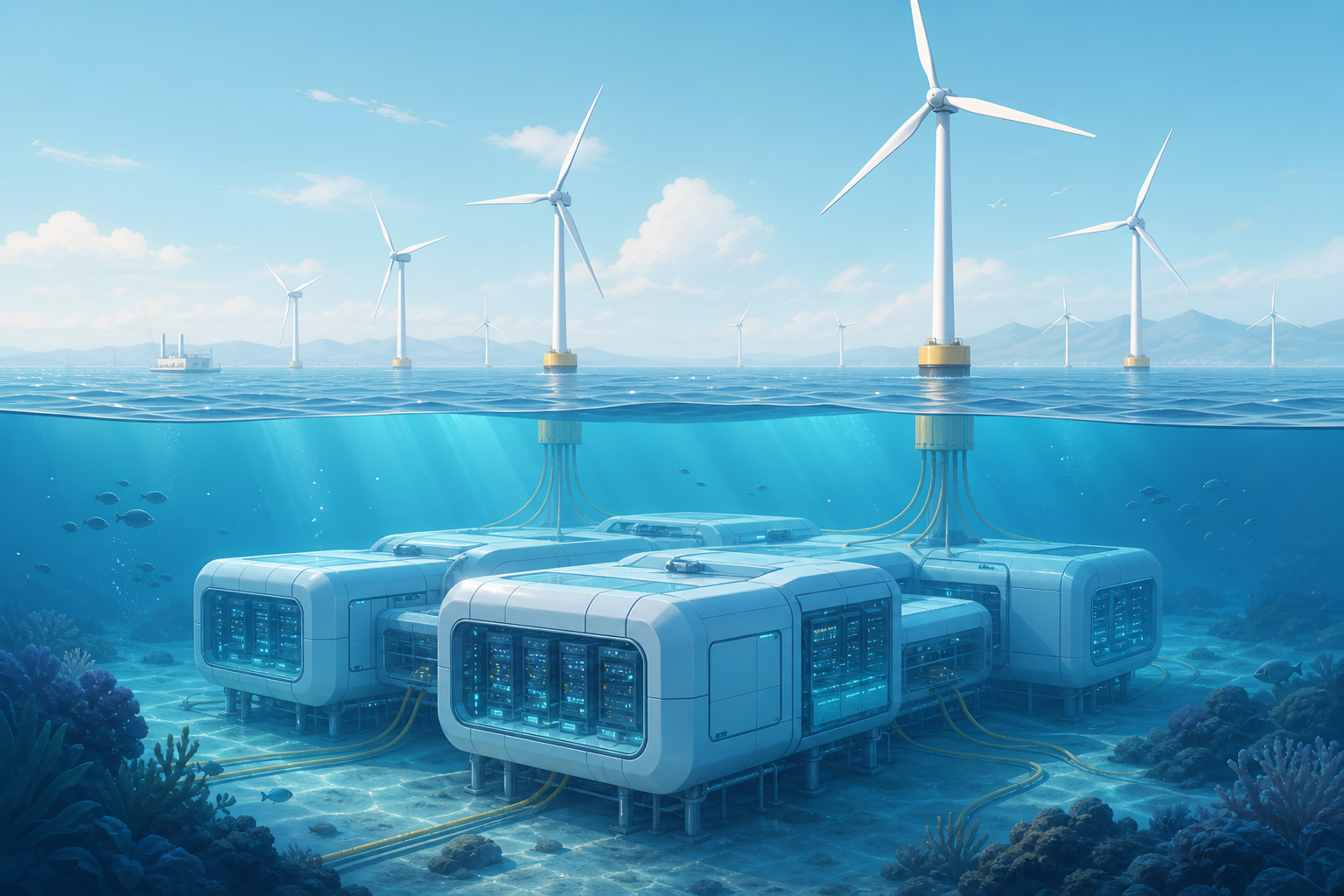
In brief: A joint initiative by HiCloud Technology and Chinese state-owned enterprises has led to the deployment of the world's first underwater data center (UDC) entirely powered by offshore wind in Shanghai. Operating 10 meters deep with a 24-megawatt capacity, the facility uses seawater for natural cooling, cutting cooling-related power to under 10%. It aims to sustainably meet the soaring computational demands of modern AI.
by Team Mocchi's
AI's Energy Crisis and the Underwater Solution
The exponential growth of artificial intelligence is straining power grids worldwide. Traditional data centers require massive amounts of energy, not only to power advanced silicon but also to run the heavy-duty air conditioning systems needed to prevent overheating. These cooling systems alone typically account for 40% to 50% of a facility's total electricity consumption.
To address this challenge, China has launched the world's first underwater data center (UDC) powered entirely by offshore wind energy. As reported by WIRED, the facility is located off the coast of Shanghai, submerged 10 meters deep in the Lin-gang Special Zone within the China Pilot Free Trade Zone. The infrastructure represents a key step in Beijing's strategy to match AI computational demands with the transition to renewable energy sources.
Specs and Architecture of the Shanghai Complex
The project is the result of a collaboration between private firm HiCloud Technology and the state-owned China Communications Construction, representing an investment of 1.6 billion yuan (approximately $236 million).
The submerged facility has an initial capacity of 24 megawatts. By placing server containers on the seabed, the system leverages surrounding seawater as a natural, continuous coolant. This physical design slashes the energy required for thermal management to less than 10% of the total power consumed by the facility.
According to government statements, this project uses 100% less freshwater and reduces land use by more than 90% compared to equivalent onshore facilities. Over 95% of the power supply for the complex is green electricity generated by offshore wind farms, leading to an overall energy consumption reduction of 22.8%.
Measuring Thermal Performance via PUE
The thermal efficiency of the Shanghai UDC is reflected in its Power-Usage Effectiveness (PUE), the primary metric used by the industry to evaluate energy performance. In this scale, 1.0 represents the maximum theoretical efficiency, where every watt of power goes directly to computational tasks rather than cooling or lighting.
The Lin-gang facility is designed to achieve a PUE of no more than 1.15 in its initial phase, ranking it among the most efficient data centers globally. HiCloud is a pioneer in this field, having deployed the world's first commercial underwater data center in Hainan in 2023. However, the Shanghai installation marks a major milestone by integrating offshore wind power directly, cutting the cord from mainland fossil fuel grids.
The Global Race for Sustainable Computing Power
The development of the Shanghai UDC reflects a broader geopolitical landscape where computing infrastructure is viewed as a pillar of national security. According to a recent UN report, AI-specialized data center infrastructure is highly centralized, with nearly 90% located in just two nations: the United States and China.
The two powers are navigating the energy demands of AI through differing strategies. While the US has seen some domestic hesitation regarding rapid green energy transitions due to the immediate urgency of training frontier models, China is emphasizing energy self-sufficiency through extreme engineering. The viability of projects like the Shanghai underwater data center will help determine whether future AI workloads can scale without undermining global environmental goals.