IA · 31 August 2026 · 5 min read
The Automation Paradox: Why Insurance Claims Adjusters Hate AI More Than Anyone Else
In brief: An analysis of workplace data from Glassdoor has uncovered an unprecedented disconnect in enterprise software adoption: insurance claims adjusters represent the single most critical profession regarding artificial intelligence, with 98% of AI-related reviews voicing negative feedback. While corporate leadership aggressively deploys generative models and automated intake tools to cut operational overhead, frontline staff report an influx of hallucinated summaries, misrouted files, and amplified manual workloads.
by Team Mocchi's
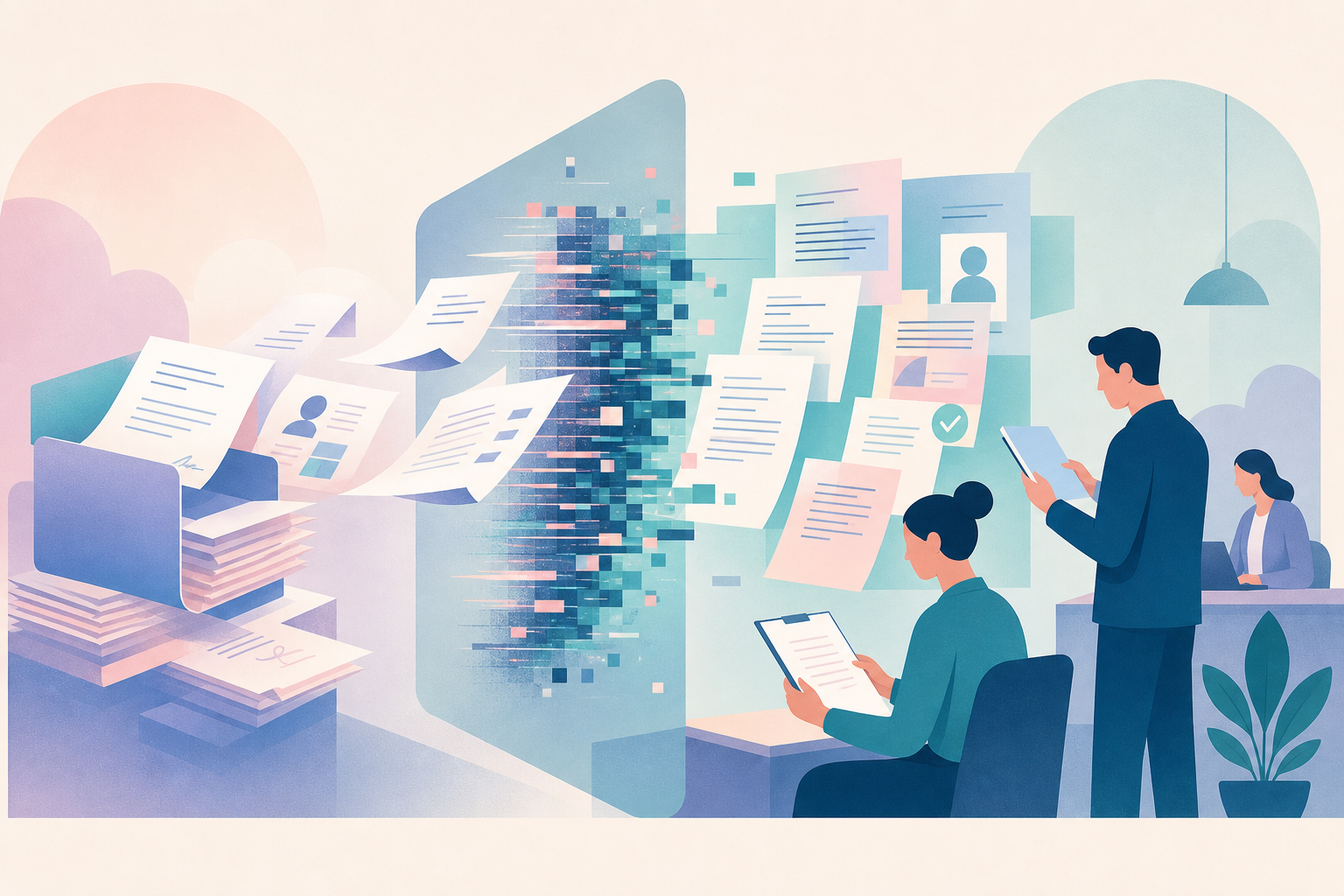
Across the enterprise landscape, insurance processing has frequently been framed as the textbook proving ground for artificial intelligence: high documentation volumes, structured forms, and standardized claims workflows. Yet frontline experiences paint a sharply contrasting picture. As detailed in a report by WIRED, insurance claims adjusters have emerged as the most vocal opponents of AI tooling within the American workforce.
A Record Disapproval: 98% Negative Reviews on Glassdoor
Research led by Glassdoor senior economist Chris Martin uncovered a striking anomaly: 98% of employer reviews authored by claims adjusters that mention artificial intelligence express negative sentiments. Employee feedback consistently cites top-down mandates enforcing immature software tools that generate operational friction rather than measurable productivity gains.
Adjusters report that rushed digital rollouts have fundamentally degraded daily workflows. Rather than focusing on nuanced risk assessments and policyholder communication, human specialists are increasingly forced to serve as cleanup crews for algorithmic misjudgments during intake, triage, and damage estimation.
Hallucinated Reports and Workflow Multiplication
The root cause of worker frustration is not generalized technophobia, but the concrete failure modes of generative models in high-stakes environments. Many carriers introduced AI systems during the First Notice of Loss (FNOL) stage, relying on large language models to synthesize incident reports and extract critical data from police filings.
When language models hallucinate non-existent details or misinterpret accident mechanics, errors propagate directly into policy files. Adjusters must manually review, reclassify, and reroute misfiled claims while managing escalations from policyholders and legal counsel baffled by inaccurate automated summaries. Instead of removing administrative burdens, unreliable automation has effectively multiplied repetitive manual checks.
Employment Contraction vs. Algorithmic Reality
This operational friction coincides with a sharp contraction in sector headcount across the United States. Bureau of Labor Statistics (BLS) figures show that claims adjusting employment dropped 21% between May 2025 and May 2026. Glassdoor data similarly indicates a 50% collapse in entry-level claims job postings over the past year.
The rapid rise of AI startups promising end-to-end claims reinvention and automated damage appraisal encouraged insurers to reduce staffing on the assumption of seamless algorithmic parity. However, the operational gap between theoretical benchmarks and real-world edge cases has sparked widespread "AI fatigue," leaving remaining staff stretched thin as they reconcile automated throughput with strict compliance requirements.
Mocchi's take
The backlash among claims adjusters illustrates a vital principle for technology leaders: deploying AI without deep domain-specific guardrails generates operational debt rather than compounding efficiency. Inserting probabilistic models into zero-tolerance enterprise workflows without rigorous deterministic checks or refined human-in-the-loop interfaces invariably shifts the cost burden onto frontline staff. For organizations modernizing complex operational pipelines, true leverage comes from augmenting domain experts with transparent, verifiable tooling—never from treating raw generative output as an autonomous substitute for specialist judgment.