Software · 18 September 2026 · 4 min read
Claude Code Relaunches Projects: Anthropic Brings Parallel Agent Teams to Git
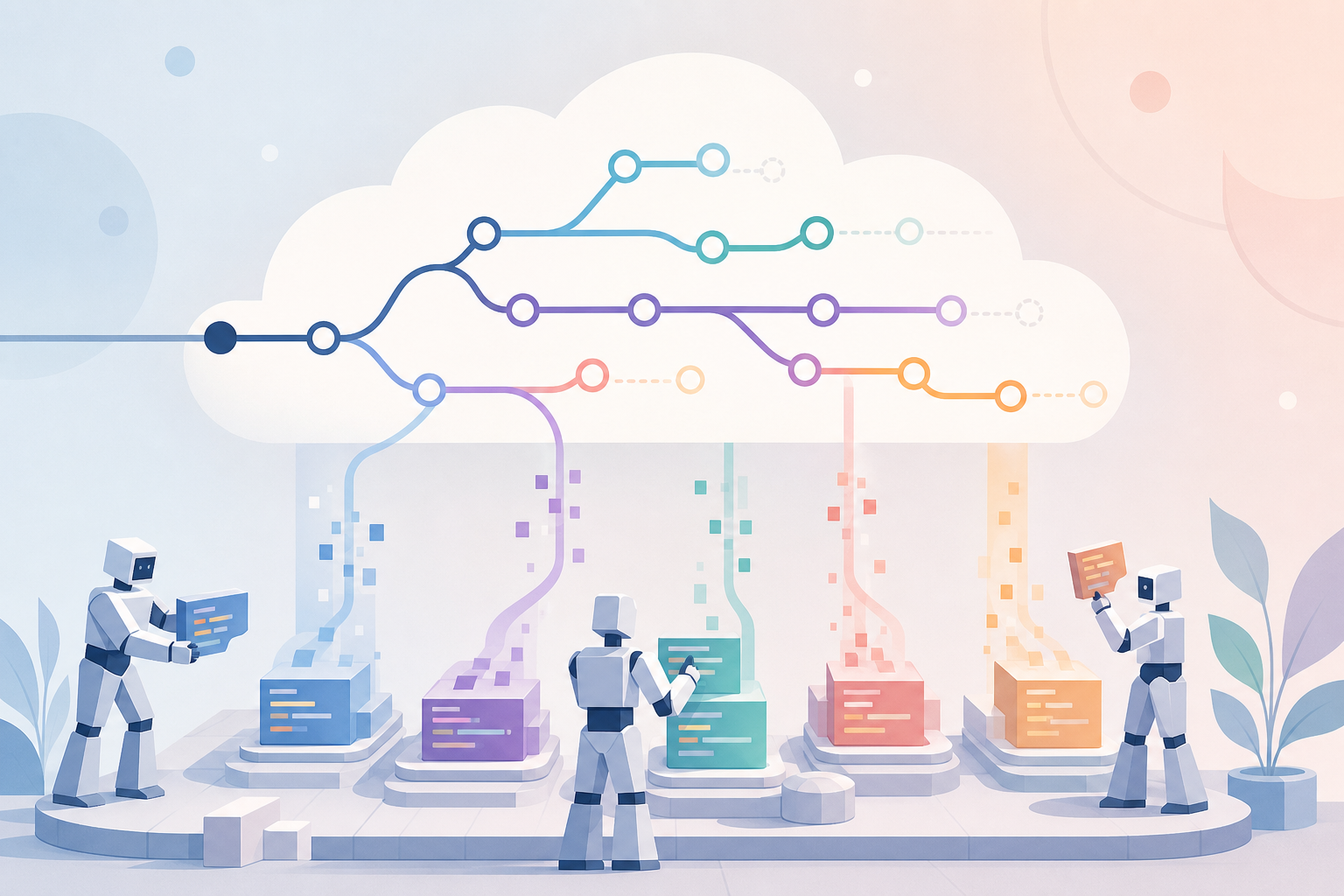
In brief: Anthropic has rolled out a completely revamped version of Projects for Claude Code, turning its programming assistant into a multi-agent development environment. Tasks are delegated across parallel cloud threads running on isolated copies of a repository, where a central coordinator guides execution and resolves overlapping code changes as native Git merge conflicts.
by Team Mocchi's
From Isolated Assistants to Collaborative Software Teams
Until recently, language-model-based coding tools operated almost entirely sequentially: a developer prompted the assistant, the model generated code snippets or edited a single file, and the cycle moved forward step by step. Anthropic's latest update to Claude Code aims to break this bottleneck by introducing concurrent execution patterns that mirror the operational flow of an engineering department.
The revamped Projects feature in Claude Code goes beyond storing shared prompts or chat histories. It coordinates entire clusters of specialized agents working within a single project workspace, equipped with shared memory, persistent project goals, and common artifact repositories.
Isolated Branches, Coordinators, and Merge Conflicts: How It Works
The architectural model behind this release represents a substantial shift from interactive scripting assistants. As reported by The Verge, every project runs parallel threads directed by a central coordinator agent:
- Independent cloud environments: Each thread runs as an isolated Claude Code cloud session, operating on its own Git branch and a distinct clone of the target codebase.
- Recursive delegation: Threads can spin off sub-agents, loops, and automated workflows to tackle complex assignments in parallel, such as generating test suites, modernizing legacy modules, or adjusting API endpoints.
- Native merge conflict resolution: When multiple threads touch overlapping areas of the codebase, execution does not halt; the system resolves the overlap just like standard pull requests and Git merge conflicts.
- Dual-layer oversight: Engineers can interact directly with individual threads or monitor macro-progress and update directives through the main coordinator dashboard.
Currently deployed in beta to select Claude Pro and Max subscribers, the update is slated to roll out to Team and Enterprise users soon, with Anthropic promising support for local tools in an upcoming release.
The Observability Challenge and Machine-on-Machine Supervision
The move toward asynchronous multi-agent architectures introduces an operational bottleneck: auditability. When dozens of agents execute tasks concurrently at machine speeds, manual line-by-line inspection becomes humanly impossible before code reaches production branches.
As highlighted in an analysis by TechCrunch, the industry is increasingly leaning on secondary AI layers to monitor and orchestrate primary agent behaviors. Anthropic's decision to anchor agent output within conventional Git semantics — relying on discrete branches, commits, and diffs — is a deliberate effort to tame agentic velocity through proven software engineering standards.
Mocchi's take
Anthropic's evolution of Projects inside Claude Code marks a definitive transition from experimental code completion to structured agentic software engineering. For development agencies and tech teams managing enterprise systems, this shift demands a strategic pivot: human engineering value will increasingly concentrate on system architecture, branch governance, and the rigor of automated testing suites rather than manual syntax generation. Without mature continuous integration pipelines and strict architectural boundaries, orchestrating parallel agent swarms will compound technical debt rather than accelerate reliable delivery.