Tech · 29 July 2026 · 4 min read
The Data Center Squeeze: Grid Power Cuts and Municipal Pushback
In brief: The physical expansion of AI data centers is colliding with hard infrastructure constraints. In the United States, the largest electrical grid operator announced plans to curtail power to hyper-scale facilities during peak demand to prevent blackouts. Simultaneously, local municipalities are issuing strict regulatory demands to protect host communities.
by Team Mocchi's
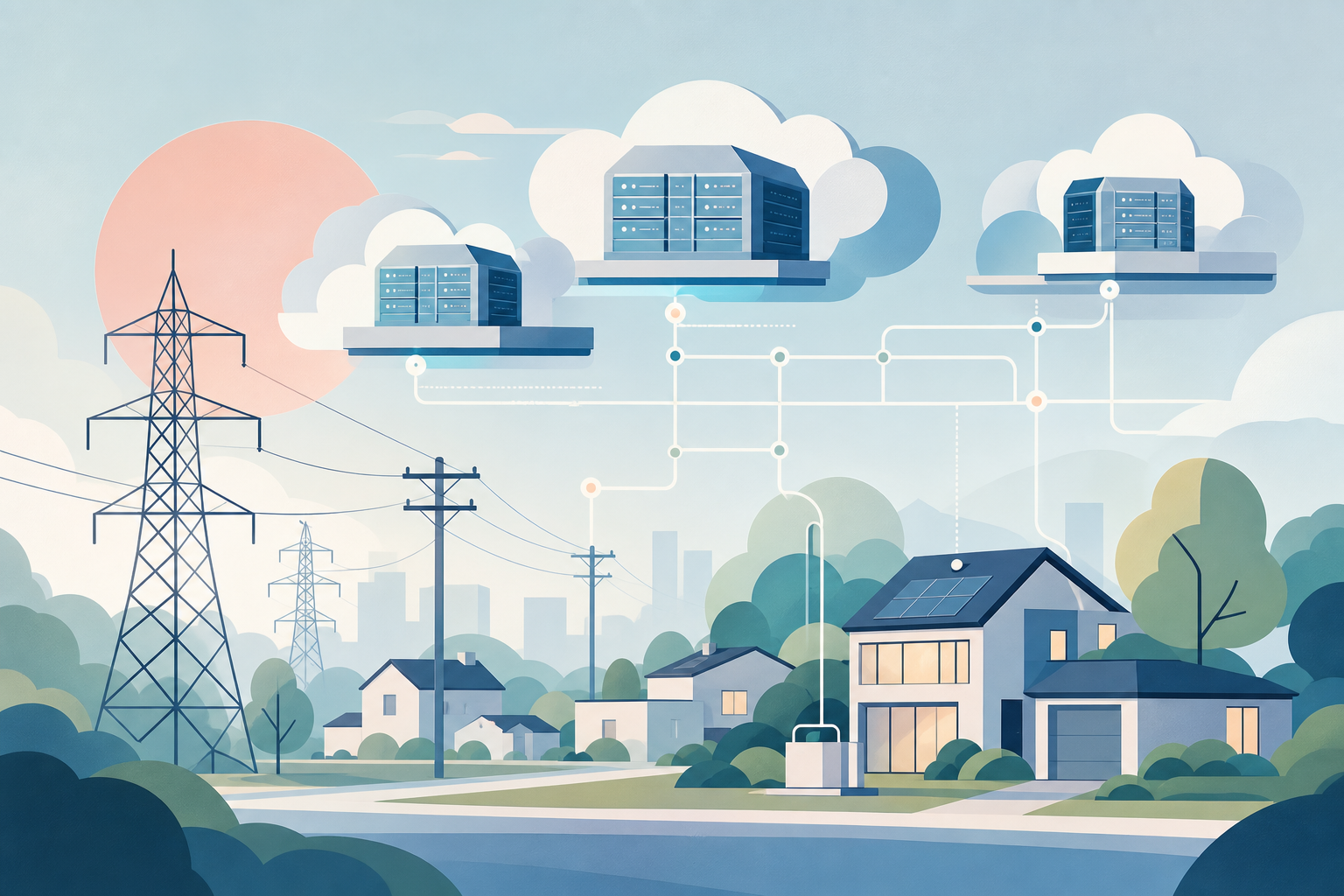
When Digital Ambition Meets Physical Infrastructure
The global race to train and deploy artificial intelligence models requires unprecedented amounts of electricity and land. While industry attention has long focused on chip availability and GPU supply chains, power grid limits and local zoning constraints are emerging as primary bottlenecks. Recent developments in the United States highlight a growing double squeeze at both the macro grid level and the micro municipal level, forcing tech companies to re-evaluate their expansion plans.
Scheduled Curtailments to Protect the Grid
At the systemic level, the operator of the largest power grid in the eastern United States, PJM Interconnection, has instituted a major policy shift. As reported by TechCrunch, the grid operator will begin curtailing power supplies to data centers rated at 50 megawatts or larger during emergency supply shortages starting in June 2027. The measure comes after power generation capacity auctions failed to keep pace with skyrocketing electricity demand driven by AI workloads, which are projected to quadruple by 2035.
While facility operators will receive advance notice and financial compensation through demand response programs, the operational hurdles remain substantial. Relying on backup diesel generators carries strict environmental usage limits—typically capped by federal rules at 50 hours per year for demand response events—forcing cloud providers toward on-site power generation and private microgrids to avoid service disruptions.
Municipal Barriers and the 43-Condition Ultimatum
While grid capacity represents a macro challenge, local community pushback poses an equally formidable barrier. Opposition from host municipalities is transitioning from informal resistance into structured local regulation. A prime example occurred in Pennsylvania, where, as detailed by Ars Technica, Plymouth Township issued a comprehensive 43-point conditional ultimatum to a proposed 2-million-square-foot data center on a former industrial site.
Rather than issuing an outright rejection, the town council published a nine-page list of mitigation requirements designed to safeguard residents. The conditions mandate rooftop acoustic walls, baseline and post-construction monitoring for low-frequency noise and vibration, electromagnetic shielding, water usage mitigations, and explicit tax guarantees. When the developer launched a legal challenge calling the demands overly burdensome, local officials countered that technological benefits cannot come at the expense of community health and well-being.
From Unchecked Expansion to Energy-Aware Design
This dual pressure signals a fundamental shift in cloud infrastructure. The era of building massive facilities with unchecked energy access and minimal local oversight is drawing to a close. Tech companies must now factor dedicated clean energy production, advanced low-power cooling systems, and transparent civic partnerships into their deployment strategies from day one.
Mocchi's take
At Mocchi's, we see this infrastructure bottleneck as a clear catalyst for algorithmic efficiency. For European and Italian businesses adopting or engineering AI systems, relying entirely on compute-heavy models hosted in energy-constrained foreign data centers introduces real supply and cost risks. The strategic path forward lies in adopting lightweight, specialized models, multi-cloud architectures, and edge computing. Engineering software that minimizes computational overhead is no longer just an environmental consideration—it is a core prerequisite for operational resilience and digital independence.