IA · 3 August 2026 · 4 min read
The Enterprise AI Deployment Paradox: Why Marc Benioff-Backed June Raised $20M to Automate Integration
In brief: AI adoption in large enterprises is hitting an unexpected bottleneck: integration with legacy software infrastructure. To solve this challenge, startup June emerged from stealth with $20 million in pre-seed funding backed by Marc Benioff, Michael Dell, and Aaron Levie. The company aims to develop autonomous AI agents that act as virtual forward-deployed engineers, automating the complex wiring between modern AI models and existing corporate databases.
by Team Mocchi's
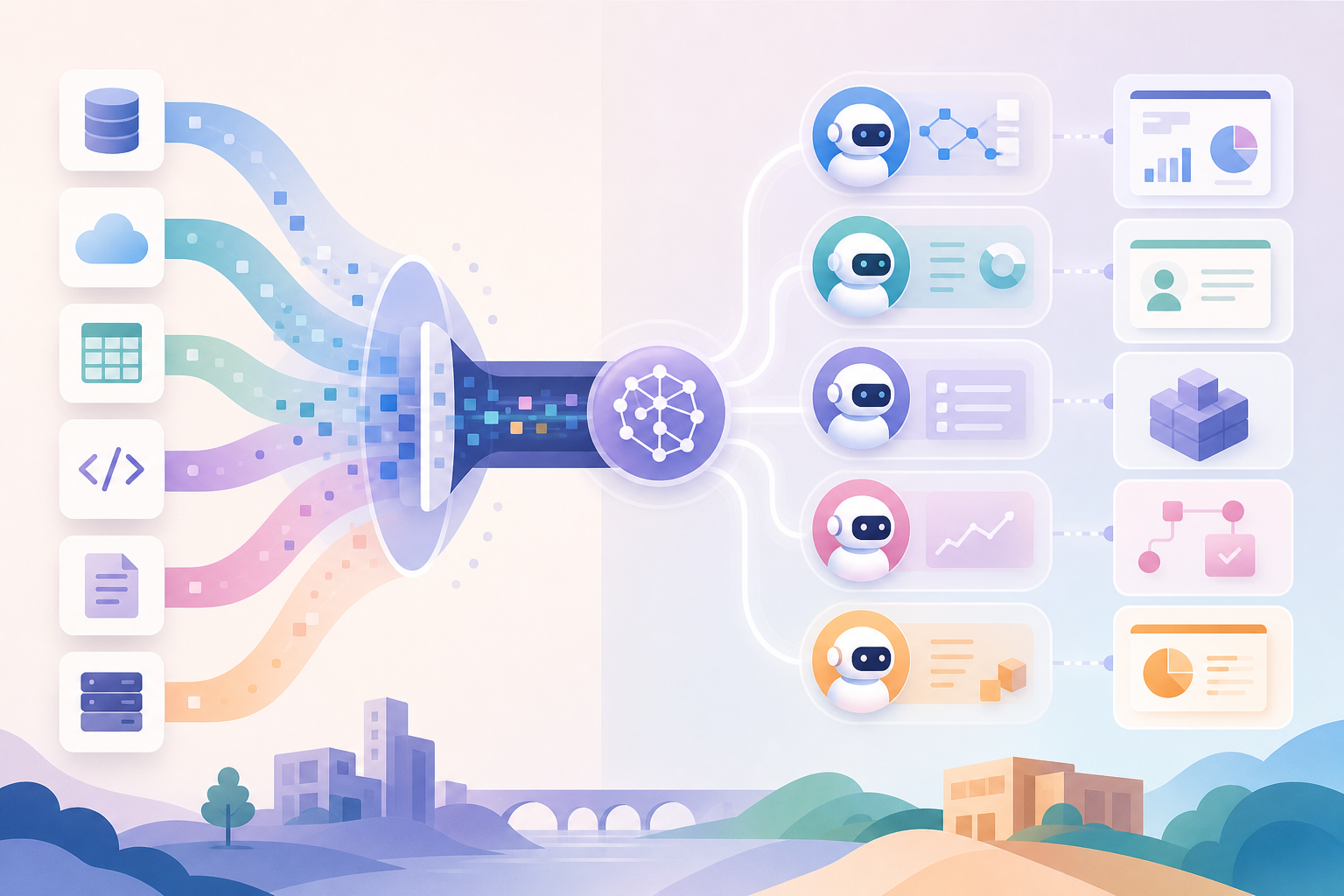
The rapid adoption of large language models across enterprise organizations has revealed an unexpected friction point: far from eliminating manual engineering, artificial intelligence is driving unprecedented demand for specialized integration personnel. While public attention focuses on conversational capabilities, corporate IT departments across Fortune 500 companies are struggling to connect advanced models with fragmented databases and legacy infrastructure built over decades.
To address this structural bottleneck, Israeli startup June emerged from stealth, announcing a $20 million pre-seed funding round led by Marc Benioff’s Time Ventures, with participation from tech industry figures including Michael Dell, Aaron Levie of Box, and George Kurtz of CrowdStrike.
The Integration Bottleneck and the Professional Services Boom
Extracting tangible value from AI in large corporate environments requires much more than simply connecting to a model's API. Algorithms must interact with enterprise data stored in entrenched systems such as Salesforce, Workday, Databricks, or ServiceNow, while navigating complex permission structures, non-standard workflows, and years of custom logic.
As reported by TechCrunch, this complexity has fueled a hiring boom for "Forward-Deployed Engineers" (FDEs)—specialized software developers embedded within client organizations to manually adapt and wire AI models into legacy platforms. Efrat Rapoport, co-founder and CEO of June and a former Salesforce executive, noted that the industry's default answer to AI implementation has been hiring ever-larger teams of human consultants, effectively turning software deployment into a continuous services expense.
Inside June: $20 Million Pre-Seed Without a Pitch Deck
June's four co-founders—Efrat Rapoport, Ohad Hen, Barak Goldstein, and Idan Tsitiat—bring extensive background in enterprise software. In 2017, they founded Bonobo AI, an early NLP conversation intelligence platform acquired by Salesforce in 2019. After spending years leading AI initiatives inside Salesforce, the team recognized that client adoption was consistently blocked by the friction of integrating AI with existing enterprise architectures.
The team's track record enabled them to raise $20 million before creating a formal pitch deck. June's thesis directly challenges the notion that generative AI will instantly displace core enterprise SaaS applications. In large enterprises, legacy databases and core business systems cannot be replaced overnight; AI tools must instead learn to interface with them automatically.
Autonomous Agents as Virtual Deployment Engineers
June's technical strategy centers on using artificial intelligence to solve its own deployment problem. The startup is developing autonomous AI agents designed to act as virtual forward-deployed engineers. These agents are trained to analyze corporate data schemas, map undocumented business workflows, build API integrations, and handle edge cases without requiring months of manual setup.
By automating metadata discovery and integration logic, June aims to eliminate the custom engineering tax that currently burdens enterprise AI projects. If successful, this approach could shift enterprise software engineering away from tedious API wiring toward high-level governance, security oversight, and architectural design.
Mocchi's take
For European enterprises navigating AI adoption, June's emergence highlights a critical reality: AI performance is strictly bounded by the underlying software architecture. In our experience, corporate AI initiatives rarely fail due to model limitations; they stall due to fragmented data schemas, legacy technical debt, and undocumented business logic. Before investing heavily in fine-tuned models or complex agentic frameworks, businesses must focus on modernizing core APIs and organizing enterprise data. Autonomous integration tools will significantly lower deployment barriers in the coming years, but clean software architecture remains the essential foundation for any scalable AI transformation.