IA · 29 June 2026 · 3 min read
The Rise of the Autonomous Office Robot: How Flexion Trains Humanoids Without Teleoperation
In brief: Swiss startup Flexion Robotics, founded by former Nvidia researchers, has unveiled a breakthrough technology that trains humanoid robots to perform complex office chores autonomously without teleoperation. By combining reinforcement learning in simulation with a master orchestrator, the hardware-agnostic system overcomes the fragility of traditional robotics, paving the way for flexible service robots in corporate environments.
by Team Mocchi's
The End of Choreography: Overcoming Teleoperation
Until recently, the vast majority of promotional videos showing humanoid robots folding shirts, organizing shelves, or smoothly navigating domestic environments hid a major secret: teleoperation. A human operator behind the scenes, equipped with motion-tracking suits or VR headsets, guided every single step and gesture of the machine. While visually spectacular, this approach has a major limitation: it does not scale. When a robot encounters an unfamiliar environment or an unexpected obstacle, the pre-programmed choreography breaks down, rendering the machine ineffective.
The Swiss startup Flexion Robotics, founded by former robotics research scientists, has presented a radical solution to this bottleneck. By introducing a new autonomous training methodology, the company demonstrated how a humanoid robot can complete complex office tasks without any remote human control or manual intervention.
A Three-Tiered Architecture for Physical Autonomy
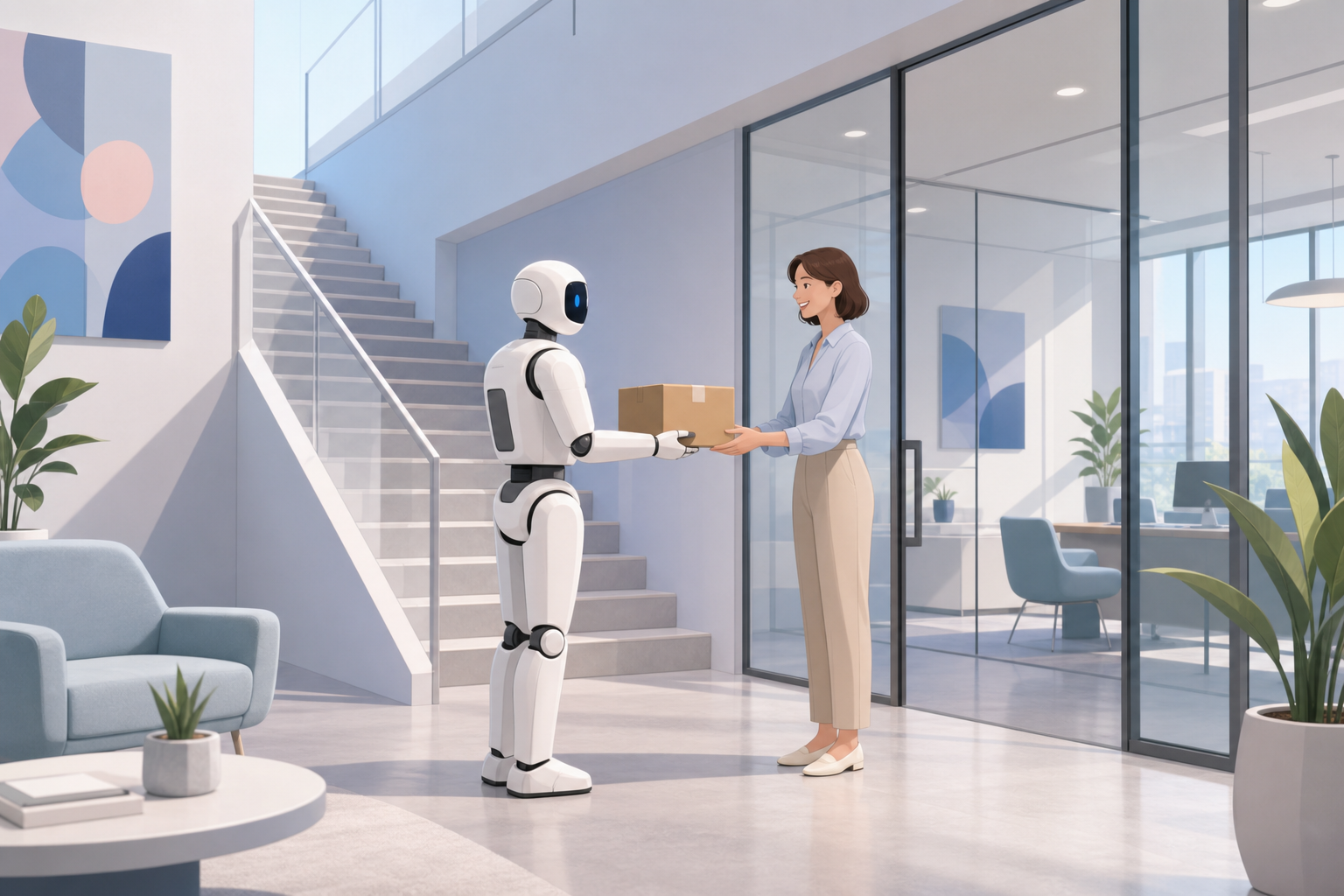
The company's live demonstration featured a humanoid robot receiving a natural language command: retrieve a newly delivered parcel of snacks from the mailroom, climb the stairs, ride the elevator, unpack the contents, and place them neatly into a kitchen drawer.
To execute this complex sequence, the technology does not rely on a single, monolithic model. Instead, it utilizes an integrated, three-tiered architecture trained entirely via reinforcement learning:
- The Orchestrating Model: A master AI algorithm that processes videos of humans performing similar physical actions to map out the logical sequence of required tasks.
- Simulation-Based Skill Mapping: The system breaks down the high-level objective into fundamental physical skills—such as stepping onto a stair, turning a door handle, or pressing a button—previously learned and perfected within a high-fidelity virtual simulation.
- Physical Motor Control: The low-level algorithm manages real-world physics, controlling joint motors, maintaining the robot's balance, and correcting its posture in real time on uneven surfaces.
This structure allows the machine to adapt dynamically. If the elevator is busy or a doorway is partially blocked, the robot does not freeze. Instead, it recalculates its trajectory and task sequence based on the behaviors it mastered in the simulator.
Software Defines Value, Hardware Becomes a Commodity
This development highlights a fundamental shift in the robotics industry: value is rapidly migrating from hardware to software. While the manufacturing of motors, structural frames, and actuators is reaching industrial standardization, the true competitive barrier lies in the operating systems and AI models governing these physical bodies.
Industry analysts estimate that the global market for robot foundation models could reach $150 billion over the next decade. Developing hardware-agnostic software is the cornerstone of this commercial strategy. The technology presented is not tied to a single robotic frame; it is designed to interface with various hardware platforms from different manufacturers. This flexibility accelerates commercial adoption, effectively transforming any mechanical body into an autonomous, task-capable agent.
New Horizons for Corporate Automation
Deploying robots capable of navigating and executing micro-tasks within office spaces and commercial facilities introduces entirely new possibilities for operational efficiency. Automation is no longer confined to industrial assembly lines behind safety cages. We are entering the era of flexible service robotics, capable of coexisting with human personnel in dynamic, unstructured environments.
For agencies designing advanced digital solutions, this milestone confirms that the convergence of high-fidelity virtual simulation and physical AI is the defining frontier of technology. The ability to seamlessly translate software commands into physical actions, while minimizing human supervision, will reshape how we design business workflows in the years to come.