IA · 21 October 2026 · 4 min read
From Inbox to Dashboard: Google Brings Gemini's Personal Intelligence to Cars
In brief: Google has begun deploying its Personal Intelligence features for Gemini inside vehicles, rolling out the update to Android Auto and preparing it for cars with Google built-in. The integration enables the assistant to pull real-time data across Gmail, Google Calendar, Google Photos, and search history to resolve travel queries and navigation destinations seamlessly. The move highlights Google's ecosystem advantage while putting renewed focus on privacy inside shared vehicle cabins.
by Team Mocchi's
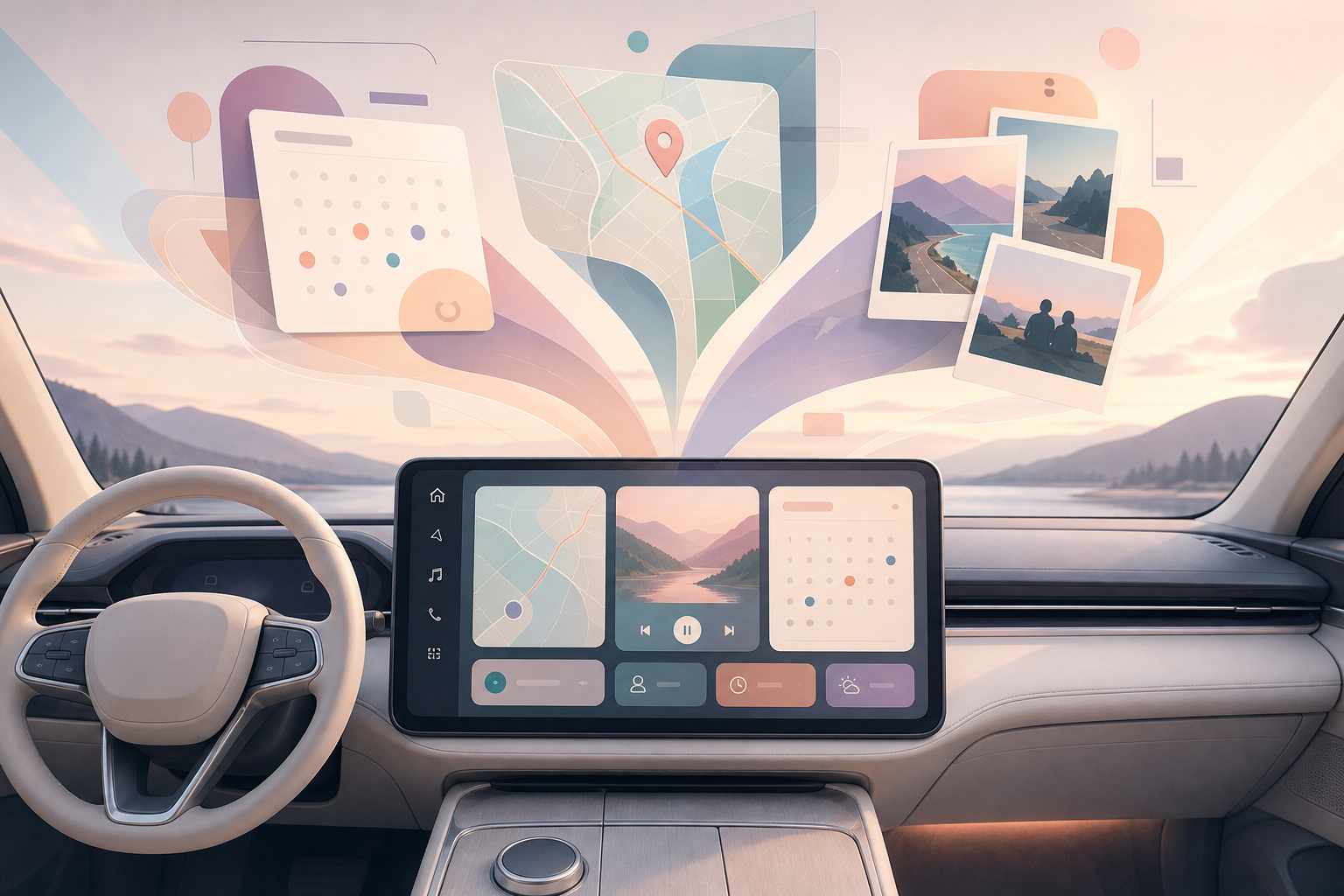
While the battle among frontier artificial intelligence models is often fought through synthetic benchmarks or software generation metrics, the real-world value of everyday AI is increasingly defined by reducing friction between disparate applications. Moving precisely in that direction, Google has announced the rollout of Personal Intelligence to automotive dashboards, enabling its Gemini assistant to tap into users' cloud-stored account data while driving.
Initially arriving on Android Auto and scheduled for rollout over the coming months to vehicles equipped with Google built-in—including models from Ford, GM, Honda, Nissan, Polestar, and Volvo—the system allows the voice co-pilot to cross-reference data from Gmail, Calendar, Maps, Photos, and YouTube, virtually eliminating the need for manual inputs or lengthy prompts while on the road.
Implicit commands: calendars, photos, and travel itineraries
The update centers on a clear concept: turning fragmented personal context into immediate, hands-free automotive navigation. As reported by The Verge, drivers no longer need to look up exact addresses before getting behind the wheel. Simply telling Gemini to «take me to my doctor's appointment» prompts the model to parse Google Calendar, identify the scheduled event, and pull down the relevant clinic location and appointment window.
Similarly, when heading toward an airport terminal, the assistant can surface flight updates directly from confirmation emails received in Gmail without requiring the driver to touch a screen. Multimodal retrieval extends into personal media collections as well: a request such as «navigate to the car wash from the photo I took last week» leverages visual analysis and embedded location metadata in Google Photos to extract coordinates and generate turn-by-turn directions.
Shared screens and the in-cabin privacy balance
This rollout underscores Mountain View's key architectural moat in the broader AI race: the sheer breadth and depth of personal context already sitting within its cloud services. As noted by Ars Technica, generative models perform significantly better when they already know who you are, bypassing the need for tedious prompt engineering. Yet porting personal correspondence and private photo libraries into an infotainment console introduces sensitive privacy questions.
Vehicles frequently transport colleagues, friends, or family members. Google has emphasized that Personal Intelligence remains an opt-in toggle within connected app settings and only surfaces personalized output when an authenticated smartphone is paired via cable or active Bluetooth. For vehicles running native Google built-in environments, personalization can be toggled off at the vehicle level. Still, users who consented to app integration on their mobile devices may find those preferences active on the road, making an audit of Workspace permissions prudent.
Mocchi's take
The arrival of Personal Intelligence in car dashboards illustrates that the most defensible moat in applied artificial intelligence is not raw parameter count, but frictionless access to an enterprise or personal data graph. For teams engineering software solutions and in-transit digital touchpoints, this shift establishes an undeniable baseline: end users will quickly reject systems that require manual data re-entry when that context already exists digitally. At the same time, expanding proactive agents into shared physical environments like vehicle interiors demands uncompromising, granular permission architectures—because the margin between seamless convenience and data overexposure has never been narrower.