IA · 31 July 2026 · 4 min read
Gemini Robotics 2: Google DeepMind's Push to Bring AI Into the Physical World
In brief: Google DeepMind has unveiled Gemini Robotics 2, a major upgrade to its embodied AI model that expands control from upper limbs to the full body of humanoid robots. Combining vision-language reasoning with spatial action models, the system enables robots to perform complex real-world tasks and coordinate multi-robot workflows. With this release, Google aims to establish Gemini as a universal operating system for physical robotics.
by Team Mocchi's
From digital screens to real-world movement
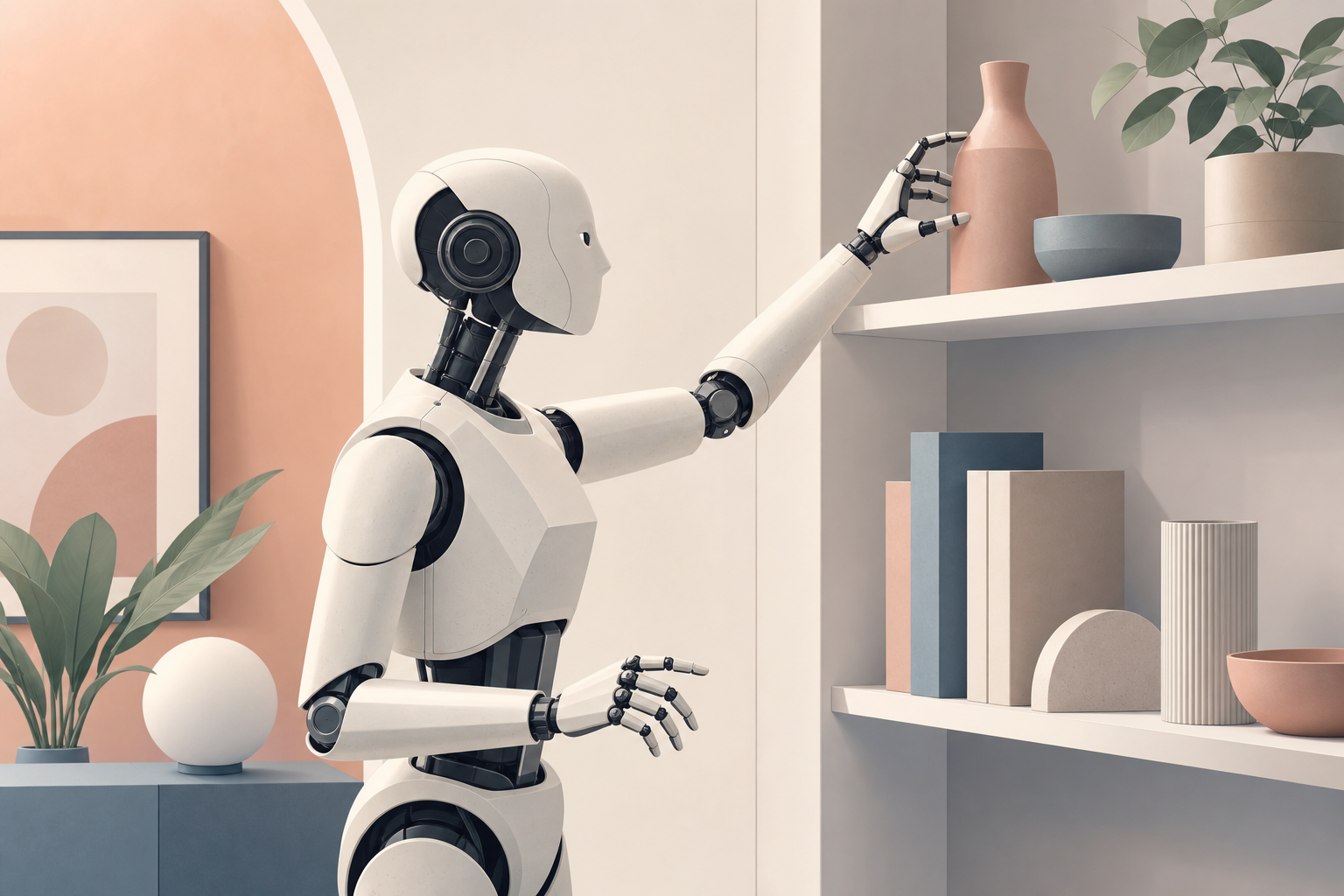
The evolution of large AI models is rapidly breaking out of text interfaces to confront the messy reality of physical space. Google DeepMind has officially announced Gemini Robotics 2, the next generation of its embodied artificial intelligence architecture designed to control robots in the physical world. While previous iterations focused primarily on upper-body mechanics and dual-arm manipulation, the latest update marks a major shift by orchestrating full-body humanoid movement "from feet to fingertips."
As reported by The Verge, the upgraded model enables complex whole-body coordination, allowing robots to walk, crouch, stretch, and perform multi-step physical tasks. In practical demonstrations, Apptronik’s Apollo 2 humanoid robot successfully bent down to pick up a watering can, retrieved specific items from storage shelves, and executed fine motor tasks such as unscrewing lightbulbs and tying trash bags using articulated five-fingered hands.
A three-tier architecture: vision, action, and edge execution
Under the hood, Gemini Robotics 2 relies on an integrated multimodal pipeline rather than a single monolithic model. In an in-depth report, WIRED details how the system combines three distinct layers: a Vision-Language Model (VLM) for contextual reasoning, Vision-Language-Action (VLA) models for spatial translation, and an optimized on-device model for edge execution.
The embodied reasoning component — named Gemini Robotics ER 2 — handles long-horizon task management by accurately discerning when complex physical workflows begin and end. This reasoning capability enables multi-robot coordination: in DeepMind's trials, an Apollo 2 humanoid directed a stationary dual-arm robot to sort tools into bins. Meanwhile, the lightweight On-Device model processes sensory input directly on local hardware without cloud connectivity, adapting quickly to different robot frames, sensor arrays, and degrees of freedom.
Safety frameworks and the "Android for robotics" vision
Deploying frontier AI into real-world physical environments elevates safety concerns far beyond traditional software sandboxes. Carolina Parada, head of robotics at Google DeepMind, emphasized that managing physical uncertainty requires layered safety guardrails embedded at every level of the AI architecture. To validate system behavior, Google introduced the ASIMOV-Agentic benchmark, which evaluates whether complex AI commands could trigger hazardous actions and enforces safe halts when humans approach.
Google CEO Demis Hassabis has articulated a long-term strategy to establish Gemini as the foundational operating system for physical robotics, echoing how Android unified the mobile hardware ecosystem two decades ago.
Mocchi's take
For software teams and industrial enterprises, the emergence of general-purpose embodied AI marks a fundamental shift from rigid automation to adaptive physical intelligence. Industrial robotics has historically been confined to deterministic, highly structured environments with custom programming for every single movement; Gemini Robotics 2 demonstrates that vision-language-action models can make physical hardware agile, context-aware, and collaborative. Moving forward, the competitive advantage for developers and tech providers will not stem from manufacturing custom robotics, but from building robust software bridges, domain-specific edge integrations, and safety layers that allow physical AI agents to operate alongside human workforces.