IA · 17 September 2026 · 4 min read
Google Home Opens to Autonomous Agents: MCP Brings AI Into the Living Space
In brief: Google has launched early access to a Model Context Protocol (MCP) server for Google Home, allowing third-party AI agents such as Claude, Hermes, and ChatGPT to interact directly with its smart home ecosystem. The integration lets autonomous agents analyze sensor history, query security camera feeds, and manage connected appliances while enforcing safety safeguards on critical hardware like smart locks. The release marks a significant transition for agentic software from code editors into physical environments.
by Team Mocchi's
From chat windows to physical switches
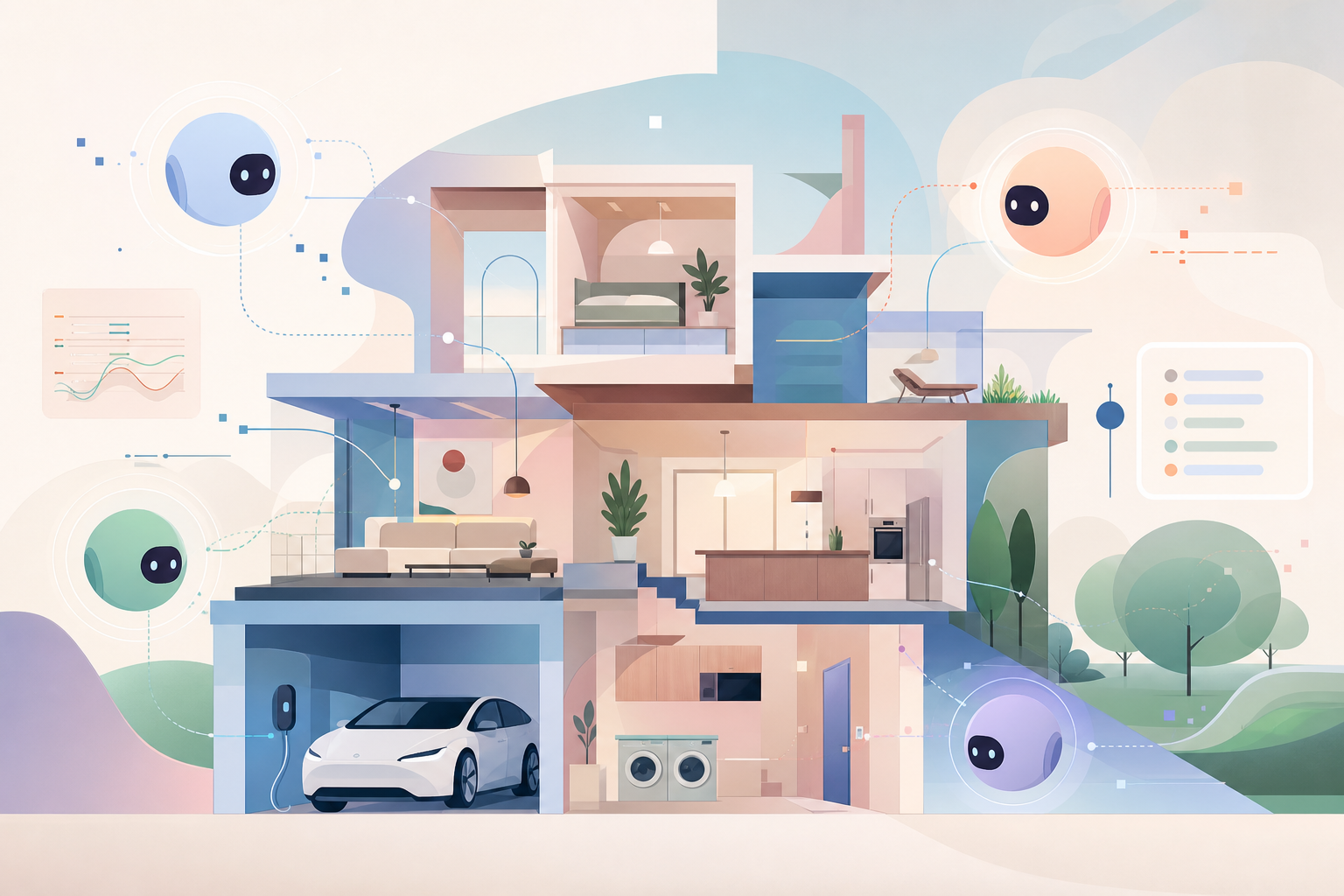
Until recently, autonomous artificial intelligence agents have largely been confined to code editors, terminal sessions, and enterprise data consoles. In an unexpected move, Google is bridging this analytical capability with the physical world by rolling out Model Context Protocol (MCP) support across its smart home ecosystem. The integration enables any external AI agent supporting the open standard — including Anthropic's Claude, ChatGPT, Hermes, or open-source tools like OpenClaw — to inspect device states, query telemetry, and trigger actions across connected household hardware.
As reported by The Verge, the MCP server does not replace Gemini for Home, which remains the default voice interface across Google Nest speakers. Instead, it adds a programmatic integration layer. Third-party agents can synthesize historical events and act autonomously: users can instruct an agent to inspect camera logs to verify when family members arrived, calculate appliance usage over the past month, or generate a tailored web dashboard to track energy consumption in real time.
Architecture and technical setup
The infrastructure relies on Mountain View's enterprise cloud tooling. According to details shared by TechCrunch, users configure a dedicated Google Cloud project and supply the Home MCP server endpoints to their agent of choice. Once permissions are confirmed via standard authentication flows, the agent gains structured access to devices registered in the Google Home ecosystem, including third-party hardware running on the Matter standard.
Beyond monitoring telemetry and issuing device commands, the protocol provides a direct audio return path: after completing an assigned workflow or noticing an anomaly, an agent can broadcast a spoken update through Google Nest smart speakers, establishing an uninterrupted feedback loop between cloud-based reasoning and physical living spaces.
Guardrails and subscription tiers
Granting probabilistic reasoning models direct control over physical actuators inevitably introduces safety risks. To mitigate unintended behaviors or prompt hallucinations, Google has established strict system boundaries: external agents are strictly barred from operating smart door locks, and cloud API rate limits are enforced. Ambiguous or out-of-bounds requests are dropped before reaching HVAC systems or major appliances.
Availability is initially constrained. Access is rolling out exclusively to Google Home Premium Advanced subscribers in the United States, priced at $20 per month or $200 annually. This premium tier bundles extended video event archives and rich descriptive alerts, providing the contextual depth an agent requires to run complex multi-step queries.
Mocchi's take
Google's decision to support MCP within its smart home footprint is a major milestone that reaches far beyond consumer gadgets. For software teams like ours designing custom AI architectures, watching a major platform embrace the Model Context Protocol confirms that open connectivity standards are outpacing proprietary walled gardens. For European businesses working in building management, industrial IoT, and hospitality, this development signals an impending shift: the primary interface for physical environments will no longer be a standalone dashboard, but an agent capable of interpreting heterogeneous signals across standardized APIs. However, rigorous safeguards remain essential: combining probabilistic LLMs with physical infrastructure demands hard deterministic boundaries to satisfy operational safety and GDPR compliance.