XR · 12 November 2026 · 4 min read
Back on Your Face: Google Debuts First Gemini Smartglasses Starting at $395
In brief: Google has officially opened preorders for its first generation of Gemini-powered smartglasses, developed in partnership with Samsung alongside eyewear brands Warby Parker and Gentle Monster, starting at $395. The lightweight, screen-free wearable adopts an audio-and-camera approach to challenge the market dominance of Ray-Ban Meta. To address privacy concerns rooted in the 2013 Google Glass backlash, the device includes mandatory recording LEDs and directional beamforming microphones.
by Team Mocchi's
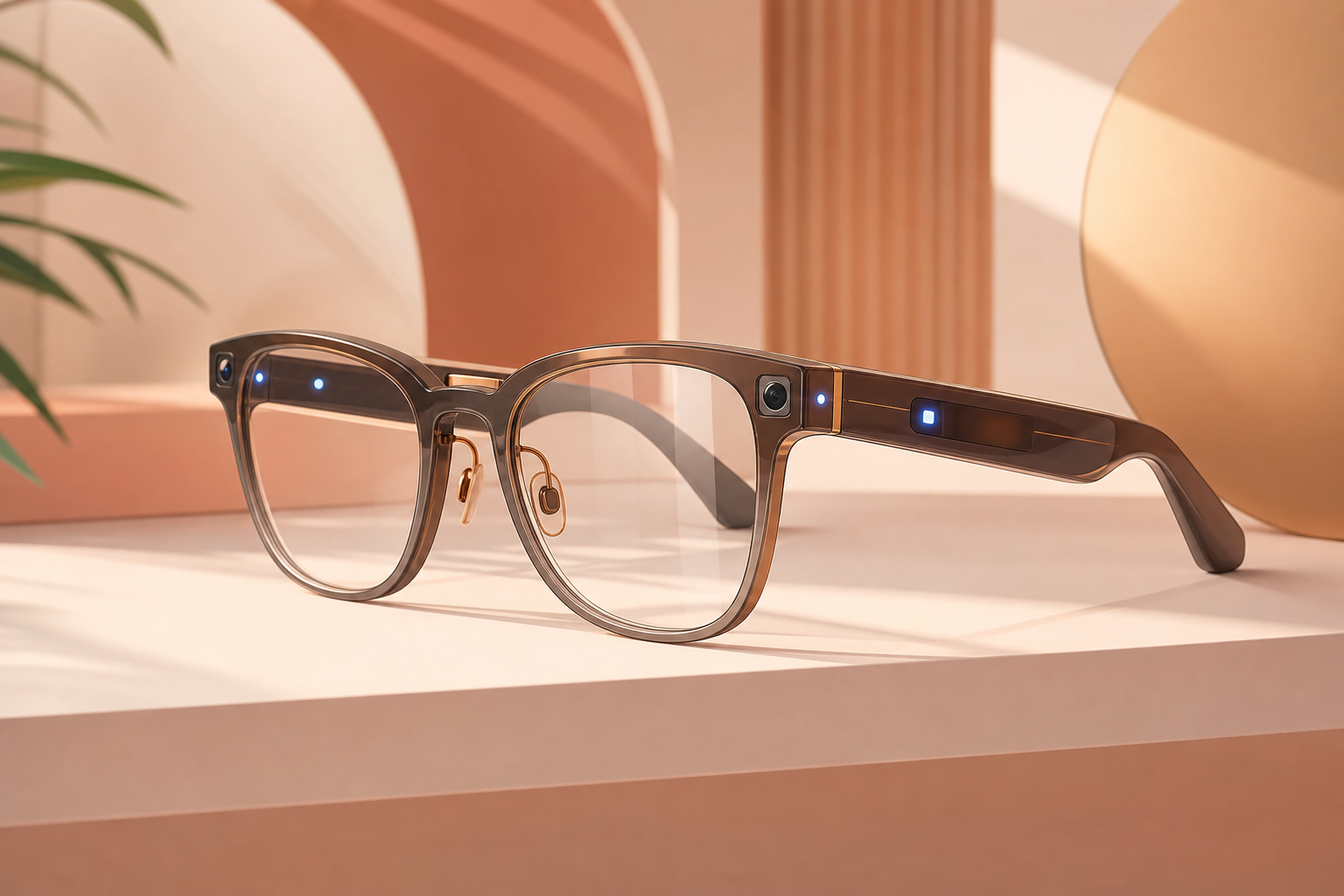
Fourteen years after the pioneering yet polarizing arrival of Google Glass, Mountain View is returning to smart eyewear. This time, there are no transparent display prisms or clunky frames tailored exclusively for early adopters: Google's new intelligent glasses are designed for everyday consumers, aiming to weave the multimodal Gemini assistant directly into daily routines. Preorders are now live, with base prices ranging from $395 to $449, placing the hardware in direct competition with Ray-Ban Meta's market dominance.
A four-way partnership bridging tech and fashion
Determined to avoid the aesthetic pitfalls of the past, Google assembled a four-party industrial collaboration. As reported by Ars Technica, the division of labor is sharply defined: Warby Parker and South Korean design house Gentle Monster crafted the frames, Samsung engineered the miniaturized computing platform housed within the temples, and Google supplied the full software ecosystem and artificial intelligence backend.
Warby Parker introduced three starting models—Alden, Reid, and Wren—available in Pine, Saddle, and Jet Black starting at $395 for the US market, with options for clear corrective lenses or sunglasses. Gentle Monster took a broader design approach with six distinct styles featuring clear, tinted, or polarized lenses starting at $449, distributed in the US and South Korea. Despite packing processors and sensor arrays, the frames weigh approximately 41 grams before prescription lenses are fitted, offering comfort comparable to traditional eyewear.
Gemini Live, computer vision, and no display screens
Architecturally, Google opted out of transparent displays or heads-up projectors inside the lenses. Interaction relies entirely on voice and touch, adopting the proven form factor that fueled commercial adoption across the industry. Users can wake the assistant with an "Hey Gemini" wake word or by tapping the capacitive touch strip built into the temple arm.
At the core of the device sits Gemini Live, deeply woven into Google's ecosystem. Equipped with a discreet front-facing camera and directional beamforming microphones, the model answers queries while observing the wearer's surroundings. It can scan book covers on a shelf to fetch critical reviews, read a live event poster to automatically populate Google Calendar, or stream turn-by-turn pedestrian routing via Google Maps through custom open-ear speakers positioned above the ear canals.
Confronting the Google Glass legacy on privacy
Public perception remains the most formidable barrier. Back in 2013, the presence of a wearable video sensor sparked severe backlash, earning early users the moniker "Glassholes" and prompting bans in movie theaters, dining establishments, and corporate offices. Google designed several hardware and software guardrails to defuse similar pushback.
A noticeable external LED indicator sits on the frame's front facet, hardwired to illuminate whenever the camera records or transmits data, preventing covert background capture. Acoustically, the microphone array uses beamforming algorithms calibrated strictly to the user's mouth, suppressing background conversations from bystanders. Google also confirmed that real-time visual streams handled by Gemini will not be retained to train facial recognition models, restricting frame persistence to the active query cycle.
Mocchi's take
The launch of Gemini smartglasses marks a decisive transition for wearable AI from bulky lab experiments to normalized enterprise-grade consumer accessories. For European technology teams, this convergence of featherweight frames and continuous multimodal intelligence presents immediate utility that easily outpaces heavier mixed reality headsets. In field operations—such as industrial maintenance, logistics scanning, and technical onboarding—hands-free contextual AI interaction offers substantial productivity dividends. However, software integrators must treat data governance as a cornerstone: routing audio and video telemetry captured on the move demands rigorous compliance with the GDPR and the European AI Act, particularly when deployed in shared workplaces or customer-facing environments.