IA · 31 October 2026 · 4 min read
Google Powers Up Its First Orbital AI Server as Project Suncatcher Takes Flight
In brief: Google has achieved a major milestone in Project Suncatcher, its experimental orbital compute mission. The prototype satellite powered up custom Tensor Processing Units (TPUs) in orbit to run the Gemma 4 model and transmit results back to Earth. The campaign aims to study chip survivability under space radiation and vacuum thermal stress, laying the groundwork for interconnected orbital AI nodes planned for 2027.
by Team Mocchi's
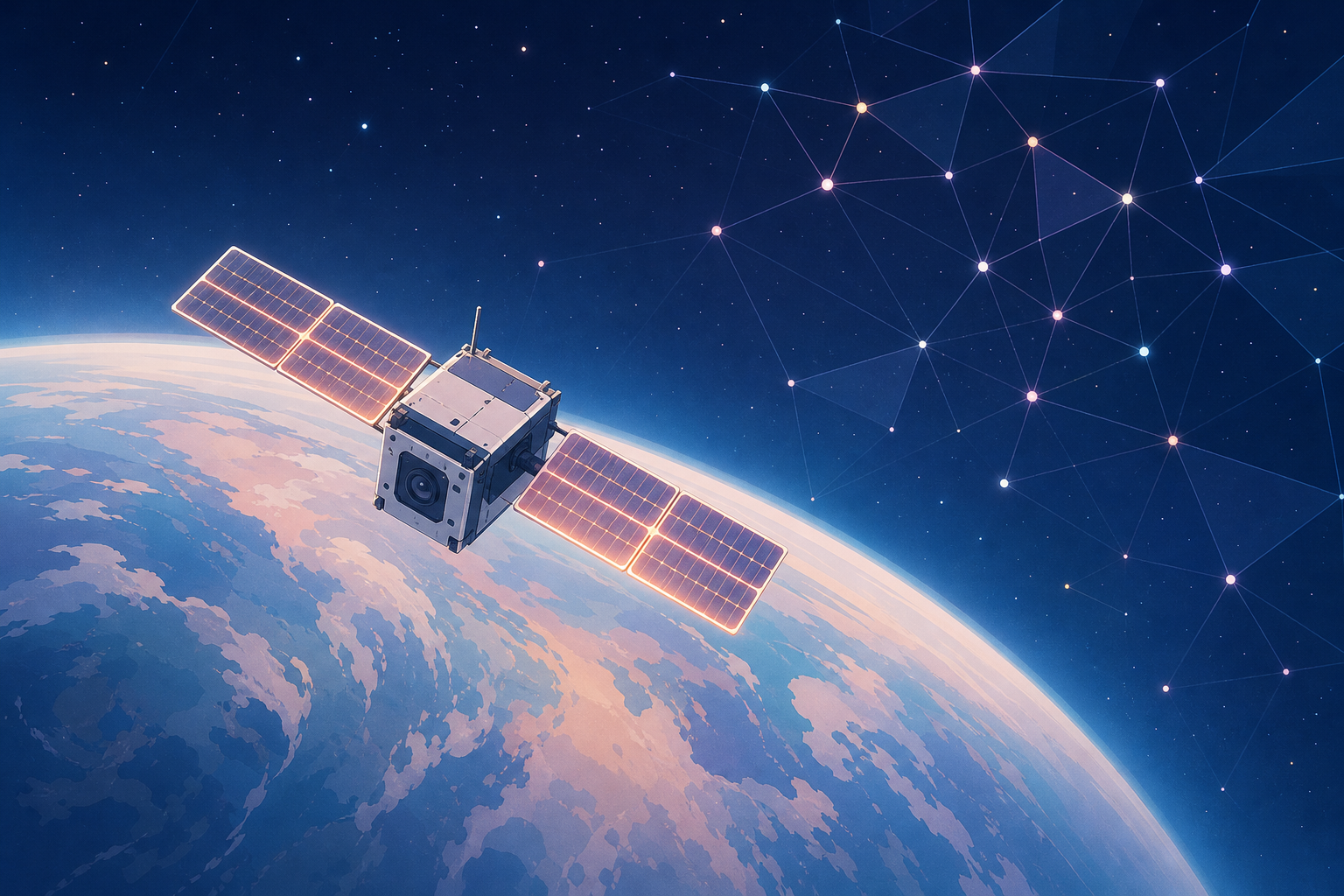
The compute demands of artificial intelligence have officially left Earth's atmosphere. Google has confirmed the operational debut of its prototype spacecraft developed under Project Suncatcher, an exploratory research initiative examining the feasibility of running generative model inference directly in orbit. Launched earlier this month aboard a SpaceX Falcon 9 rocket, the satellite spent three weeks in an orbital commissioning phase before executing its very first end-to-end inference workload commanded from the ground.
During this inaugural test, the satellite loaded Google DeepMind's open-weight model Gemma 4 onto its hardware to compose a brief poem about viewing Earth from orbit and return detailed telemetry data on surrounding space conditions. As highlighted by The Verge following confirmation by CEO Sundar Pichai, this transmission represents a critical proof-of-concept for the entire orbital loop: ground uplink, chip initialization, on-board inference execution, and downlink transmission.
Four TPUs in the vacuum of space
Traditional aerospace payloads rely on heavily radiation-hardened legacy processors operating at conservative clock frequencies. In contrast, Google's Suncatcher satellite carries four custom TPUs (Tensor Processing Units), similar to the accelerators deployed across its terrestrial hyperscale cloud. The vehicle's deployable solar arrays generate up to 1 kW of electrical power.
Yet, operating hyperscale silicon in low Earth orbit introduces severe physical constraints. According to reporting from TechCrunch, power delivery limitations mean the satellite can safely power up only a single TPU at any given time, restricting active compute bursts to roughly twenty minutes per session to align with power reserves and ground station visibility windows.
Conquering thermal dissipation and cosmic bit flips
For Google’s hardware engineers, the primary goal goes far beyond novelty prompts; it centers on measuring how advanced silicon holds up against the harsh environment of space. In orbit, computing systems must contend with two persistent hazards: the lack of air for thermal convection and continuous exposure to ionizing cosmic radiation.
Without an atmosphere, servers cannot rely on standard fans or ambient airflow to cool processors. All excess heat generated by the TPU core must be radiated away passively into the vacuum of space, necessitating specialized thermal interfaces to avoid destructive throttling. Simultaneously, the research team is evaluating the real-world frequency of radiation-induced bit flips (Single Event Upsets), which can alter parameters in high-density memory arrays and corrupt floating-point calculations.
Google indicated that testing will run continuously over the coming months to stress-test the hardware across varying orbital temperatures. The findings will directly feed into the next phase of Project Suncatcher in 2027, which aims to deploy twin interconnected satellites linked via optical inter-satellite links.
Mocchi's take
We see Google's space trial as a clear sign of the physical boundaries that generative AI is bumping against on Earth: when cloud giants explore orbital data centers to bypass terrestrial grid limits and water-cooling footprints, software engineering must reckon with real-world resource constraints. For European businesses and engineering teams, this reinforces that tomorrow’s competitive advantage will not come from brute-forcing compute, but from aggressive model optimization, edge efficiency, and lean architectures that maximize business impact within sustainable boundaries.