Tech · 17 November 2026 · 4 min read
More Electricity Than a Nation: Harvard Study Maps the True Footprint of AI Hyperscalers
In brief: A comprehensive study led by researchers at the Harvard T.H. Chan School of Public Health and published in Nature Sustainability has mapped 403 hyperscale data centers across the United States using satellite imagery and environmental datasets. The findings show an annual electricity demand of roughly 82 terawatt-hours—nearly 1.8 percent of all US electrical consumption—and a carbon footprint matching that of Denmark, countering claims that the digital transition is already largely decarbonized.
by Team Mocchi's
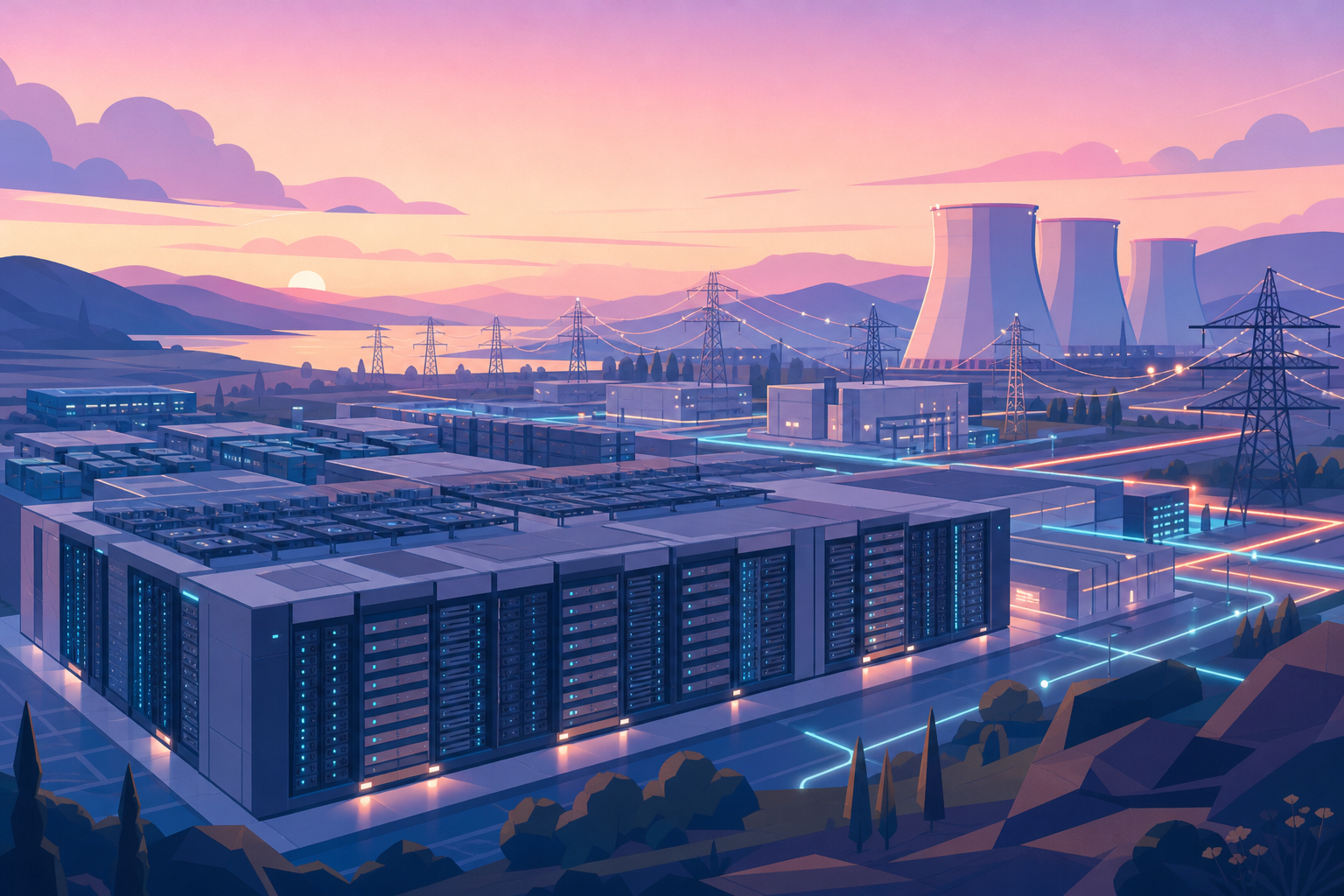
A satellite-driven survey of 403 cloud giants
Over the past two years, the global race to build, train, and run massive artificial intelligence models has driven an unprecedented construction boom. Cloud providers and technology enterprises have accelerated the deployment of hyperscale facilities, frequently securing high-capacity power interconnections under non-disclosure agreements and offering little transparency regarding actual power consumption. A peer-reviewed study led by Gianluca Guidi, a postdoctoral fellow at the Harvard T.H. Chan School of Public Health and published in Nature Sustainability, delivers the first systematic independent accounting of this infrastructure on American soil.
To overcome the lack of publicly available central registries, the research team correlated commercial real estate databases with high-resolution satellite imagery. From an initial pool of 675 candidate facilities, researchers validated 403 operational hyperscale data centers by verifying electrical substation equipment, structural footprint, and industrial cooling apparatus. As reported by Ars Technica, the methodology remains conservative: while the average capacity of the analyzed sites reached 40 megawatts, hundreds of secondary or early-stage development projects were excluded from the final sample.
Over eighty terawatt-hours and persistent fossil reliance
The resulting figures illustrate an infrastructure footprint of macroeconomic scale. Between May 2024 and April 2025, the 403 facilities consumed an estimated 68 to 99 terawatt-hours (TWh) of electricity, with a central baseline of approximately 82 TWh. This represents roughly 1.8 percent of all electricity used across the United States—an amount on par with the combined annual demand of entire states such as Wisconsin or Indiana.
According to analysis published by The Verge, that energy total exceeds the individual power consumption of more than 140 nations worldwide, including Austria, Israel, and Venezuela. By mapping each facility to local Environmental Protection Agency (EPA) grid emission factors, the authors determined that these data centers generated 25.7 million metric tons of CO2 during the twelve-month period—a carbon footprint comparable to the annual national emissions of Denmark.
The most sobering finding lies in the primary energy mix powering these sites: 54 percent of their electricity came from fossil fuels, predominantly natural gas along with coal units in regional transmission queues. Renewable energy accounted for just 25 percent of delivered power, while nuclear generation made up 21 percent. The installations were not concentrated in particularly green grid zones, tracking only marginally cleaner than the national US grid baseline.
Computational loads and grid limitations
The paper also highlights a critical structural difference in how modern compute loads interact with local utilities. While standard enterprise cloud workloads traditionally operate around 45 to 50 percent of a facility's nameplate capacity, dedicated AI training and inference clusters run closer to 70 percent on an uninterrupted basis. This constant, high-density draw leaves regional grid operators with shrinking reserve capacity and strained transmission lines built decades ago.
As John Sterman, director of the MIT Sloan Sustainability Initiative, pointed out regarding the findings, corporate climate pledges and power purchase agreements cannot undo near-term carbon output. Once released, greenhouse gas emissions cause irreversible atmospheric impacts. Without strict mandates requiring developers to bring dedicated, net-new zero-carbon generation online before powering up these compute clusters, surging AI demand risks sustaining aging fossil generation assets that would otherwise retire.
Mocchi's take
For European enterprises, this study delivers a sobering reality check as corporate sustainability reporting mandates like CSRD take full legal effect. When engineering or deploying artificial intelligence workloads, teams can no longer treat cloud backends as clean or immaterial abstractions. Prioritizing architectural efficiency, opting for compact specialized models over oversized general systems, and selecting cloud regions backed by verified low-carbon grids are no longer mere technical preferences—they are core operational responsibilities that directly impact compliance and enterprise emissions profiles.