IA · 29 August 2026 · 4 min read
Hugging Face Unveils Microduck: The Open-Source Robot Democratizing Physical AI
In brief: Hugging Face has introduced Microduck, an open-source bipedal robot priced at $399 and developed alongside its subsidiary Pollen Robotics. Featuring LiDAR, an onboard camera, and an embedded processor, the device enables developers to train behaviors in simulation and deploy them to hardware via reinforcement learning.
by Team Mocchi's
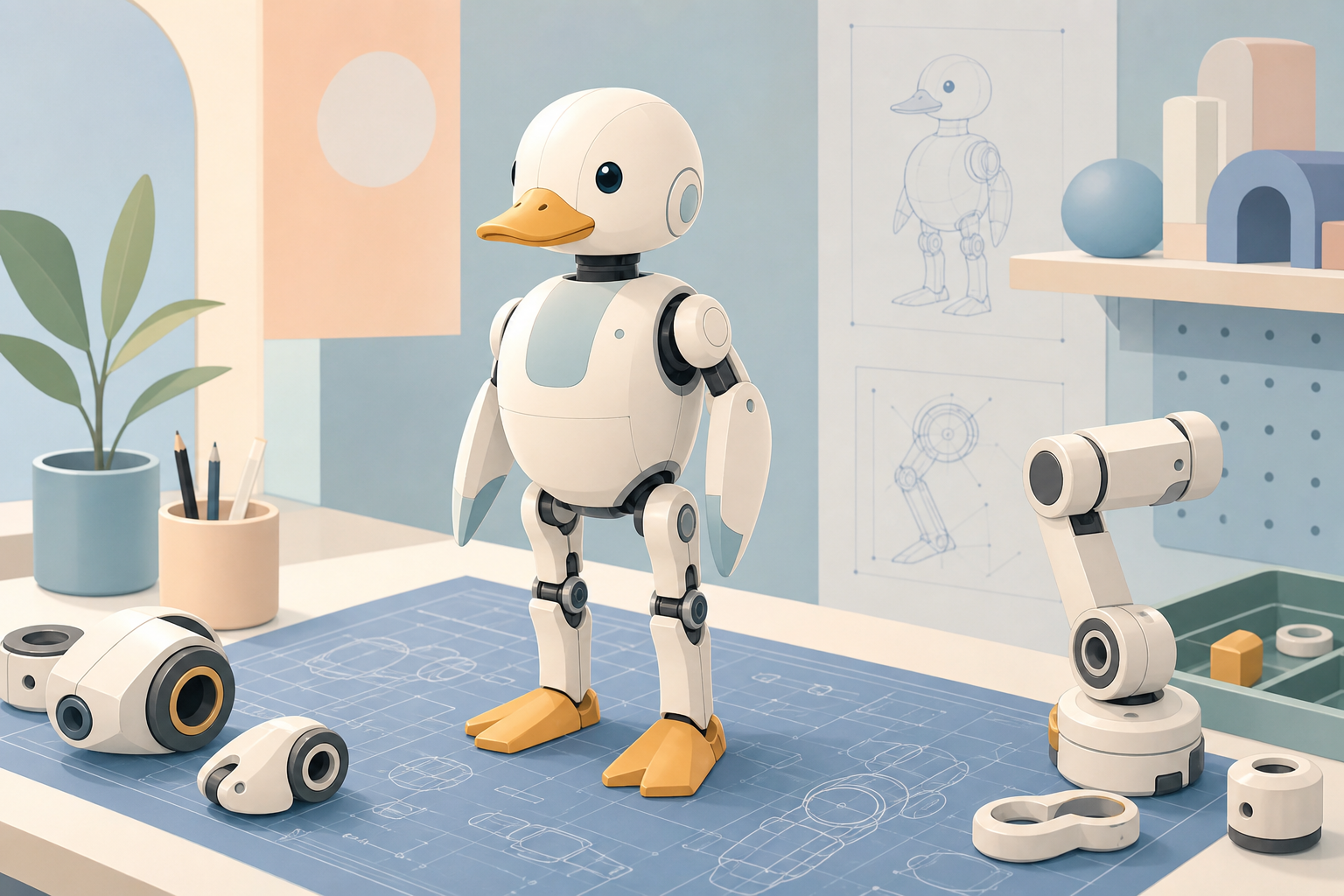
Stepping into the physical realm: Hugging Face's open hardware
Hugging Face, the primary hub for open-source AI models and datasets, is deepening its hardware footprint with the introduction of Microduck. Developed alongside its French robotics arm, Pollen Robotics, the 25-centimeter-tall bipedal robot is available for preorder at $399, with initial shipments planned before the end of 2026.
The launch highlights the growing industry pivot from purely digital language models to Physical AI and embodied intelligence. As reported by TechCrunch, CEO Clem Delangue aims to lower cost and complexity barriers, giving independent researchers and developers an accessible platform to experiment with world models and reinforcement learning.
Hardware specs and sim-to-real training
Despite its compact and playful appearance, Microduck includes a complete sensor and computing architecture. The robot is powered by a Rockchip RK3566 processor and features a camera, LiDAR sensors for spatial awareness, and dual inertial measurement units (IMUs) for balance. Articulated leg, neck, and head joints enable actions such as waddling, crouching, picking up objects with its beak, and righting itself after falling.
According to The Verge, the project's core strength lies in its fully open stack. Hugging Face has published the drivers, software SDK, simulation environments, and reinforcement learning code on GitHub. Developers can train control policies in virtual physics simulations at accelerated speeds and transfer them directly to the physical hardware, compressing iteration cycles that previously required custom test rigs. The robot also features procedural audio generation, giving each unit a distinct sound profile upon first activation.
Open source, security, and privacy
Deploying camera- and sensor-equipped autonomous devices in domestic and corporate environments raises valid privacy considerations. On this front, Hugging Face contrasts its open-source philosophy with the closed-ecosystem approach typical of mainstream consumer hardware.
Code transparency and local inference capabilities allow engineers to audit data pipelines directly, ensuring full control over what telemetry leaves the machine. This auditability is critical for academic labs, prototyping environments, and enterprise research units that must maintain tight control over sensory data.
Mocchi's take
The arrival of affordable, open hardware platforms like Microduck shifts the focus of AI development from screen-based models to embodied Physical AI. For businesses in automated manufacturing, logistics, and rapid prototyping, this democratization dramatically lowers the barrier to entry for testing neural network-driven control policies. Experimenting with sim-to-real workflows at minimal cost allows engineering teams to build hands-on expertise in kinematics, sensory integration, and spatial models, paving the way for full-scale industrial applications.