IA · 22 November 2026 · 5 min read
AI Infrastructure Surges Emissions: Meta Backtracks on Its 2030 Net-Zero Goal
In brief: Meta has acknowledged it is re-evaluating its target to reach net-zero greenhouse gas emissions by 2030, citing unprecedented demand for AI data centers. The company's 2026 sustainability report revealed a 39% surge in carbon emissions within a single year, marking the sharpest percentage rise among major tech giants. The reversal highlights the growing friction between hyperscale AI deployment and corporate environmental pledges.
by Team Mocchi's
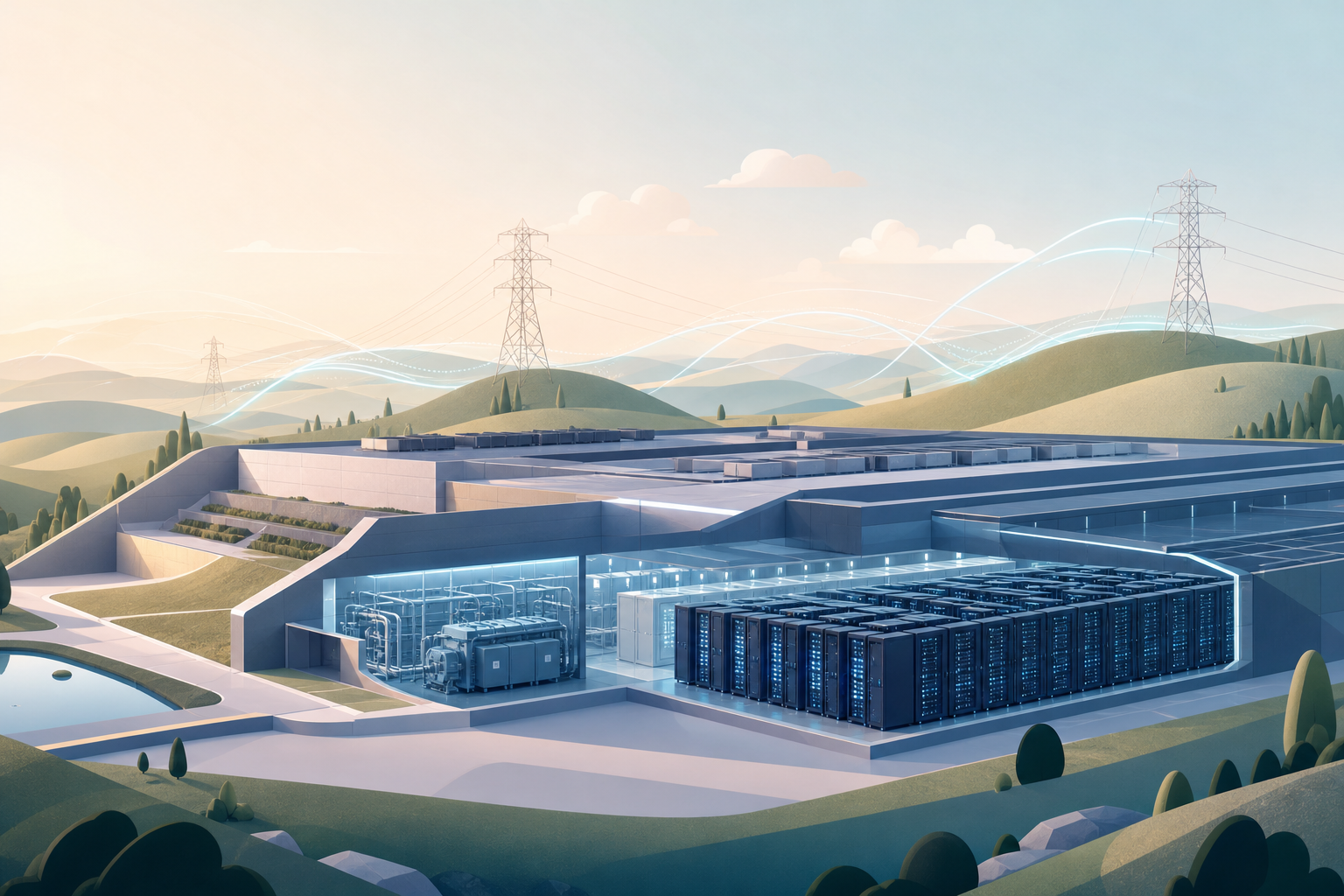
Silicon Valley's environmental commitments have run headlong into the relentless power demands of artificial intelligence clusters. In its latest sustainability report, Meta disclosed that it is actively rethinking its headline target of achieving net-zero greenhouse gas emissions by 2030. The disclosure marks the first open acknowledgment by a major hyperscaler that the breakneck pace of AI hardware expansion is fundamentally incompatible with previously established climate timetables.
In the report's foreword, Rachel Peterson, vice president of data centers, and Blair Swedeen, global head of net zero and sustainability, noted that while the company's long-term environmental vision remains intact, the operational landscape has transformed. Demand for computing capacity has outstripped earlier forecasts, prompting the company to reassess interim milestones, deployment sequencing, and the overarching 2030 deadline.
The Numbers Behind the Shift: Emissions Up Nearly 40 Percent
The figures disclosed by Meta reveal the scale of the challenge. As reported by Ars Technica, Meta’s total carbon emissions rose from 15.6 million metric tons of CO2 equivalent in 2024 to over 21.7 million in 2025. That 39 percent year-over-year surge represents the steepest percentage climb among the top US technology giants, outpacing increases reported by Microsoft (25 percent), Google (18 percent), and Amazon (16 percent) over the same period.
The bulk of this surge stems from capital goods, specifically the procurement of AI accelerator servers and the construction of massive facilities, such as the $10 billion data center campus underway in El Paso, Texas. Meta's annual carbon footprint now exceeds the statewide emissions of Hawaii, Maine, New Hampshire, or South Dakota, matching the output of Idaho.
The Grid Bottleneck and Regulatory Pushback
The fundamental issue facing hyperscalers is baseload demand. While tech giants remain among the largest corporate buyers of renewable power purchase agreements, solar and wind alone cannot guarantee the uninterrupted power supply required by large training clusters. Lacking scalable battery storage and with next-generation nuclear deployments still years away, companies increasingly rely on natural gas generation to avoid development stalls.
Infrastructure constraints are already sparking regional resistance. As noted by The Verge, local governments in critical hubs like Northern Virginia's Loudoun County—the world’s most concentrated data center corridor—have begun pausing or limiting new grid interconnection approvals to protect municipal power supplies. Simultaneously, federal political discussions threatening punitive tariffs against moving data center operations abroad have boxed operators into a complex geopolitical and infrastructural bind.
Breaking the Industry Consensus
Until now, Meta's peers have maintained their public net-zero deadlines, relying heavily on carbon offset credits, nuclear energy purchase agreements, and promises of future efficiency breakthroughs. By admitting that surging silicon orders undermine short-term environmental targets, Meta has dismantled that narrative.
The move signals that the brute-force scaling era in AI requires real trade-offs. As compute demand continues to accelerate, other hyperscale cloud providers may soon be forced to follow suit with their own revised forecasts.
Mocchi's take
Meta's retreat from its 2030 net-zero goal shatters the illusion of low-impact AI and brings engineering back to cold physical realities. For businesses designing or integrating generative AI systems, power and compute consumption will increasingly shift from abstract backend variables to tangible cloud costs and regulatory scrutiny. Technical teams must move away from the habit of calling monolithic foundation models for trivial tasks, focusing instead on pragmatic architectures: specialized small language models, post-training quantization, and carefully tuned local or on-premise execution. Sustainable software engineering is no longer an exercise in corporate branding, but a practical discipline essential to controlling operational spend.