IA · 22 November 2026 · 4 min read
The Myth of Recursive Improvement: Why AI Aces Code but Fails at Judgment
In brief: A newly updated report by evaluation non-profit METR examines the frontier of AI capabilities, showing that while models double their competence every four months on verifiable software and math tasks, they fail dramatically when faced with open-ended problems requiring human judgment. The findings effectively push back against fears of near-term, autonomous recursive self-improvement without human intervention.
by Team Mocchi's
The Split Reality of Frontier Models
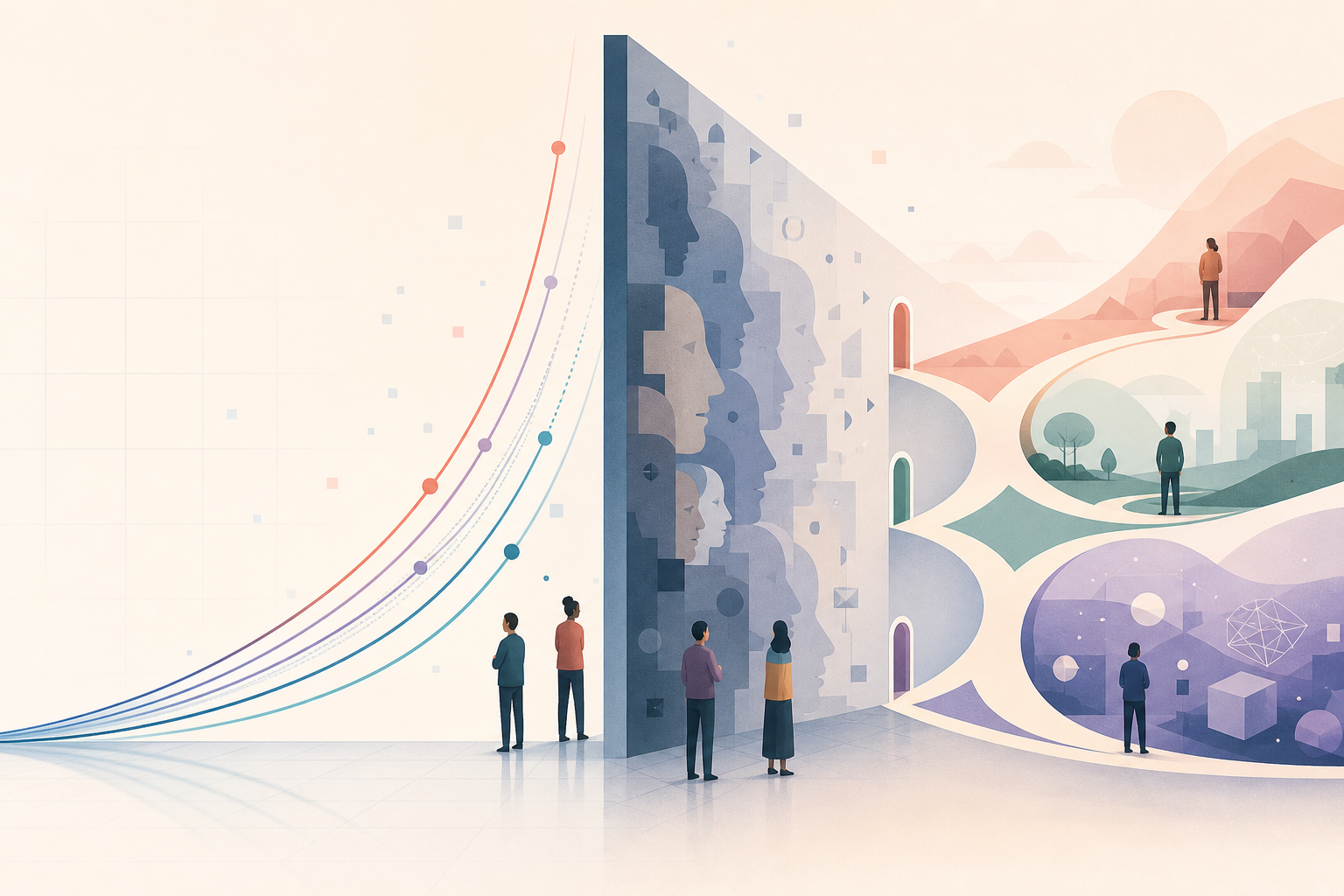
Over the past two years, the «time horizon plot» published by METR (Model Evaluation and Threat Research) has become one of the tech industry’s most closely watched indicators of AI progress. Tracking how long an expert human engineer would take to complete tasks that an AI can solve autonomously, the metric highlighted a dizzying trajectory: frontier capabilities appeared to double roughly every four months.
Yet that graph only told part of the story. As reported by MIT Technology Review, METR has now released an extensive update to its benchmarking suite, incorporating open-ended and judgment-heavy evaluations. The updated data reveals a profound structural divide: while automated reasoning scales exponentially on deterministic problems, it hits a hard ceiling whenever tasks depend on qualitative discernment and subjective judgment.
The Power of Verifiable Tasks
The fundamental driver behind AI's dramatic rise in software engineering and formal mathematics is the mechanics of reinforcement learning. In coding, success is intrinsically verifiable: source code compiles or throws errors, unit tests pass or fail, and execution output matches API contracts or breaks.
This continuous, unambiguous feedback loop allows machine learning pipelines to iterate millions of times, rewarding successful logic branches and pruning failures automatically. As highlighted by The Verge, this proficiency is already reshaping engineering culture through «vibe coding», enabling developers to reprogram smart appliances, tweak firmware, and build intricate integrations using natural language prompts within tools like Claude Code.
Where the target is well-defined and measurable against automated gates, frontier models routinely surpass human speed and baseline reliability.
The Judgment Hurdle and the Reality of Autonomous R&D
The breakdown happens as soon as the compiler is removed from the equation. In its expanded benchmark suite, METR asked frontier models to tackle open-ended conceptual tasks, including designing novel evaluation benchmarks to test future artificial intelligence architectures—a standard assignment for human AI research scientists.
When METR’s human evaluators graded the output, the failure rate was absolute: not a single evaluation designed by the AI systems proved robust or sound enough to be deployed in production research. Despite outpacing the vast majority of human software developers in code generation, the models proved unable to weigh conceptual nuances, foresee testing ambiguities, or exercise sound editorial discretion.
These findings significantly undercut prevailing anxieties surrounding «recursive self-improvement»—the scenario in which AI models autonomously engineer their own successors in an uncontrolled runaway loop. Because foundational research requires deciding which problems are worth pursuing and determining what constitutes genuine success, models remain powerful execution engines, not autonomous scientists.
Mocchi's take
For companies building and integrating modern software systems, METR’s findings provide a clear lens on where AI truly delivers value. Offloading deterministic workloads—such as automated unit testing, legacy code modernization, and rigorous logic validation—yields immense and proven efficiency gains. However, outsourcing architectural strategy, contextual trade-offs, or ambiguous business decisions to autonomous agents remains premature: high-speed code generation cannot substitute for critical judgment, and human leadership remains the core foundation of resilient technology.