Tech · 28 June 2026 · 3 min read
The Memory Gold Rush: Why Micron is the New Powerhouse in the AI Hardware Race
In brief: In recent trading sessions, Micron saw its valuation hit $1.27 trillion, briefly surpassing Meta and Tesla. This surge underscores a major pivot in the tech sector: as GPU compute demand continues, High-Bandwidth Memory (HBM) has emerged as the critical physical bottleneck for training and deploying frontier AI models.
by Team Mocchi's
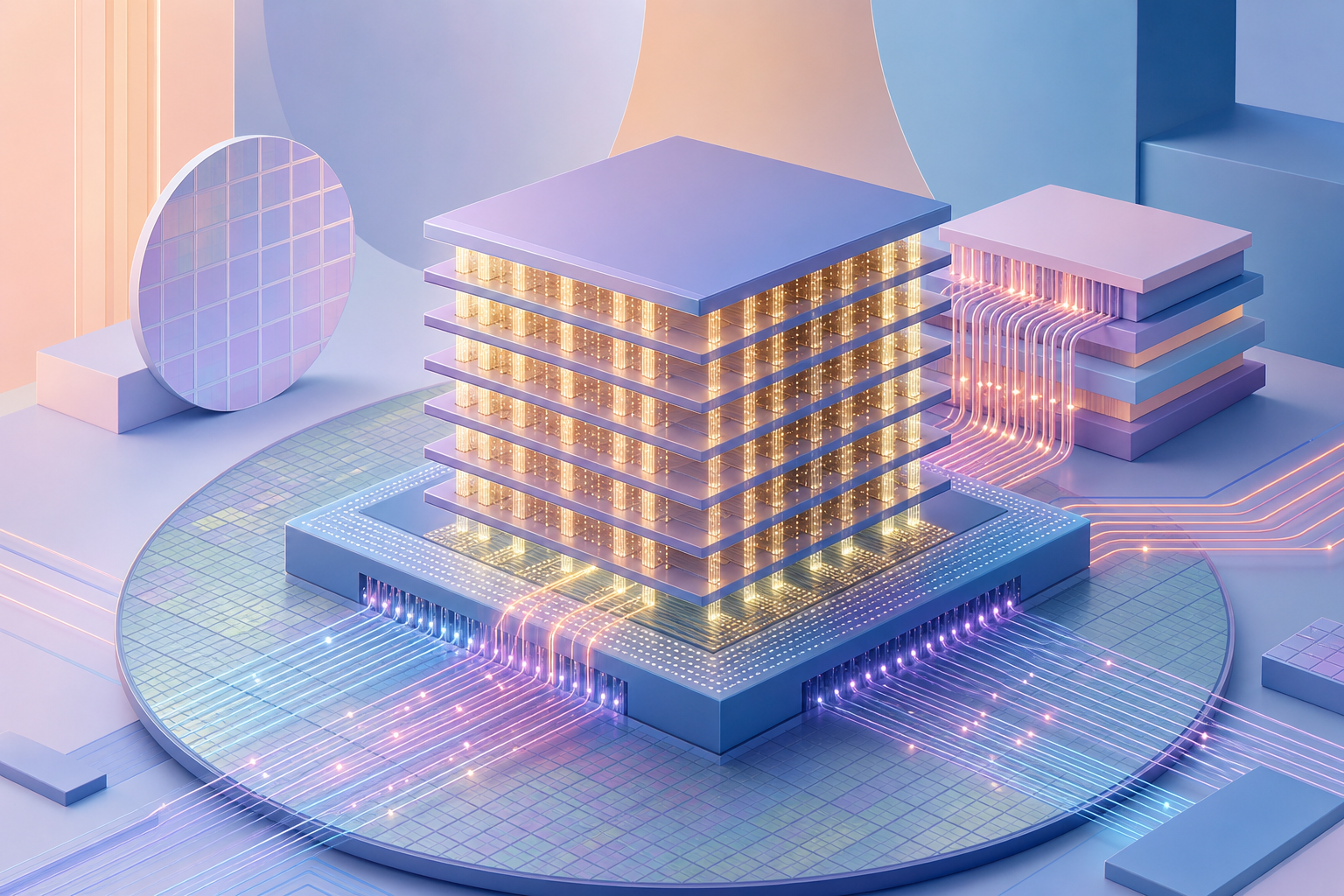
The New Titan of Artificial Intelligence Hardware
The artificial intelligence gold rush has found a new key player. In recent hours, stock market dynamics have consolidated a radical shift in the balance of power in Silicon Valley: a prominent American memory chip manufacturer, historically associated with consumer-grade storage cards and PC RAM, briefly surpassed the market valuation of tech giants like Meta and Tesla, reaching a market capitalization of $1.27 trillion. With a stock price surging more than 236% in the last month alone to trade above $1,100, this meteoric rise highlights a fundamental transition in the market.
While the initial phase of generative AI expansion was dominated by pure processing chips (GPUs), the current phase is clashing against a physical bottleneck: the speed at which data can be fed into these computational engines.
Breaking Through the "Memory Wall" with HBM
The primary performance bottleneck in modern supercomputers built for training and running large language models (LLMs) is known in the industry as the "memory wall." Even the most advanced graphical processors can sit idle if they do not receive data quickly enough to sustain their massive computing capacity.
The solution to this challenge lies in High-Bandwidth Memory (HBM). Unlike traditional RAM, HBM stacks memory dies vertically and connects them directly to the main processor using high-density, ultra-thin interfaces. By placing the memory stacked units on the same substrate as the GPU, physical distances are drastically reduced, which minimizes latency and multiplies bandwidth. A single AI server demands orders of magnitude more high-performance memory than any traditional server or consumer device, making HBM the ultimate enabling technology for next-generation intelligence.
Hyperscalers Trigger a Supply Chain Squeeze
The global shortage of these specialized components has triggered an aggressive hoarding campaign. Large cloud service providers (hyperscalers) and major AI labs are securing entire production runs years in advance to guarantee the operational continuity of their infrastructure.
This intense competition is not confined to high-end data centers; it is rippling across the entire consumer electronics industry. Fearing prolonged lead times and rising costs, traditional manufacturers of enterprise servers, PCs, and mobile devices have also begun stockpiling standard DRAM and NAND memory. This double-digit increase in demand has put unprecedented pressure on the global supply chain, with memory manufacturing facilities operating at maximum capacity.
Geopolitical Advantages and the Horizon Ahead
In this high-stakes landscape, geography is becoming a decisive asset. While competing with established South Korean giants, the domestic US manufacturer holds a distinct geopolitical advantage, especially amid Western initiatives to onshore critical semiconductor manufacturing. Western tech giants and government agencies are increasingly prioritizing supply chain resilience, driving a preference for domestic production partners to avoid East Asian geopolitical choke points.
Whether this extraordinary demand will remain stable in the long run or eventually lead to overcapacity once initial infrastructure buildouts normalize remains an open question. However, current global expansion plans suggest that the appetite for high-performance memory is far from being satisfied. For any company aiming to build or run frontier AI models, securing access to state-of-the-art memory has officially become the new strategic imperative.