IA · 28 July 2026 · 4 min read
Microsoft Launches MAI-Cyber-1-Flash and Perception: The Autonomous Agent Push in Cybersecurity
In brief: Microsoft unveiled MAI-Cyber-1-Flash, its first domain-specific AI model dedicated to code vulnerability analysis, alongside Project Perception, an autonomous agent platform for enterprise cyber defense. The suite claims top scores on industry benchmarks while cutting operational costs substantially.
by Team Mocchi's
A Vertical Model Built for Code Defense
At an event in San Francisco, Microsoft announced the launch of its first artificial intelligence model engineered specifically for cybersecurity: MAI-Cyber-1-Flash. Built on the MAI-Thinking-1 platform, the compact LLM was developed to analyze complex codebases, discover software vulnerabilities, and generate automated code patches.
Unlike general-purpose models fine-tuned for security, MAI-Cyber-1-Flash draws on Microsoft's extensive telemetry, which processes over 1 trillion security signals per day across 1.6 million enterprise customers. The initiative aims to equip enterprise defenders with automated tools capable of countering AI-driven cyber threats at matching speed and scale.
CyberGYM Benchmarks and the MDASH Integration
The new model makes its debut inside MDASH (Multi-model Agentic Scanning Harness), an agentic framework introduced earlier this year to scan software applications for exploitable bugs. In internal benchmarks, pairing MAI-Cyber-1-Flash with GPT-5.4 within MDASH yielded a 96% score on CyberGYM, widely viewed as the gold standard benchmark for cyber AI evaluation.
As reported by TechCrunch, Microsoft AI CEO Mustafa Suleyman emphasized that these results outperform frontier models including Anthropic's Mythos 5, Google Gemini, and OpenAI's GPT lineup. Beyond accuracy gains, Microsoft claimed the updated harness slashes operational execution costs by half compared to previous iterations.
Project Perception: Red, Blue, and Green Agent Squads
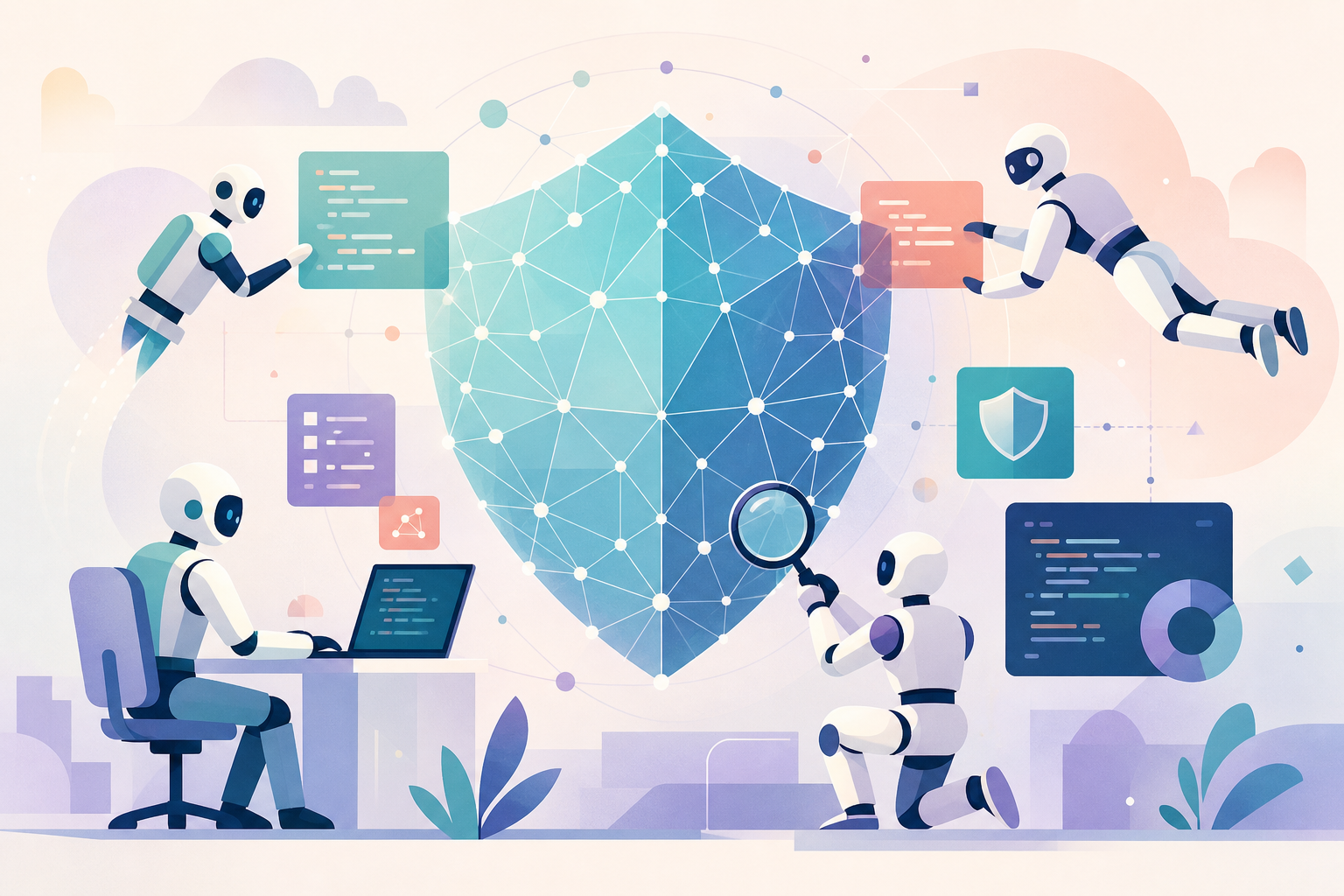
Alongside the specialized model, Microsoft introduced Project Perception, an autonomous multi-agent platform designed to orchestrate defensive security workflows. The system delegates tasks across three dedicated agent squads:
- Red Teams: simulate complex attack vectors to map vulnerability surfaces before adversaries exploit them;
- Blue Teams: evaluate real-time risks and work to contain active threats;
- Green Teams: generate, verify, and apply corrective code patches.
As noted by Ars Technica, Project Perception dynamically routes tasks to the most cost-effective model, handling an estimated 90% of routine security operations at a fraction of standard costs while reserving frontier models for edge cases.
Mocchi's take
The arrival of domain-specific, low-cost AI models for cybersecurity marks a pivotal shift for enterprise software architectures. For businesses looking to secure modern applications, automating vulnerability discovery through autonomous agent teams significantly shortens remediation windows, addressing persistent talent shortages in security engineering. However, deploying autonomous agents directly onto codebases requires strict governance: delegating bug identification and patching to algorithms is only effective when paired with human audit oversight and disciplined integration into existing CI/CD pipelines.