Tech · 4 July 2026 · 3 min read
From Pixels to Ultrasound: Midjourney's Bold Hardware Gamble in Wellness Scanning
In brief: Midjourney Medical has detailed its 3D ultrasound immersion scanner prototype. Aimed at spas as a wellness product to bypass lengthy regulatory approvals, the device promises affordable, radiation-free body mapping, though biomedical imaging experts remain highly skeptical about its physical feasibility and AI-driven reconstruction.
by Team Mocchi's
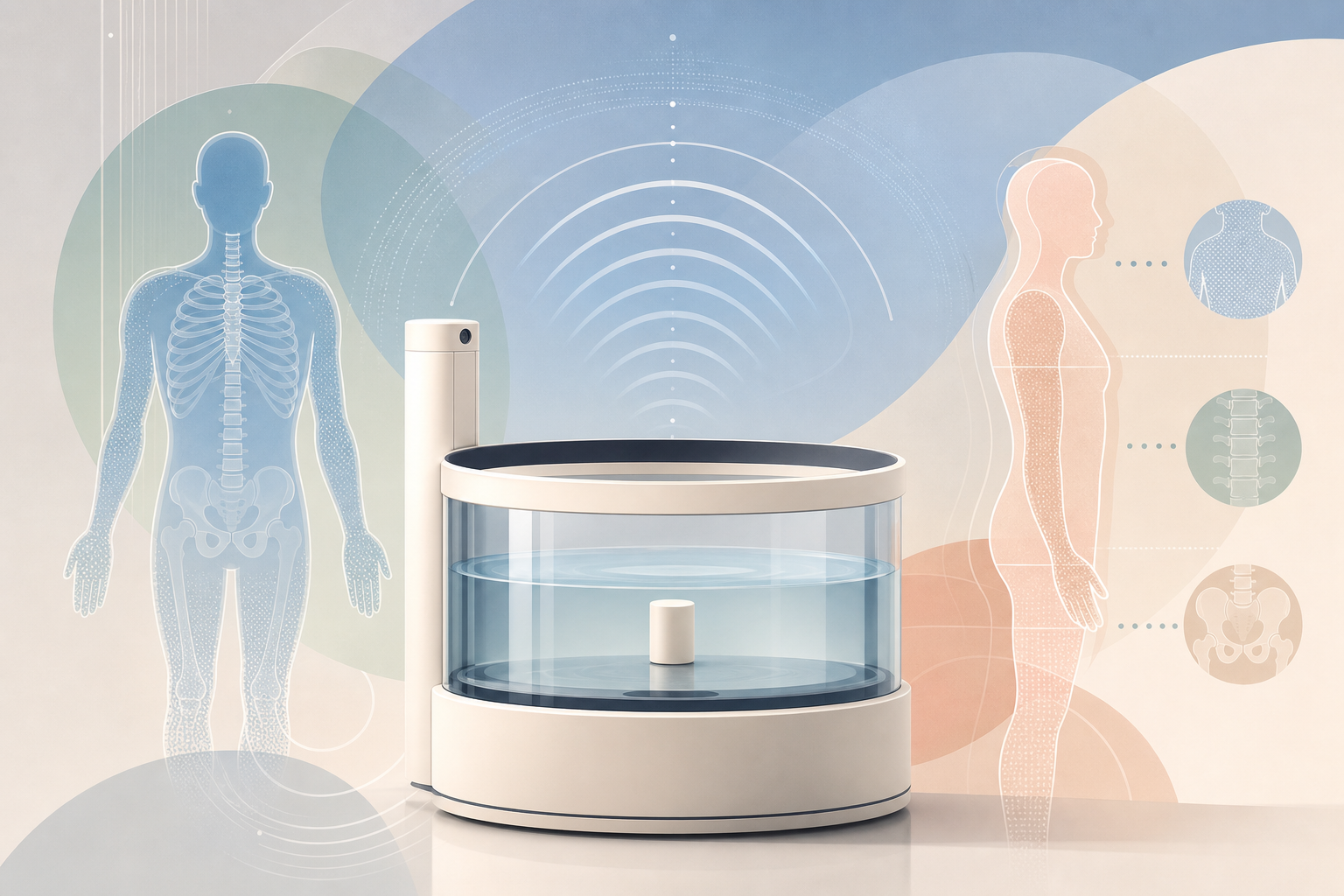
Midjourney, widely recognized for its generative artificial intelligence model used to create images, is currently pursuing a project that feels like science fiction: a three-dimensional medical ultrasound scanner built around an immersion tank. A recent behind-the-scenes video documentary, filmed by the laboratory's own engineers, has revealed for the first time the construction details of this peculiar hardware.
The machine combines dozens of modified ultrasound probes, Raspberry Pi units, and commercial computers inside a structure resembling a high-tech hot tub equipped with an internal lift. The stated goal is highly ambitious: to democratize diagnostic imaging by offering detailed, inexpensive, and radiation-free full-body scans. However, the chosen path raises critical questions regarding both the actual efficacy of the technology and the regulatory strategies selected to bring it to market.
A Tech-Enabled "Hot Tub" for Body Mapping
The heart of the medical device is an unconventional approach to computed ultrasound tomography. Instead of utilizing traditional machinery that requires a technician to manually glide a probe over the patient’s skin using gel, the user is lowered into a water tank. Inside the pool, dozens of ultrasound sensors are arranged in a circular array to capture reflected sound waves from every angle, while an automated lifting system gently moves the subject to map the entire anatomy in three dimensions.
According to technical insights shared by the engineering team, the scanner was assembled by hacking together and calibrating commercial ultrasound probes, managed by single-board computers and linked to high-powered external processing units. Water serves as an ideal transmission medium for sound waves, eliminating the need for gel and allowing for uniform scanning. The core concept involves processing the massive volume of raw acoustic data using proprietary AI algorithms to reconstruct 3D models of the human body with a level of detail previously impossible for traditional ultrasound.
The Wellness Shortcut Around Medical Bureaucracy
One of the most debated strategic decisions made by the company's medical division concerns the initial market rollout. Rather than positioning the scanner as a clinical diagnostic tool—a path that would require years of clinical trials and rigorous approvals from health authorities like the FDA—the startup is aiming for a rapid debut as a "wellness product."
The first scanners are planned for deployment in spas and wellness centers, focusing on precise body composition tracking (fat, muscle, and tissue density). This approach allows the company to temporarily bypass the lengthy bureaucratic processes of official medicine, accelerating data collection in real-world settings.
Despite this formal classification as a lifestyle product, leadership does not hide its long-term medical ambitions. The vision is that by accumulating chronological series of frequent scans for the same individuals over time, they can eventually provide physicians with an unprecedented historical archive to monitor the evolution of anomalies or health patterns.
Expert Skepticism and the Limits of Physics
However, the scientific community and biomedical imaging experts are viewing the announcement with deep skepticism. Major criticisms center on the fact that ultrasound, while a mature and safe technology, has inherent physical limitations related to wave diffraction, penetration through deep tissues, and acoustic artifacts generated by bone structures or air in the lungs and intestines.
The prototypes demonstrated so far have not provided solid scientific evidence or peer-reviewed publications demonstrating how the scanner can overcome these physical obstacles at the promised speed and resolution. Many specialists worry that, without a rigorous medical validation process, the AI-driven reconstruction of 3D images might introduce visual "hallucinations" similar to those found in text-to-image models—showing anatomical structures that look highly plausible but are nonexistent or medically inaccurate.
Financial Independence as a Driver for Unconventional Innovation
What makes such an eccentric and risky experiment possible is the parent company's unusual corporate structure. Unlike almost every other Silicon Valley startup working in artificial intelligence, the image-generation firm has no external venture capital or board of directors to answer to, having been entirely self-funded since its inception through its highly successful commercial image generator.
The founder has repeatedly emphasized how this total financial independence allows the group to invest massive capital into pure research and unconventional hardware without the pressure of generating immediate returns or justifying deviations from their core business. The ultrasound scanner challenge represents the ultimate test of whether creative and economic freedom, combined with the computational power of the AI era, can truly disrupt an ultra-regulated and conservative sector like medical technology.