IA · 18 June 2026 · 3 min read
NVIDIA Introduces ENPIRE: The Framework Where AI Coding Agents Autonomously Train Physical Robots
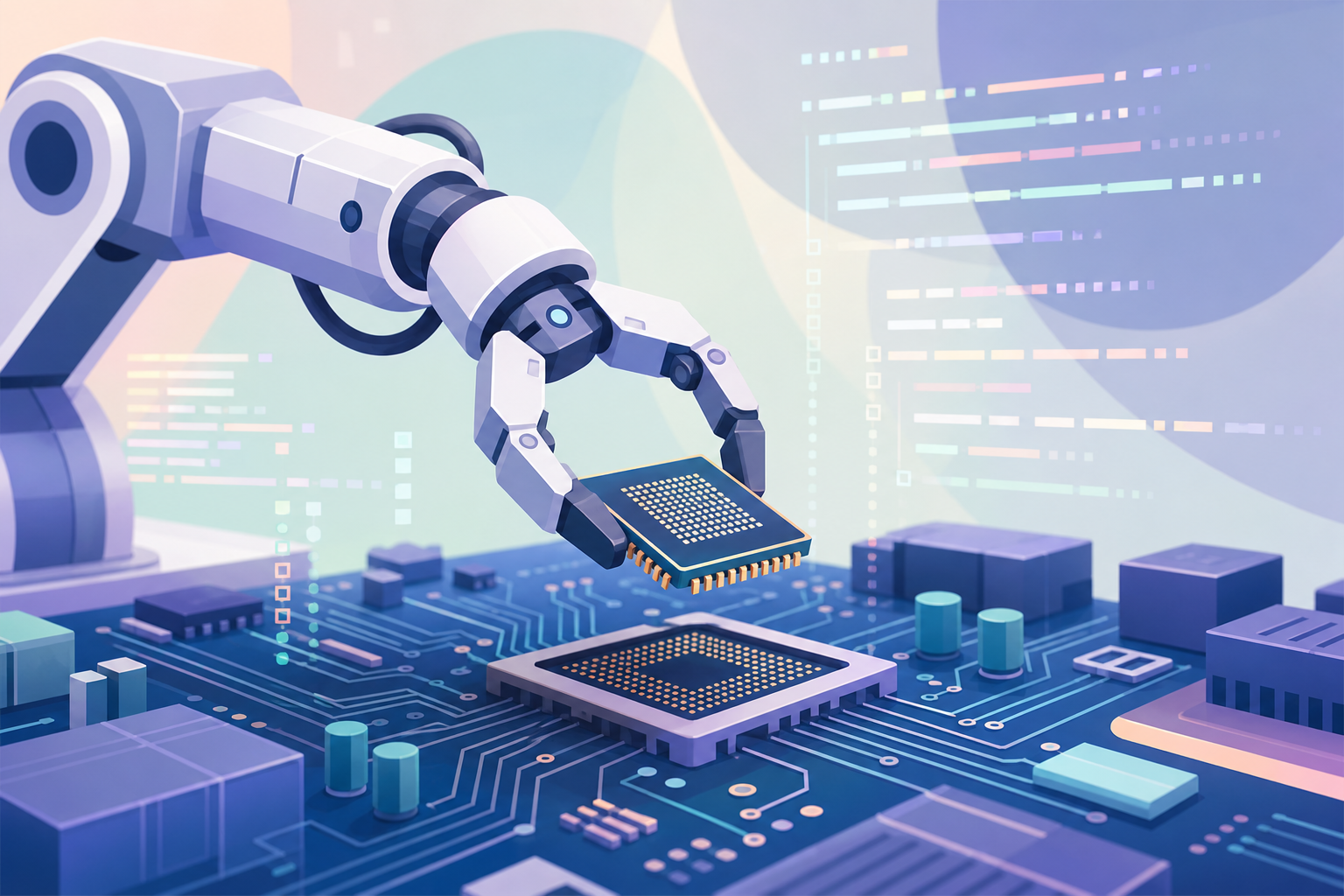
In brief: Researchers from NVIDIA’s GEAR lab, Carnegie Mellon University, and UC Berkeley have unveiled ENPIRE, an agentic harness framework that enables AI coding agents to autonomously train robots. During testing, teams of agents utilizing models like GPT-5.5 and Claude Code designed algorithms that taught physical robotic arms to complete highly precise tasks, including inserting GPUs into motherboards and cutting zip ties, achieving success rates up to 99%.
by Team Mocchi's
The Paradigm of Autonomous Robotic Training
In traditional robotics, training a mechanical arm to perform high-precision tasks has historically required hundreds of hours of manual programming, sensor calibration, and reward function engineering by human experts. A groundbreaking study published by NVIDIA's GEAR (Generalist Embodied Agent Research) lab, along with collaborators from Carnegie Mellon University and UC Berkeley, introduces a dramatic paradigm shift through a framework called ENPIRE, detailed by Ars Technica.
ENPIRE is an "agentic harness" designed to wrap around large language models (LLMs) specialized in writing code. This system provides AI agents with the tools required to interact with physical robotic environments, equipping them with memory, context windows, feedback loops, and error-verification mechanisms. The result is a self-improving loop capable of working autonomously to discover optimal robotic control policies.
Inside the ENPIRE Architecture
The ENPIRE framework is built around four core modules that allow AI agents to operate independently in a physical laboratory environment:
- Automatic Reset and Verification: Manually resets the physical testing environment (such as unplugging a GPU to prepare for the next trial) and uses computer vision systems to verify if the task objective was successfully met.
- Policy Refinement: Dynamically adjusts the mathematical rules and parameters guiding the robot’s movements in three-dimensional space.
- Parallel Evaluation: Tests generated policies across multiple physical robots working in parallel, significantly accelerating data collection.
- Failure Analysis and Continuous Learning: If a trial fails, the agent parses system logs, ingests relevant academic papers from its internal database, and refines the training algorithm’s code.
During research trials, the team tested ENPIRE using several advanced AI coding agents, including OpenAI's Codex (GPT-5.5), Anthropic's Claude Code (Opus 4.7), and Moonshot AI's Kimi Code (Kimi K2.6). The agents collaborated and independently generated distinct algorithmic approaches, testing them in real-world environments and retaining only the code modifications that improved overall success rates over successive cycles.
Putting AI to Work: Installing GPUs and Cutting Zip Ties
The practical outcomes achieved by ENPIRE exceeded researchers' expectations. The AI-guided training allowed the robots to complete a variety of complex physical manipulation tasks, achieving an overall success rate of 99%.
Notable accomplishments included:
- GPU Installation: The robots successfully learned to position and insert graphics cards with millimeter-level precision into thin PCIe slots on motherboards, subsequently unplugging them to reset the experiment.
- Cutting Zip Ties: A highly delicate procedure requiring the robot to apply precise force to grip and cut plastic ties without damaging adjacent wiring.
- Precision Sorting and Pathing: Organizing small metal pins into compartmentalized boxes and solving the standard "Push-T" benchmark, which requires pushing a T-shaped block until it perfectly aligns with a target layout on a table.
"A part of our NVIDIA GEAR lab now self-improves tirelessly overnight," wrote Jim Fan, Director of AI at NVIDIA, on social media. "We just read the reports in the morning."
The Future of Industrial Automation and Multi-Agent Software
NVIDIA has indicated plans to open-source ENPIRE, enabling developers and organizations globally to set up their own self-directed robotic testing facilities. This development could dramatically accelerate the training of humanoid robots and industrial arms, allowing them to adapt dynamically to new assembly lines without requiring costly, time-consuming manual reprogramming.
For custom software agencies and enterprise IT leaders, ENPIRE serves as a powerful validation of multi-agent orchestration and the "software writing software" approach. The ability of AI to autonomously evaluate its performance in the physical world and refactor its code based on environmental feedback signals a new frontier in both industrial automation and autonomous software development.