IA · 4 September 2026 · 5 min read
Nvidia Launches PAIR: The Software Router Turning Idle PCs Into a Local AI Data Center
In brief: At IFA 2026, Nvidia unveiled the Personal AI Router (PAIR), a free open-source tool designed to discover computers on a local network and combine them into a distributed compute cluster for AI inference. By leveraging machines while they are idle and supporting both GeForce RTX GPUs and Apple M4 chips, the tool aims to lower the cost and friction of running agentic workflows locally.
by Team Mocchi's
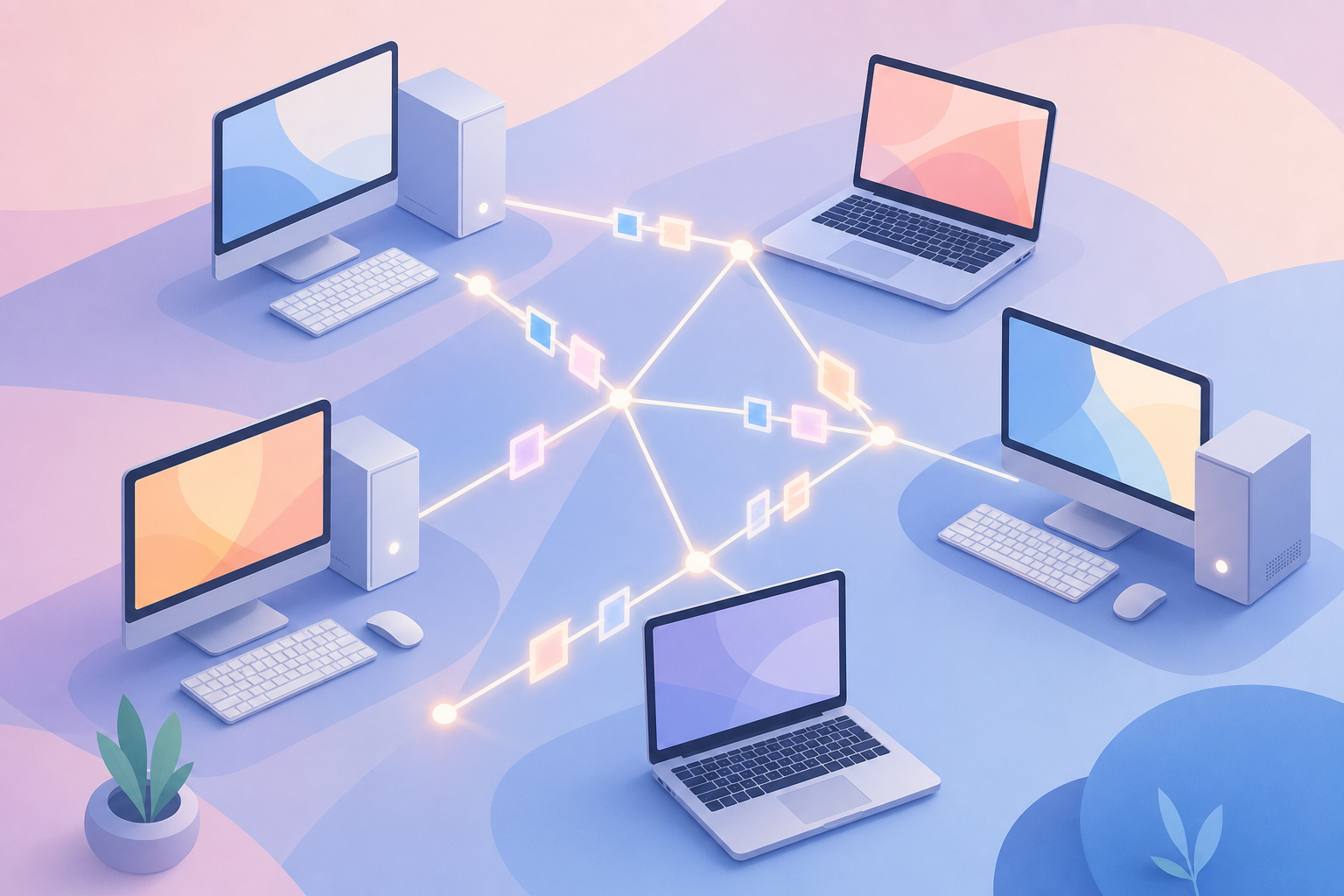
Rising cloud API costs and the need to protect sensitive business data are driving developers and organizations toward local inference. However, executing large language models and complex agentic workflows locally has routinely run into the hardware limits of individual workstations. At IFA 2026 in Berlin, Nvidia presented an architectural answer to this constraint: the Personal AI Router (PAIR), a free open-source tool built to aggregate compute power across devices connected to the same local area network.
Despite what its name might suggest, PAIR is not a physical networking appliance. It is cross-platform software—currently in beta for Windows, Linux, and macOS. As reported by The Verge, the application automatically scans the local network, discovers compatible machines, and coordinates them so they can handle inference requests in parallel using popular local runtimes such as Ollama and LM Studio.
A distributed cluster powered by idle cycles
The central innovation in PAIR lies in its dynamic workload management. The router software assigns incoming inference tasks exclusively to systems sitting in an idle state, ensuring it never interferes with active user workloads like gaming, 3D rendering, or video compilation. If a user resumes heavy work on a connected machine, PAIR redistributes in-flight sub-tasks to other available nodes across the network without failing the overall operation.
This disaggregated model aligns naturally with agentic workflows, where complex objectives are decomposed into dozens of parallel or sequential reasoning steps. On the security front—vital when deploying tools across office networks—Nvidia pairs devices using a one-time six-digit code and encrypts internal network traffic through mutual TLS (mTLS), enforcing mutual cryptographic authentication between all participating nodes.
Unexpected flexibility: RTX meets Apple Silicon
The most notable technical surprise involves hardware support. While PAIR predictably supports Nvidia's own catalog—ranging from GeForce RTX 20-series GPUs up to professional RTX cards and DGX Spark systems—it also extends support to rival hardware, explicitly including Apple Silicon systems running M4 chips or newer.
During a media briefing, Nvidia product manager Seth Schneider described a realistic scenario in which a combination of work laptops, desktop rigs, and MacBooks within the same environment provides over a hundred teraflops of previously dormant compute. According to Schneider, this untapped capacity represents a massive pool of zero-marginal-cost tokens that organizations and households have already purchased but never fully mobilized.
Converging silicon and autonomous agents
The launch of PAIR forms part of Nvidia's broader push into edge computing for artificial intelligence. Alongside the software router, the company unveiled streamlined one-click setups on Windows for leading agent platforms, including Hermes Agent, OpenClaw, and Perplexity Portable Computer.
This software layer complements the first wave of hardware powered by the RTX Spark superchip, showcased on the show floor at IFA. As detailed by Wired, devices such as the Lenovo Yoga 9n pack an Arm-based SoC combining Grace CPU cores and Blackwell RTX graphics with up to 128 GB of unified memory, bridging the efficiency gap with Apple Silicon and establishing an ideal hardware base for distributed edge clusters like those powered by PAIR.
Mocchi's take
For software agencies and mid-sized enterprises building digital solutions, Nvidia's move signals a clear transition in AI infrastructure: shifting away from purely centralized cloud endpoints toward heterogeneous local compute clusters. Being able to federate existing RTX workstations and Apple Silicon MacBooks without investing in dedicated server racks substantially lowers the cost of running and experimenting with autonomous agents. While local power consumption and network latency stability still warrant real-world testing, this decentralized model provides a practical path forward for teams handling proprietary source code and sensitive operational data that must never leave the company perimeter.