Tech · 21 August 2026 · 4 min read
AI Takes Flight: Big Funding and Ecological Questions for Orbital Data Centers
In brief: As terrestrial AI data centers face severe energy constraints, infrastructure startups are turning to low Earth orbit: Starcloud has raised a $250 million round extension at a $2.3 billion valuation. However, new studies on massive orbital compute constellations highlight critical concerns regarding satellite lifespan and the irreversible loss of rare materials.
by Team Mocchi's
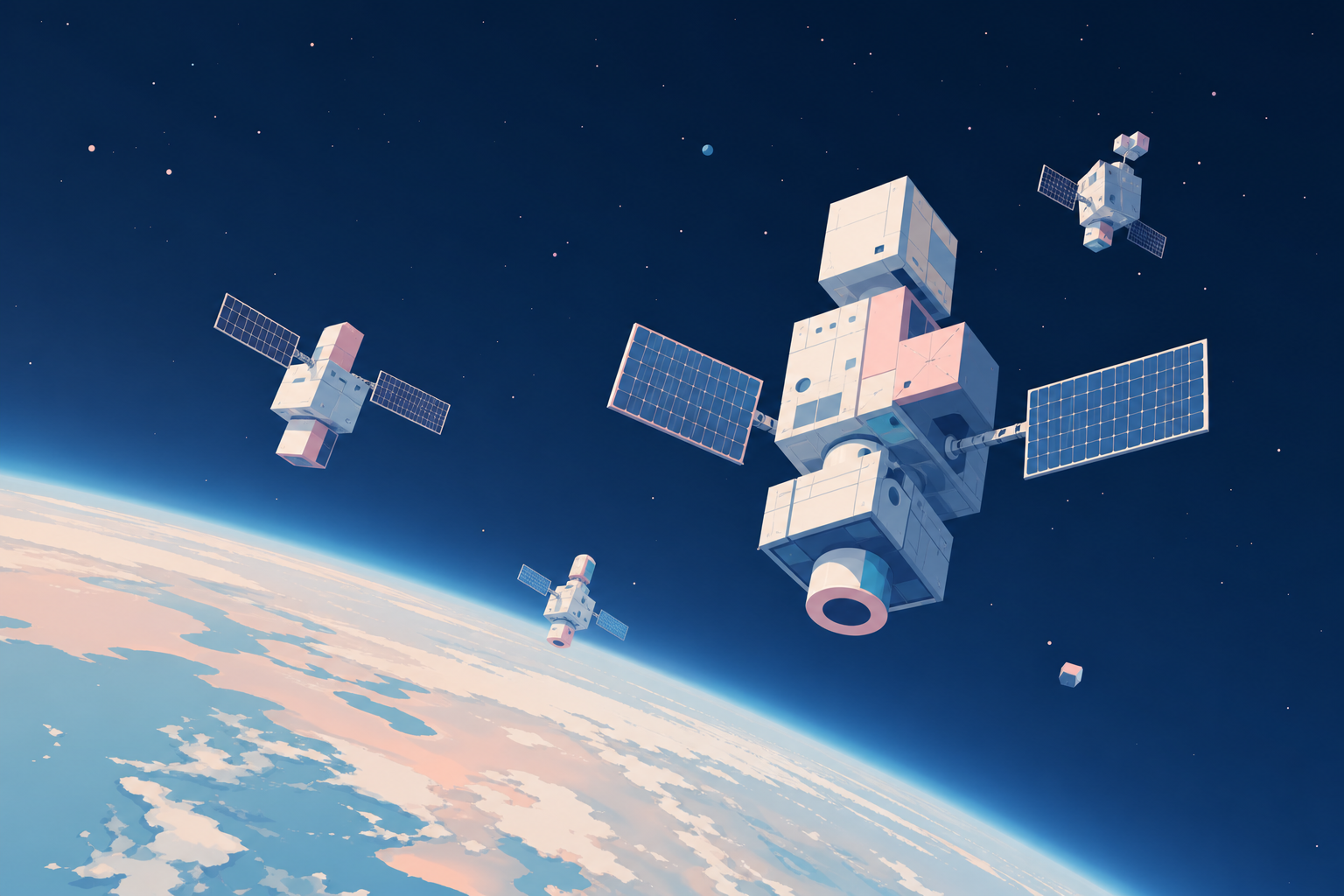
As terrestrial artificial intelligence data centers face tightening power grids and physical real estate limits, compute infrastructure is increasingly looking toward low Earth orbit to harness continuous solar energy and natural vacuum cooling. Shifting inference and training hardware beyond Earth's atmosphere is moving from theoretical research into a competitive domain marked by massive venture backing alongside severe engineering and environmental hurdles.
Starcloud's capital injection and the launch bottleneck
Underscoring this shift, orbital computing startup Starcloud announced a $250 million extension to its Series A funding round, bringing total capital raised to $420 million at a valuation of $2.3 billion. As reported by TechCrunch, the company plans to deploy these funds to expand manufacturing infrastructure and accelerate the development of its flagship Starcloud-3 compute spacecraft, intended to launch on SpaceX's heavy-lift Starship rocket.
Securing funds now is critical due to an impending squeeze in rocket launch capacity. With the Falcon 9 vehicle scheduled to phase out around 2028 and competing heavy launchers still scaling operations, space infrastructure providers must lock in flight capacity years in advance. Starcloud, which has submitted regulatory filings to the FCC for up to 88,000 satellites, aims to deploy its initial 8 kW Starcloud-2 units through rideshare missions in 2027.
The orbital e-waste puzzle and material depletion
While space provides unfiltered solar power, the material lifecycle of massive compute constellations introduces unprecedented challenges. Multi-satellite constellations proposed by major aerospace players could scale to hundreds of thousands of nodes, yet the realistic operational lifespan of server-grade GPUs under heavy AI workloads rarely exceeds five years.
An analytical breakdown published by Ars Technica shows that maintaining a massive orbital data center constellation could require decommissioning hundreds of thousands of units each year. While a portion would burn up upon atmospheric re-entry — releasing oxidized metals that could affect the upper atmosphere — the rest would be directed into graveyard disposal orbits.
This continuous replenishment cycle effectively exports substantial quantities of critical raw materials outside Earth's supply chain. Hardware estimates point to hundreds of kilograms of gold, tons of silver, and noticeable fractions of annual global production of palladium and thallium being permanently lost to orbit each year, creating an unexpected reverse asteroid mining scenario.
Mocchi's take
The push to move computing workloads into space illustrates that the foremost constraint on AI progress is physical infrastructure, from energy grids to hardware supply chains. For businesses designing and implementing AI solutions today, this reality underscores the critical importance of software-level architectural optimization: reducing compute footprints, improving model distillation, and maximizing token efficiency on Earth remain the most effective strategies for controlling operational costs and ensuring long-term sustainability.