IA · 27 November 2026 · 4 min read
Waves of Light Against AI's Thermal Wall: Photonic Processors Enter the Data Center
In brief: The relentless scaling of artificial intelligence models is hitting physical barriers imposed by power grid capacity and thermal dissipation. German hardware startup Q.ANT has begun deploying optical processors in commercial facilities run by cloud provider IONOS, processing complex mathematics using light waves rather than electrons. Instead of replacing standard GPUs, the technology acts as a specialized coprocessor designed to eliminate memory bottlenecks and drastically cut cooling requirements.
by Team Mocchi's
The Thermal Wall and the Data Center Power Crunch
The ongoing expansion of frontier artificial intelligence models has crossed the threshold where raw compute scaling can ignore local electrical constraints. Over the past year, the power appetites of massive server clusters have forced hyperscalers to reassess their infrastructure roadmaps. According to an investigation by MIT Technology Review, surging electricity demand has triggered a renewed reliance on dedicated natural-gas generation to bypass congested utility interconnection queues, pushing Meta's annual greenhouse gas emissions up by 45% in its latest sustainability disclosures.
Until recently, the industry's primary response involved migrating infrastructure toward cold climates or regions with abundant hydroelectric power. Yet logistical bottlenecks, local grid moratoriums, and severe shortages of high-density liquid cooling equipment are making one fundamental physics constraint undeniable: moving billions of electrons across silicon pathways inevitably generates heat, and expelling that heat frequently consumes as much energy as the computation itself.
Computing with Photons: The Physics of Optical Processing
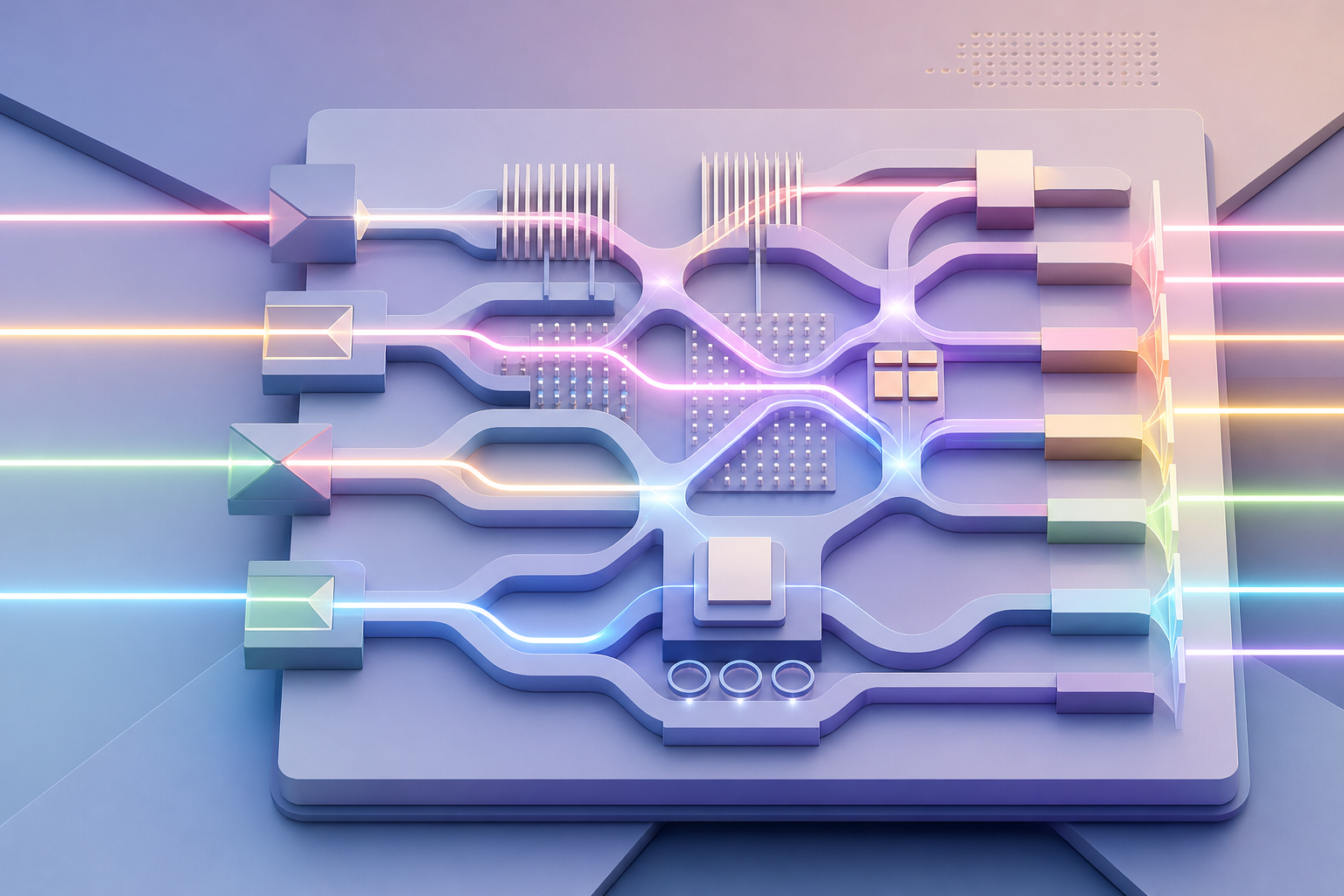
To break through this physical bottleneck, an emerging wave of hardware ventures is designing processors that calculate using optical waveforms rather than electrical charges. As reported by Wired, German hardware startup Q.ANT has begun rolling out optical processors engineered specifically to target the computational stages where conventional microchips are least efficient.
The underlying architectural thesis does not involve discarding traditional GPUs, but supplementing them. Conventional accelerators remain unmatched at linear matrix arithmetic—the iterative multiplications and additions that form the backbone of neural inference. However, when an algorithm encounters complex non-linear mathematical operations, silicon transistors must break the problem down into thousands of sequential steps, each requiring round-trip access to memory.
This continuous transfer between compute cores and memory registers represents the single largest contributor to electrical consumption. Photonic chips, by contrast, exploit the wave characteristics of light: a sine wave naturally represents continuous, non-linear curvature in a single step, bypassing redundant memory queries and transmitting information without resistance-induced thermal dissipation.
From Laboratory Prototypes to IONOS Racks
Moving specialized optical computing from controlled lab conditions to live server racks has historically been the technology's primary hurdle. Q.ANT has moved beyond synthetic benchmarks by deploying its photonic hardware into data centers operated by European cloud vendor IONOS. According to chief executive Michael Förtsch, more than thirty engineering teams are currently writing and optimizing neural models tailored to this hybrid computational flow.
The decisive battleground over the coming quarters will be the developer toolchain. Nvidia's grip on artificial intelligence infrastructure is grounded not only in silicon packaging, but in nearly two decades of software optimizations via CUDA. Convincing enterprise developers to offload non-linear functions to optical coprocessors requires frictionless runtime compilers, predictable latency models, and provable total cost of ownership reductions.
Mocchi's take
The arrival of photonic processors inside production data centers indicates that the era of monolithic, single-vendor silicon architectures is reaching its physical limits. For businesses designing software systems and deploying enterprise models, the immediate takeaway is not that standard GPUs will vanish overnight, but that compute stacks are growing increasingly heterogeneous. Over the next development cycle, operational efficiency will be dictated not merely by model parameter counts, but by how intelligently pipelines route distinct mathematical stages to specialized hardware accelerators. Seeing European hardware players take an active lead in this architectural shift is a promising step toward diversifying critical tech infrastructure.