IA · 22 October 2026 · 5 min read
An AI Designing AI: Recursive Launches Flint, the Laptop Coding Model Born from Self-Improvement
In brief: California-based startup Recursive has launched Flint, an open-weight coding model tailored to run locally on consumer laptops. What makes it unique is its development pipeline: nearly every aspect of its architecture and optimization was designed by Eureka Machine, the company's autonomous AI research engine. Licensed under Apache 2.0, Flint cuts out cloud API bills while offering complete IP privacy for proprietary codebases.
by Team Mocchi's
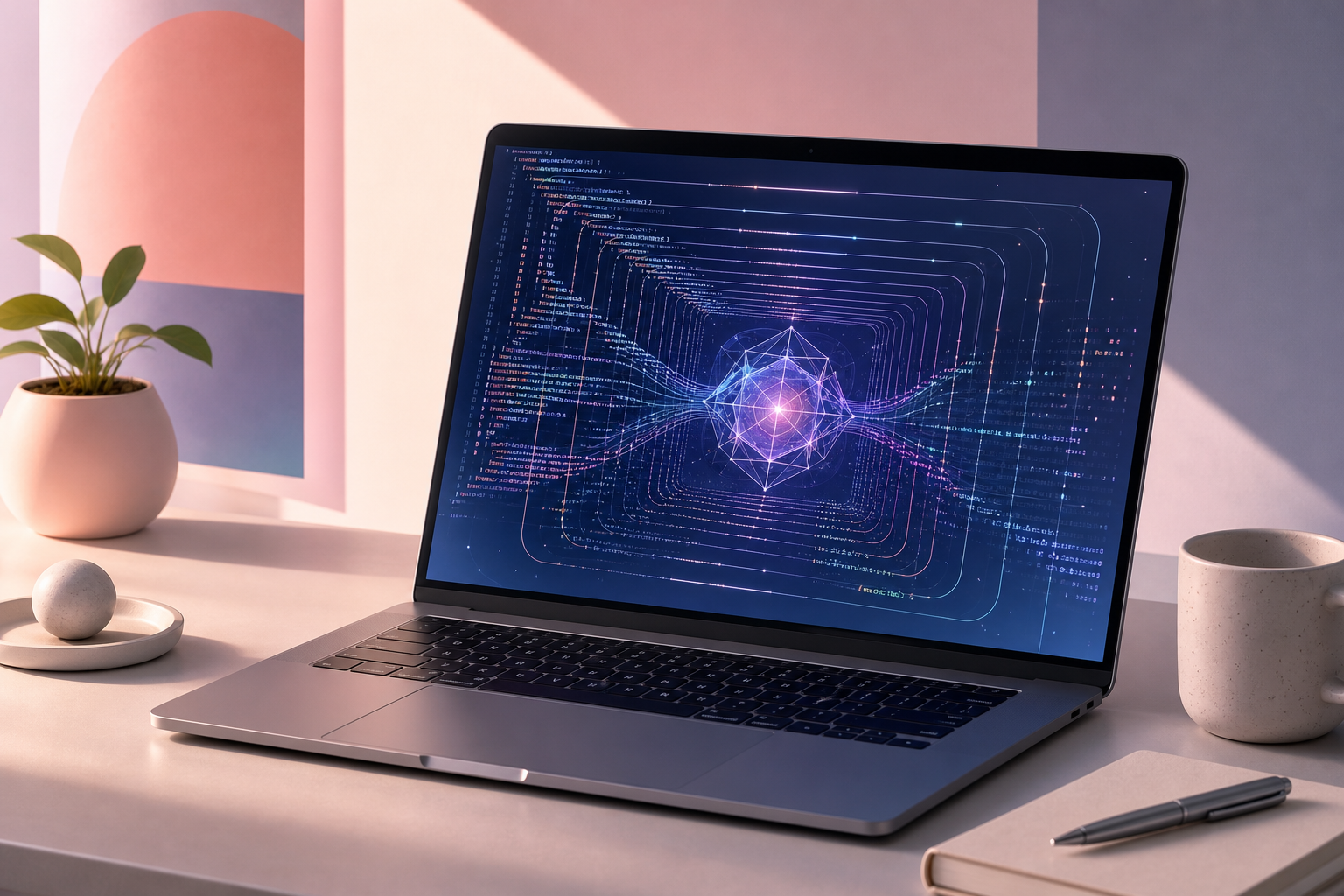
The concept of an algorithm engineering an improved version of itself—initiating a compounding feedback loop without perpetual human intervention—has long been confined to academic hypotheses and debates on superintelligence. Now, recursive self-improvement (RSI) is making its practical debut in commercial software development. Silicon Valley startup Recursive, co-founded by former Salesforce chief scientist Richard Socher and backed by major chipmakers, has released Flint: a code-generation model published on Hugging Face under the open source Apache 2.0 license.
What sets Flint apart is not merely its coding benchmark results, but the workflow behind its creation: the model was almost entirely designed, refined, and compiled by another artificial intelligence.
AI engineering itself: the role of the Eureka Machine
At the core of the project is Recursive’s automated research platform, dubbed the Eureka Machine. As reported by TechCrunch, this proprietary system took charge of nearly every stage in the development pipeline: proposing novel training methods, tuning neural architectures, and crafting compiler-level optimizations tailored to specific chips.
This level of automation enabled a lean engineering team to ship a performant model from scratch in under four months. Valued at $4.65 billion following a $650 million funding round supported by GV, Greycroft, Nvidia, and AMD Ventures, Recursive aims to demonstrate that using AI to conduct AI research accelerates scientific iteration far beyond manual parameter tuning.
Forty billion parameters on a laptop: the Mixture-of-Experts advantage
Despite its automated origin, Flint was purposely engineered to escape cloud lock-in. Built on a Mixture-of-Experts (MoE) architecture, the model contains 40 billion total parameters, yet activates only 2.5 billion parameters for any given token or prompt. This sparse routing allows it to execute comfortably on consumer hardware, including modern laptops and developer workstations with shared memory architectures.
This architectural choice directly tackles two major barriers facing enterprise adoption of AI coding assistants: recurring per-token API costs and intellectual property security. Because Flint runs fully offline on local silicon, proprietary code never crosses external network perimeters, eliminating inference fees and offering zero-latency suggestions directly inside developer environments.
Safety concerns and the Washington debate over RSI
Flint’s launch has also reignited the debate surrounding recursive self-improvement. Safety researchers and policymakers have expressed caution, warning that open-ended recursive loops could theoretically evolve beyond human interpretability. In the US Congress, lawmakers have already drafted bills proposing moratoriums or strict licensing on systems utilizing autonomous self-improving code.
However, as noted by WIRED, founder Richard Socher downplays catastrophic narratives, characterizing them as sci-fi tropes disconnected from engineering reality. Recursive emphasizes that the Eureka Machine works within constrained bounds, keeping human engineers firmly in the loop to inspect and benchmark every iteration. Independent evaluation shows that Flint’s coding output rivals manually tuned models of similar footprint.
Mocchi's take
For engineering teams and digital agencies building proprietary software under strict privacy and regulatory standards, Flint represents an important milestone. The pairing of local Mixture-of-Experts execution with open licensing proves that businesses do not have to rely perpetually on metering cloud APIs to deploy fast, context-aware coding assistants. Beyond developer productivity, Recursive’s milestone illustrates that the next wave of AI performance will not stem solely from brute-force compute scale, but from smarter algorithmic designs synthesized by AI systems themselves.