IA · 29 June 2026 · 4 min read
The Return of the Experts: Why Ford Rehires 350 Veteran Engineers After AI Shortfalls
In brief: Following quality issues caused by over-reliance on AI-driven predictive systems, Ford rehired 350 veteran engineers ('gray beards'). Their mandate is to identify physical component failures before assembly and use their extensive expertise to retrain and calibrate the AI models. This strategic shift has prevented costly recalls, proving that the future of complex engineering lies in human-in-the-loop systems.
by Team Mocchi's
The Limits of Blind Automation
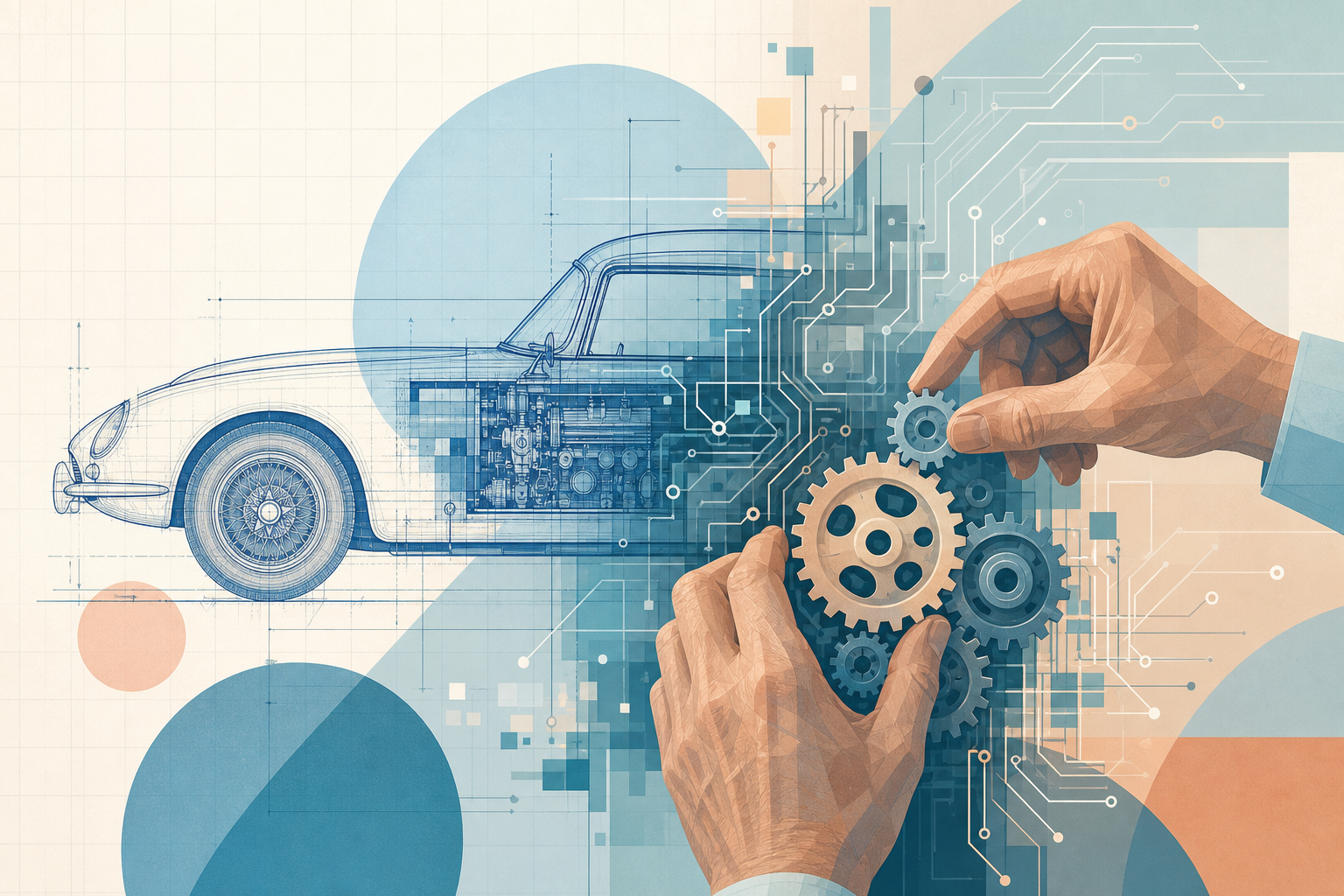
The industrial sector is undergoing a period of profound reflection regarding the real-world maturity of artificial intelligence applied to large-scale manufacturing. A prime example comes from the global automotive industry, where a historic manufacturer recently had to make a sharp pivot in its digitalization and quality control strategy. After aggressively pushing toward automated and AI-driven predictive systems, the company was forced to scale back its reliance on purely digital workflows. It rehired 350 veteran engineers—many of whom had already retired or transitioned to supply chain partners. This initiative, aimed at plugging the quality gaps left by automated systems, highlights how digital transformation requires a far more careful calibration than the industry initially assumed.
When Virtual Models Fall Short
The decision to reintroduce human experts into critical design and validation workflows stemmed from disappointing results generated by relying exclusively on predictive algorithms. Corporate executives openly acknowledged that their initial methodology was flawed. They had assumed that once the AI model was trained on design requirements and historical data, it could independently generate an optimized, flawless physical product.
However, real-world manufacturing introduces variables that defy standard mathematical modeling. Microscopic material imperfections, real-world tolerance stack-ups, and dynamic, unpredictable stresses in the field are incredibly difficult to synthesize into a static dataset. Without the physical intuition of professionals with decades of hands-on experience, the automated systems failed to identify critical stress points before parts reached the assembly line. This oversight led to a rise in structural defects and increased the risk of massive, expensive product recalls.
The Value of Tacit Knowledge in Hybrid Systems
The return of these 350 senior engineers—affectionately termed "gray beards" in the automotive world—does not mean the manufacturer is abandoning its technological roadmap or halting its digitalization efforts. Instead, the company has realized that the accuracy of AI models is directly tied to the quality of their training and the rigor of human oversight. These veterans now hold a dual, highly strategic role: they act as hands-on quality inspectors capable of catching engineering oversights on the shop floor, and they serve as mentors both for junior staff and for the algorithms themselves.
In software engineering and industrial design, this is closely tied to the concept of "tacit knowledge"—the deep pool of skills, hunches, and practical experience that professionals acquire over decades, which cannot easily be written down in a manual or ingested into a training database. By leveraging this tacit knowledge, the senior engineers are actively helping to reprogram, calibrate, and refine the AI tools. Their guidance eliminates the predictive hallucinations and cognitive biases that automated systems typically experience when confronted with edge cases or incomplete datasets.
A Financial Tailwind Measured in Hundreds of Millions
The results of this strategic shift were not merely qualitative; they had an immediate and positive impact on the company's financial performance. Catching structural flaws in the component design phase, long before they could enter mass production, dramatically reduced downstream liabilities. The resulting decrease in warranty expenses and the avoidance of massive vehicle recall campaigns yielded net savings that executive leadership estimated in the hundreds of millions of dollars.
This financial turnaround reinforces a vital lesson for modern enterprises: cost optimization is not synonymous with complete human replacement. Often, the highest return on technology investment is achieved by coupling advanced software platforms with domain experts who can validate, contextualize, and refine the digital outputs, driving operational error rates down to near zero.
Beyond the Hype: The Era of Pragmatic Integration
This development offers a critical takeaway for the wider custom software and technology integration ecosystem. The illusion that artificial intelligence can completely replace tacit knowledge and experience-based intuition runs headfirst into the sheer complexity of the real world. Neural networks are highly capable of recognizing complex patterns, processing massive datasets, and automating repetitive tasks, but they lack common sense, physical intuition, and the ability to adapt to unprecedented conditions.
For organizations currently building custom applications or implementing advanced AI integrations, long-term success will hinge on designing collaborative architectures. The objective should not be to remove the human element from the loop, but rather to build systems where experienced professionals guide, correct, and elevate the work done by the algorithm. Only through this symbiotic approach—combining raw computational power with irreplaceable human expertise—can businesses achieve sustainable, high-fidelity operational excellence.