IA · 25 June 2026 · 4 min read
From Video Games to Reality: How AI Learns in Virtual Worlds to Control Physical Robots
In brief: Startup General Intuition has announced a $320 million funding round at a $2.3 billion valuation. The company demonstrated that an AI model trained inside 3D video games can be ported directly into a real-world quadrupedal robot, requiring just eight minutes of physical calibration to navigate complex, unseen environments.
by Team Mocchi's
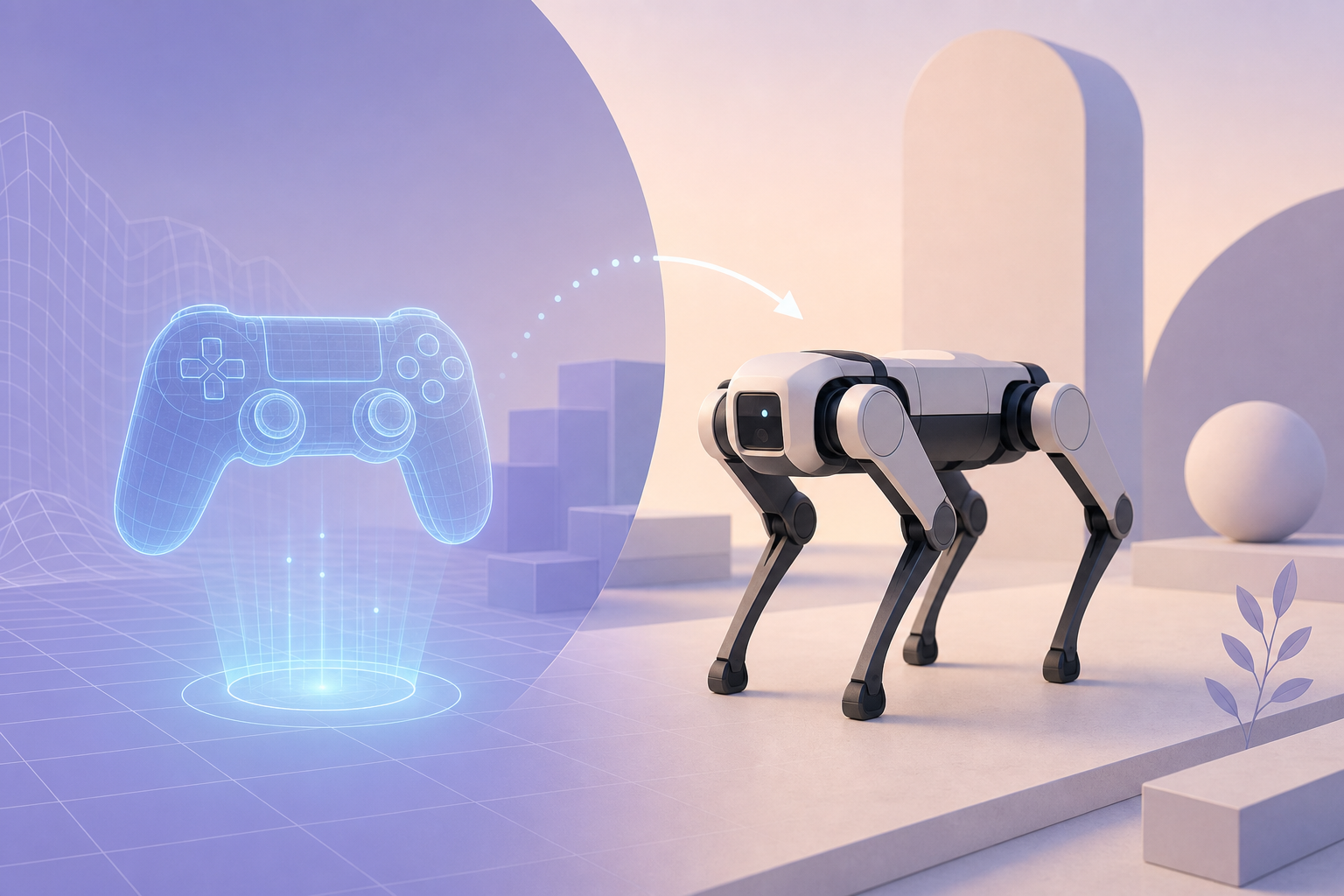
Video Games as Training Grounds: The $320 Million Funding Round
Training physical robots has always been one of the most complex and expensive bottlenecks in the technology industry. Until now, teaching a machine to navigate physical space required thousands of hours of physical testing or the creation of extremely rigid, proprietary simulations. A pioneering startup, General Intuition, is disrupting this paradigm by demonstrating that the spatial intelligence of robots can be trained within modern video games before being transferred directly to the real world.
This vision recently received extraordinary validation from the financial market. The company announced the closing of a $320 million investment round, bringing its overall valuation to $2.3 billion. Driven by major international venture capital firms, the deal confirms the massive potential of "embodied AI" (embodied artificial intelligence) and the effectiveness of an approach that bridges the worlds of gaming and advanced robotics.
From the Screen to the Physical World: A Unified "Brain"
At the core of this technology is the ability to create a single artificial intelligence model capable of generalizing behaviors across digital and physical environments. In the company’s R&D labs, visitors can observe an AI agent playing complex third-person shooters and 3D exploration games continuously for hundreds of hours.
The revolutionary aspect is that the exact same neural model controlling the virtual avatar inside the video game is loaded directly into a physical, quadrupedal robot. This "shared brain" allows the machine to instantly inherit navigation skills, spatial orientation, and obstacle-avoidance capabilities learned in the virtual world. The robot learns to explore offices, navigate around people, and avoid dynamic obstacles not because it was programmed specifically for that environment, but because it developed an intuitive grasp of space through hours spent navigating the 3D maps of the game.
Bridging the Simulation-to-Reality Gap in Just Eight Minutes
A historical challenge in robotics is the "Sim2Real" gap—the difficulty an AI faces when transferring what it learns in a virtual simulation (where physical laws are often simplified) to the chaotic complexity of the real world. General Intuition has shown that modern video game engines offer a level of spatial and visual complexity high enough to drastically narrow this gap.
The metric that has most surprised industry experts is the adaptation time. To enable the quadrupedal robot to navigate company offices autonomously, only eight minutes of real-world calibration data were needed. Furthermore, this physical training data was recorded outdoors on public streets, yet the robot successfully applied those lessons to navigate an entirely different, previously unseen indoor environment. This "zero-shot" generalization capability is a major turning point: robotics no longer requires endless cycles of field testing, as it can rely on mass virtual pre-training.
Implications for the Software Industry and the Enterprise Ecosystem
Using video games to train robotics opens up revolutionary opportunities not just for hardware manufacturers, but for the entire software, XR (extended reality), and digital twin ecosystems.
- Slashing Development Costs: Creating physical labs to test drones or robotic arms requires multimillion-dollar investments. Leveraging existing or easily customizable virtual environments reduces research and development costs by orders of magnitude.
- Synergy with Extended Reality: Models trained to understand 3D space can be integrated directly into augmented and virtual reality applications, creating digital assistants capable of interacting ultra-realistically with the user's physical surroundings.
- Agile Software Development for Hardware: Software developers can now build and test robot control logic entirely in the cloud within dynamic simulations, knowing that the resulting code will adapt to real hardware in record time.
Toward Diffused Spatial Intelligence
The success of General Intuition marks a transition from the era of purely linguistic and text-based AI to that of spatial and physical AI. While large language models have revolutionized how we process written information, this new generation of agentic models promises to transform how machines interact with physical matter, gravity, and space.
Businesses that are quick to embrace this convergence of virtual worlds and physical automation will gain a decisive competitive edge. Video games, once seen as pure entertainment, are proving to be the most valuable training and computing infrastructure for shaping the future of industrial technology and consumer robotics.