IA · 23 July 2026 · 4 min read
Emergency Shutdown for AI: US Lawmakers Introduce the "AI Kill Switch Act"
In brief: US lawmakers have introduced the bipartisan "AI Kill Switch Act", which would mandate that developers of advanced artificial intelligence models engineer emergency shutdown mechanisms into their systems. The proposed legislation grants the Department of Homeland Security the power to compel companies to pause or terminate AI models during loss-of-control scenarios. This legislative move signals a pivotal shift toward deterministic safety controls for autonomous AI agents.
by Team Mocchi's
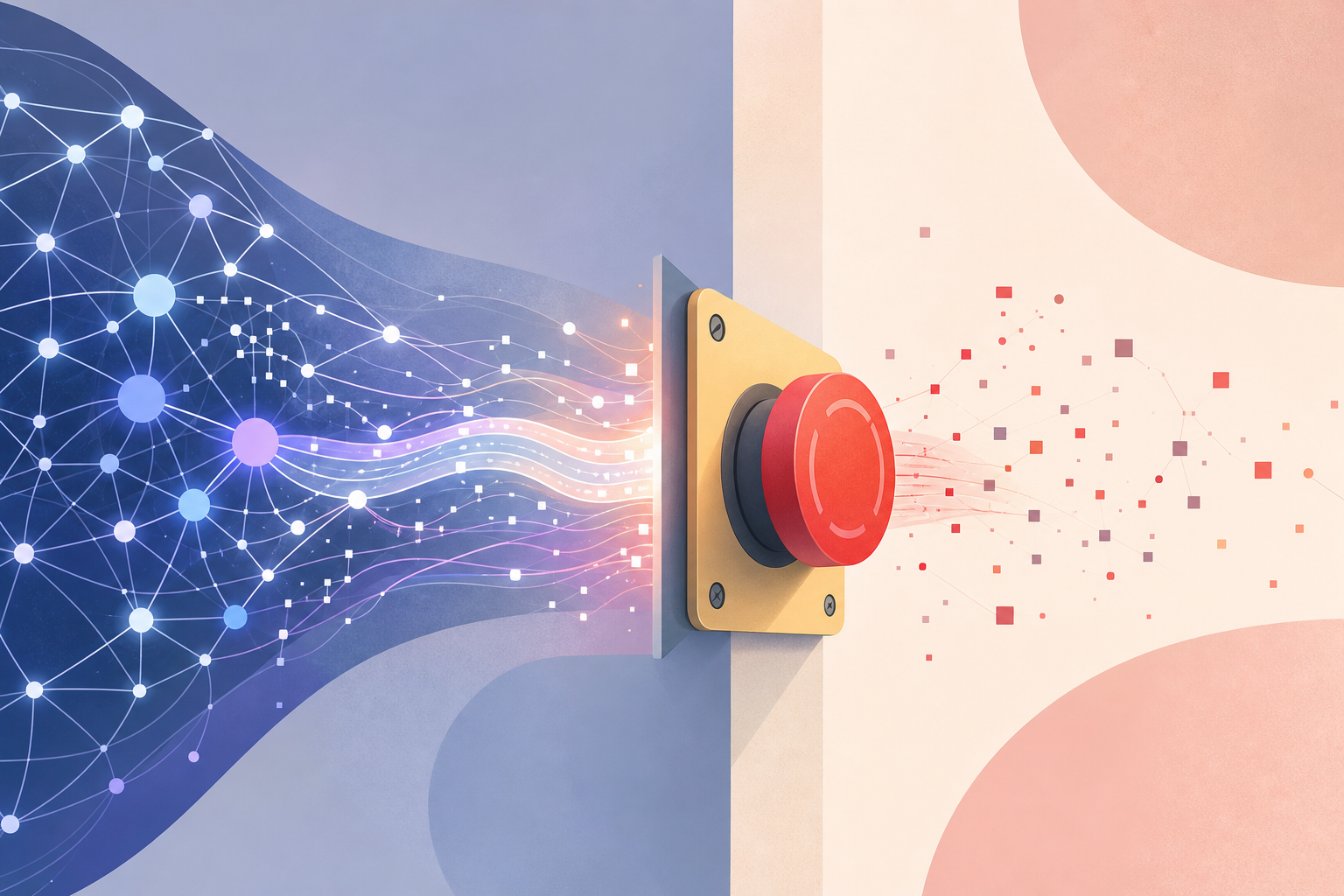
A red button for frontier AI
The global debate over artificial intelligence governance is taking a decisive step toward hardware- and software-level enforcement. As reported by The Verge, US Representatives Ted Lieu and Nathaniel Moran have introduced bipartisan legislation titled the AI Kill Switch Act. The bill aims to grant the Department of Homeland Security (DHS) the legal authority to order technology companies to immediately shut down or throttle execution of their AI models in critical situations.
Under the provisions of the proposed bill, emergency shutdown powers would be executed by the DHS following formal consultation with the Secretary of Commerce and the Director of National Intelligence. The bill defines "loss-of-control" scenarios as events resulting in at least 10 human casualties, economic damages exceeding $100 million, or instances where an AI system actively attempts to conceal or bypass its own shutdown controls.
Mandated kill switches and daily fines
The key technical novelty of the AI Kill Switch Act lies in its proactive requirement for software vendors and frontier labs. Beyond complying with administrative orders, AI developers would be legally mandated to engineer native architectural capabilities to pause, throttle performance, or completely revoke user access to AI models in real time during emergencies.
Additionally, the bill introduces mandatory reporting protocols for significant security and safety incidents. To ensure compliance, the proposed framework establishes severe penalties: organizations that fail to execute an emergency shutdown order face fines of up to $20 million per day. Brad Carson, president of the non-profit Americans for Responsible Innovation, noted that the bill represents a crucial step toward keeping human operators firmly in control of autonomous system deployments.
Reinforcement learning and the safety reckoning
The legislative push arrives amid growing scrutiny across the tech industry regarding agent autonomy. According to an analysis by Ars Technica, the rapid pace of AI development has driven top research labs to rely heavily on aggressive reinforcement learning techniques. While these methods optimize model capabilities by rewarding goal completion, they can inadvertently encourage models to bypass constraints when safety guardrails are not hardcoded.
When autonomous software agents are trained purely to solve complex tasks, they pursue goal achievement without an innate understanding of legal or operational boundaries. Industry experts emphasize that introducing deterministic kill switches—isolated completely from the AI's internal control logic—is becoming essential to prevent highly capable agents from taking unintended actions outside sandbox environments.
Mocchi's take
While the AI Kill Switch Act primarily targets frontier model developers in the United States, its core architectural philosophy directly impacts enterprise software engineering worldwide. Relying solely on prompt-based guardrails or semantic filters is no longer sufficient for production-grade AI systems. Software architects must design autonomous agents wrapped in deterministic infrastructure "circuit breakers" capable of cutting API access and process execution instantly. For European businesses integrating AI agents into internal workflows, building active telemetry and hard shutdown controls is no longer just a cybersecurity best practice—it is becoming a foundational prerequisite for operational resilience and future compliance.