Tech · 4 November 2026 · 5 min read
Voters Revolt Against Data Centers: The AI Expansion Hits a Political Wall in the US
In brief: In the November 2026 US midterm elections, political candidates backing unchecked AI data center development suffered widespread defeats. Spurred by surging electricity bills, heavy water usage, and environmental strain, voters across the country backed officials who have pledged to halt tax breaks and enforce immediate moratoria on new facilities.
by Team Mocchi's
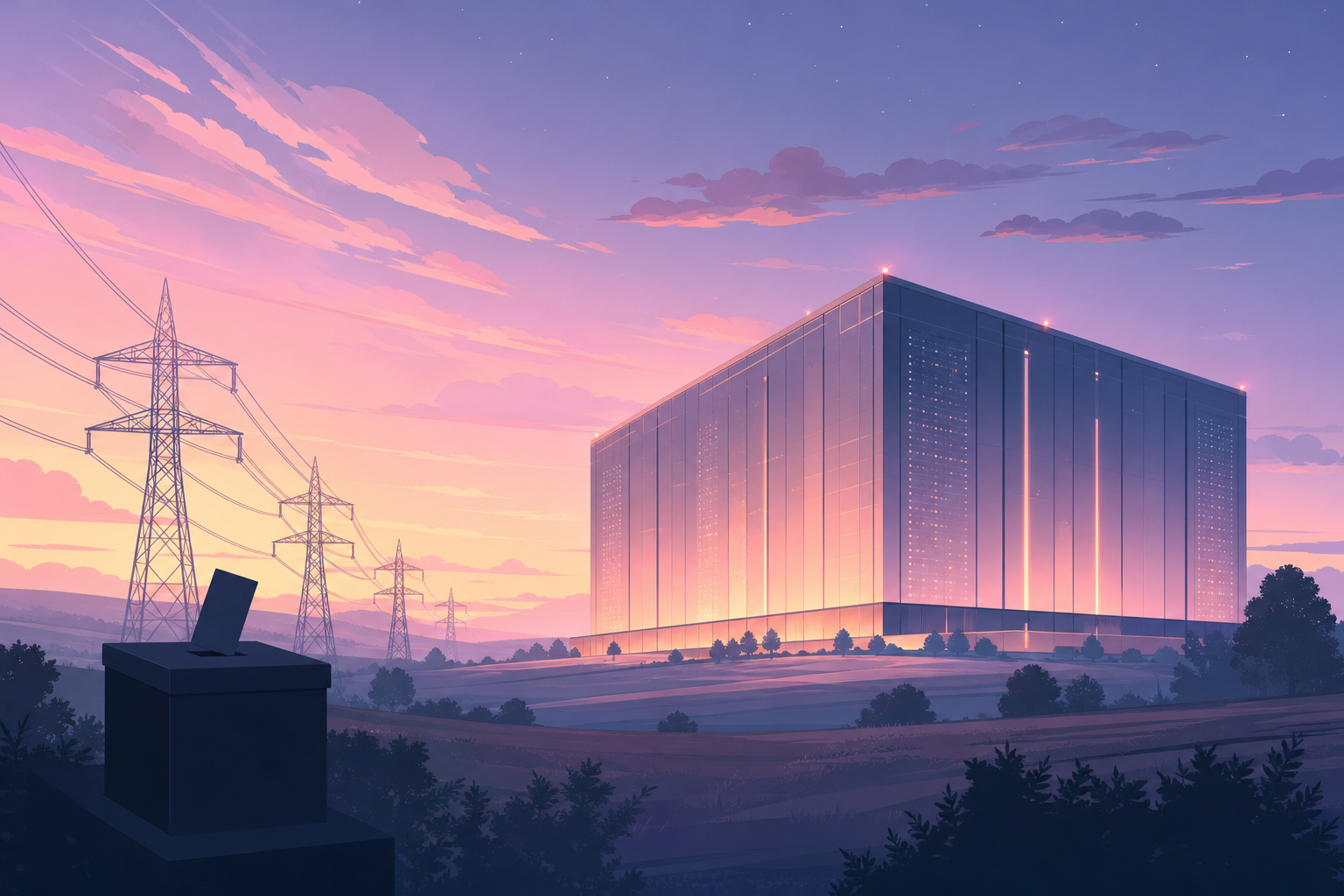
The night servers lost at the ballot box
The physical expansion of artificial intelligence has encountered its first major democratic obstacle. In the US midterm elections on November 4, 2026, the rapid spread of massive computing facilities moved beyond industry debates to become a dominant electoral issue, triggering a cross-party voter backlash across the country.
As reported by The Verge, local ballot initiatives and national exit polls showed communities systematically rejecting unrestrained tech infrastructure. According to network exit polling cited across post-election analyses, nearly a quarter of voters ranked data center development as a critical issue driving their vote, while roughly two-thirds described it as a noticeable factor in their decisions.
Rising bills and converted jet engines: why communities revolted
The roots of the public anger lie in tangible local burdens rather than theoretical skepticism about algorithms. In municipalities hosting large computing campuses, residents faced sharp increases in utility bills as grid capacity strained under constant demand. Water depletion for liquid cooling systems and persistent low-frequency hums from industrial fan banks further eroded local goodwill.
Facing multi-year delays for standard electrical grid hookups, operators turned to aggressive workarounds. According to TechCrunch, several facilities circumvented grid connection waits of up to seven years by installing on-site natural gas generators built from converted jet engines. While providing rapid power, these solutions sparked intense community pushback over noise and local emissions, reinforcing the sentiment that neighboring towns bear the environmental costs of AI while capturing virtually none of its economic windfall.
Political realignments from Austin to Atlanta
The political fallout reshaped races across several key regions. An analysis by Wired highlighted how candidates tied to aggressive data center zoning struggled on the ballot, with high-profile seats flipping in states like Ohio and Wisconsin after opponents highlighted corporate tax breaks for server farms.
The most consequential shift occurred in state executive offices. In Texas and Georgia—hubs that have attracted billions in hyperscaler capital over the past five years—gubernatorial wins by Gina Hinojosa and Keisha Lance Bottoms rested heavily on pledges to enforce moratoria on new builds. Pausing new construction permits and unwinding favorable utility rates could stall dozens of capital-intensive projects already in the pipeline.
When AI's physical footprint clashes with local democracy
This election cycle marks a definitive turning point for technology leaders who long treated land, water, and power access as straightforward corporate commodities. The primary bottleneck constraining state-of-the-art model training and deployment is no longer silicon supply alone, but the social and political tolerance of the regions hosting the infrastructure.
As newly elected officials introduce stricter environmental reviews and phase out energy subsidies, cloud providers will face prolonged permitting cycles. The industry must inevitably adapt, reconsidering site selection criteria and accelerating research into compute-efficient architectures.
Mocchi's take
The US midterm results deliver a clear warning to Italian and European technology leaders: the assumption that compute is an invisible, limitless resource has evaporated. While European frameworks have already emphasized power transparency, the American backlash confirms that grid capacity and social acceptance are becoming hard operational boundaries for artificial intelligence worldwide. For companies building and integrating software, relying indefinitely on oversized centralized models carries growing infrastructure risks. Focusing on lean algorithmic design, task-specific small models, and edge computing is no longer merely good engineering practice—it is the soundest strategy against rising cloud volatility.